Cut Microsoft Cost, Not Support Capabilities: 4 Strategies.

Microsoft costs don’t stop going up, and IT leaders are feeling the squeeze.
From rising Enterprise Agreement (EA) prices to ballooning Microsoft 365 subscription costs and ever-increasing Unified Support fees, many organizations are paying more than ever for tools and services they can’t easily live without. At the same time, internal IT teams are being asked to deliver more with less—less budget, fewer resources, and tighter timelines.
The challenge is clear: How can enterprises cut their Microsoft cost without losing critical capabilities or putting their operations at risk?
In this post, we’ll explore four proven strategies enterprises are using to reduce their Microsoft spend while staying secure, productive, and fully supported. And we’ll show how US Cloud, the leading third-party Microsoft support provider, helps organizations across industries save 30–50% annually—without compromising performance or compliance.
The Microsoft Cost Squeeze: What’s Happening?
Microsoft has aggressively shifted to a “cloud-first” pricing model, and enterprises are paying the price.
EA renewals and M365 subscription costs are up—often significantly. Unified Support has long since replaced Premier Support with a tiered, consumption-based pricing model that penalizes large organizations. And as Microsoft invests more in AI tools and less in human support, many enterprises are stuck with slow ticket resolution, outsourced help desks, and unaccountable service.
Meanwhile, internal IT teams are stretched thin. Skilled staff are bogged down by support issues. Strategic projects take a backseat to fire drills. Productivity suffers, and CIOs are left justifying an ROI that no longer makes sense.
The good news? There are smart ways to cut these costs without losing capability—and that’s where strategic support alternatives like US Cloud come in.
Strategy #1: Reevaluate Microsoft Support Contracts
One of the most overlooked areas of Microsoft cost bloat is support—specifically Unified Support.
Many enterprises assume they must buy Microsoft Unified Support. The reality is: you don’t. More and more organizations today are, in fact, looking to replace Unified.
Microsoft’s support model is expensive and increasingly impersonal. Ticket response times often lag. Escalations can take days. And support is frequently outsourced, leading to frustrating cycles with offshore call centers.
US Cloud offers a better path:
- Up to 50% savings over Unified Support.
- Faster SLAs—15-minute response times, 24/7.
- All support delivered by S.-based engineers.
- Full escalation privileges with Microsoft when needed.
Whether you’re running Microsoft 365, Azure, or legacy on-prem systems, third-party Microsoft support from US Cloud lets you keep your environment fully supported—without overpaying for underperformance.
Competing Quotes Lower Costs
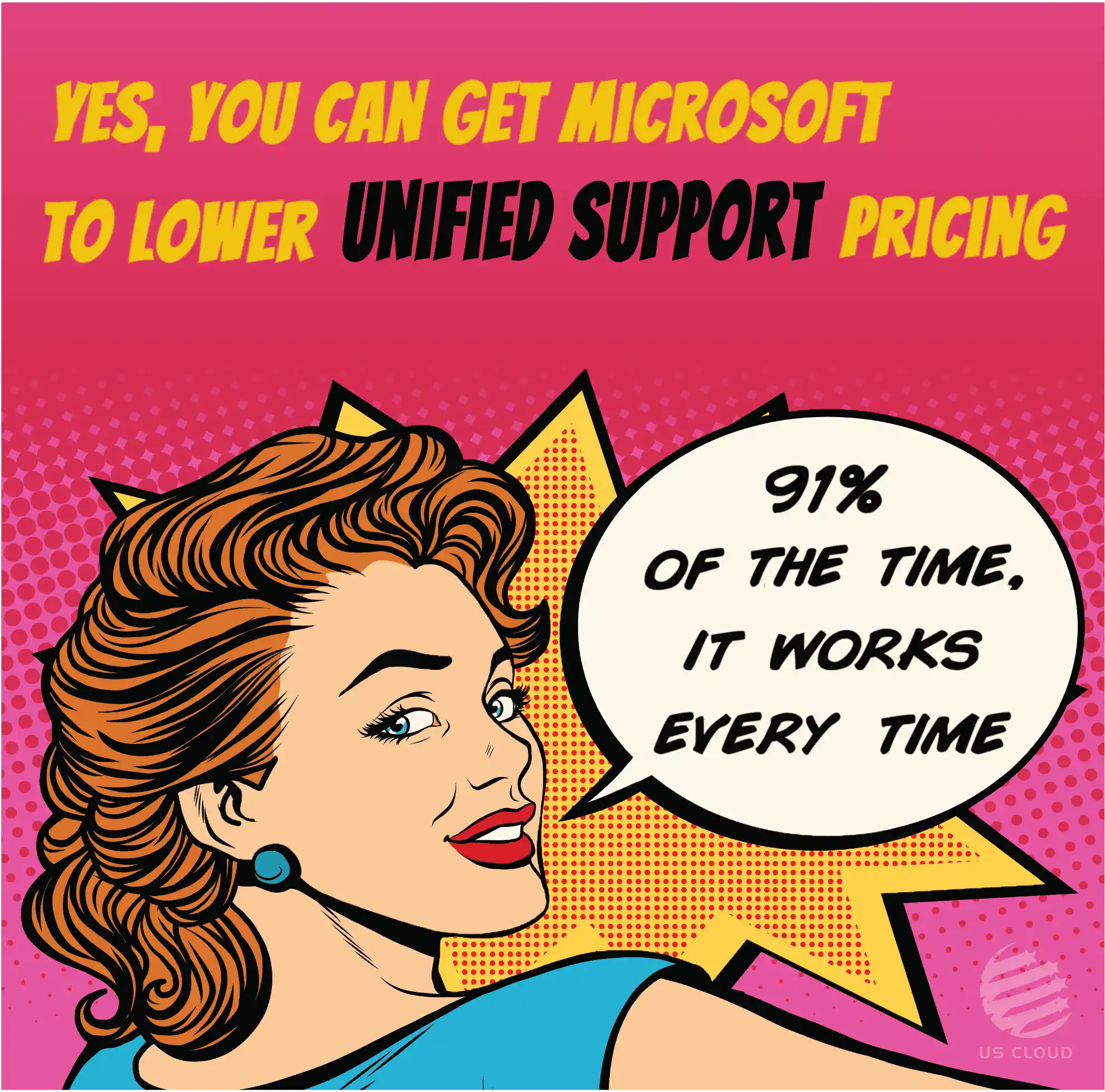
At least 91% of the time, Microsoft clients who come to the table with a quote from US Cloud see a price reduction during contract negotiations. Getting a quote from US Cloud is an easy way to effectively lower your bills, even if you end up remaining with Unified Support.
Strategy #2: Optimize Licensing, Don’t Overpay
Licensing is another area where costs creep in quietly—and escalate quickly.
Many enterprises over-license out of fear or inertia. They buy bundles like M365 E5 “just in case,” or fail to re-evaluate licensing tiers as user needs change.
Here’s how to rein it in:
- Audit usage: Are users actually using the advanced features you’re paying for?
- Downshift intelligently: Consider E3 + add-ons instead of full E5 suites.
- Hybrid approaches: On-prem Client Access Licenses (CALs) may still make sense in some scenarios.
- Leverage included tools: Microsoft includes powerful features that often go unused. Don’t pay extra for what you’re already licensed to use.
A strategic license optimization review can unlock significant savings, especially for large organizations. It’s not about cutting licenses—it’s about right-sizing them.
Strategy #3: Cut Redundant Tools
Microsoft would love for every enterprise to go “all-in” on its ecosystem—but that doesn’t always make sense for every organization.
Many teams have already invested in tools that compete with Microsoft’s offerings:
- Zoom vs. Teams
- Slack vs. Viva
- CrowdStrike vs. Defender
- Okta vs. Entra ID (formerly Azure AD)
In many cases, you’re paying twice for similar capabilities. That’s avoidable. Choose one platform over the other as much as possible. However, the upside of opting for the Microsoft-based platforms would be that no additional support would be required if you already have Microsoft support coverage.
A vendor rationalization review can identify overlaps and help you decide whether to:
- Double down on Microsoft tools where they excel.
- Keep best-in-class third-party solutions and cut Microsoft features you don’t need.
- Balance both with a hybrid approach.
Strategy #4: Use Third Parties to Extend Capabilities
Microsoft’s default answer to enterprise support and services is… Microsoft. But that’s not always in your best interest.
You don’t have to rely solely on Microsoft for:
- Cloud migrations
- Incident response
- Ticket resolution
- Ongoing IT strategy
Third-party experts like US Cloud specialize in extending the capabilities of enterprise IT teams. They bring:
- Deep Microsoft expertise.
- Dedicated engineers (not call center staff).
- Real SLAs and accountability.
- Cost savings of 30–50% on support alone.
When you outsource smartly—without vendor lock-in—you free up internal teams to focus on innovation, while keeping support costs low and predictable.
Why Enterprises Choose US Cloud
US Cloud is trusted by:
- Over 50 Fortune 500 businesses
- Companies across all industries
- International organizations
- Governmental institutions
- And more
And here’s why:
- S.-based support engineers
- 24/7 availability
- 15-minute SLA on critical tickets
- 30–50% cost savings vs. Microsoft Unified Support
- Microsoft escalation path intact
- ITAR and DFARS compliant, SOC 2 Type II certified
You don’t lose capability by leaving Microsoft Unified—you gain performance, responsiveness, and control.
Cost Savings Without Compromise
Cutting Microsoft costs doesn’t have to mean sacrificing service, slowing innovation, or putting systems at risk. The key is knowing where the bloat is—and having a trusted partner to help you take it out strategically.
From support to licensing to tool selection, every dollar you save on unnecessary Microsoft spend is a dollar you can reinvest in real transformation.
US Cloud is here to help you do just that.
Stop overpaying for underperformance. Contact US Cloud for a free Microsoft support cost analysis today.
FAQs: Cutting Microsoft Costs with US Cloud
Will Microsoft still support us if we leave Unified Support?
Yes. US Cloud maintains escalation privileges with Microsoft and can escalate tickets when needed. Your organization stays fully supported—often with better outcomes and faster resolution.
Is third-party Microsoft support compliant and secure?
Absolutely. US Cloud is ITAR-compliant, DFARS-ready, and SOC 2 Type II certified. We’re trusted by federal agencies and Fortune 500s for a reason.
What kind of savings can we expect?
Most enterprises see 30–50% annual savings on Microsoft support contracts after switching from Unified Support to US Cloud.
Can we switch mid-contract or only at EA renewal?
You can make the switch at any time. US Cloud works with your schedule and can phase in support alongside your existing contracts to avoid disruptions.
Does switching affect our Microsoft licensing or Azure services?
Not at all. You keep your Microsoft licensing, cloud infrastructure, and other services intact. US Cloud simply replaces Microsoft’s support layer—with better service and lower costs.


The Microsoft Support Industrial Complex: How Unified Support Became a $10B Tax on Enterprise Innovation

VMware to Hyper-V Migration Missing Piece: Lifecycle Support