Microsoft End of Support in 2026: What IT Leaders Need to Do Now.

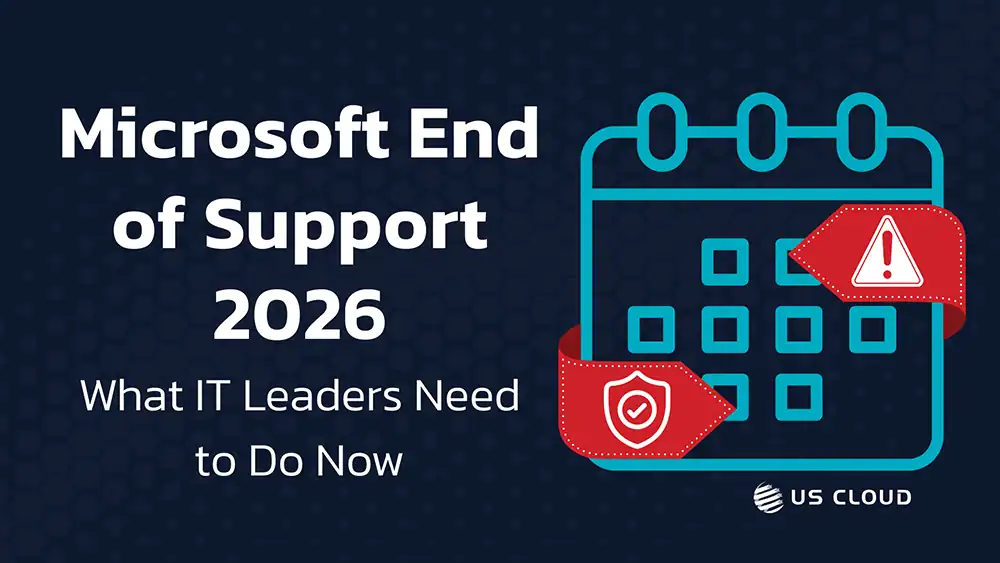
The 2026 Microsoft end of support wave is bigger than a date on a calendar—it’s a set of cascading security, compliance, and budget decisions. Several widely deployed products will reach end of support (EOS) in 2026, including SQL Server 2016 (July 14, 2026), Office LTSC 2021 (October 13, 2026), Project 2021 (October 13, 2026), and the final ESU year for Windows Server 2012/2012 R2 (October 13, 2026). When a product reaches EOS, Microsoft stops shipping security and non-security updates and ends assisted support—meaning attack surface and operational risk rise day one.
US Cloud helps enterprises cross this gap safely and affordably. If your organization must keep certain Microsoft systems running (including Windows 10 post-2025) our third-party support can cover workloads Unified Support no longer touches, while reducing total support costs.
Executive Summary
- Multiple major Microsoft products (including SQL Server 2016, Office LTSC 2021, Project 2021, and Windows Server 2012/2012 R2) reach end of support in 2026, creating serious security and compliance risks.
- Once a product hits end of support, Microsoft stops providing patches and assisted support, leaving unpatched vulnerabilities and operational gaps.
- Many organizations can’t modernize everything by 2026, making third-party Microsoft support a cost-effective bridge to maintain coverage—especially for Windows 10 systems.
- US Cloud helps enterprises stay secure and supported post-2026, providing coverage where Microsoft Unified no longer does at roughly half the cost.
What “End of Support” Really Means (and Why It Matters)
At EOS, Microsoft ceases security updates, bug fixes, and assisted support for the product. That means newly discovered vulnerabilities remain unpatched unless you’ve purchased specific ESU programs (where available). For 2026 retirements, Microsoft’s lifecycle pages (linked below) are the source of truth. Microsoft Learn
Key implications:
- Security exposure: New CVEs will not be remediated by Microsoft after EOS.
- Compliance impact: Unpatched systems can jeopardize controls for frameworks like ISO 27001, SOC 2, PCI DSS, HIPAA, etc.
- Operational fragility: Driver/application incompatibility increases; vendor support declines.
- Hidden costs: Firefighting, unplanned downtime, and premium migration projects often exceed the cost of planned lifecycle management.
The 2026 Microsoft end-of-support watchlist
While this isn’t the full list of everything that Microsoft is outmoding this year (check their overview of ending support for 2026 for a more complete list), these are some of the technologies on our shortlist. Use this table as your quick triage. (Always confirm versions in your own estate.)
| Product | Lifecycle Milestone (2026) | Why It Matters |
|---|---|---|
| SQL Server 2016 | End of Extended Support: July 14, 2026 | Security fixes stop; mission-critical databases become higher-risk targets. |
| Office LTSC 2021 | End of support: October 13, 2026 | No further updates for perpetual Office 2021; audit/license and macro security considerations. |
| SharePoint Server 2016 / SharePoint Server 2019 | End of Extended Support: July 14, 2026 | EOS means security and compatibility risks; prompt migrations to SharePoint Online or other latest subscription |
| Project Server 2016 / Project Server 2029 | End of Extended Support: July 14, 2026 | Offices using on-premises tracking to face operational & security challenges without converting server |
| Project 2021 (LTSC) | Retirement: October 13, 2026 | Project planning dependencies and file compatibility need review. |
| Windows Server 2012/2012 R2 (on ESU) | ESU Year 3 ends: October 13, 2026 | Last stop for security patches; servers must be migrated, isolated, or protected via compensating controls. |
| Dynamics 365 (Dynamics CRM 2016) | Extended End of Support: January 13, 2026 | These ERP & CRM systems still entrenched in operational use; users should plan to convert for continues updates + better integration. |
Related 2025 Milestone That Affects 2026 Planning
Windows 10 reached EOS on October 14, 2025. Microsoft 365 Apps continue to receive security updates on Windows 10 through October 10, 2028, but Windows 10 itself is out of support—affecting security posture and vendor expectations. Many organizations will still be managing Windows 10 risk well into 2026.
Pain Points We're Hearing (and How to Address Them)
We’ve been supporting clients through migrations for years. Here are some of the pain points we’ve been hearing from organizations who trust us for third-party Microsoft support.
“We can’t migrate everything by 2026.”
Taking the time to migrate your systems to updated versions can’t be done with a snap of the fingers. It takes time, resources, organization, meticulousness, and patience—and not everyone has those things.
Reality: Complex line-of-business apps, database dependencies, and validation cycles make 12–18-month migrations tight.
Action: Prioritize internet-exposed and identity-adjacent systems; segment or isolate stubborn legacy workloads; plan ESU where it’s the least-cost, least-risk bridge.
“ESU pricing and scope are confusing.”
Microsoft has historically been awful at ensuring support standards are crystal clear. Instead, many of the “Learn” articles you might read while trying to research end of support are about as clear as mud.
Reality: ESU is a paid, last-resort option that provides Critical/Important security updates up to three years after extended support ends (product-specific). It is not a feature/backport or full support entitlement.
Action: Use ESU sparingly to buy time for high-risk assets you cannot modernize this fiscal year.
“Unified won’t support some of what we still run.”
Don’t expect Microsoft Unified to help your team out because you’re still utilizing systems they’ve marked for “End of Support.” Once that technology hits its EOS or extended EOS milestone, you should already be migrated to the updated technology (or at least have a migration plan in place).
Reality: Once a product is past EOS (or not covered), you’re largely on your own—even if it’s business-critical.
Action: Engage a third-party support partner (US Cloud) that still covers certain Microsoft technologies including Windows 10 and other legacy workloads that Unified no longer touches.
“Modernizing everything will blow our budget.”
Migrating to a new system isn’t cheap, we know. There’s plenty of expense to be considered when it comes to modernizing your systems…but will you be able to afford it when an operational or security vulnerability makes immediate updates a requirement and not an option?
Reality: Emergency all-at-once replacements force capital expenditure (capex) spikes and opportunity costs.
Action: Model a hybrid plan: upgrade where ROI is clear; guardrail legacy systems with isolation, EDR, and third-party support; stage the rest over 12–24 months.
How to Assess Microsoft End of Support Impact (30–60–90 plan)
To avoid a situation through which your team would be forced to update your system to a more modern Microsoft technology, your team can use the roadmap below to assess your end of support risk.
Days 0–30: Baseline and Map Risks
- Pull accurate software/hardware inventory. Tag versions of SQL Server, Office LTSC 2021, Project 2021, Windows Server 2012/2012, and any other technologies you’ll need to migrate.
- Confirm each item’s date against Microsoft’s lifecycle pages listed above; flag anything already out of support.
- Internet-facing? Domain-joined? Access to sensitive data? Map to business services.
- For each asset, choose Upgrade, ESU, Isolate/Containerize, or Third-Party Support.
Days 31–60: Execute Near-Term Risk Reductions
- Patch to latest possible Cumulative Update (CU) on all affected products while supported.
- Network segmentation for legacy servers; restrict inbound/outbound, apply strict Access Control Lists (ACLs).
- Endpoint Detection and Response (EDR hardening): Ensure legacy endpoints/servers are covered with up-to-date telemetry and response.
- Begin migrations for the highest-exposure assets (e.g., SQL Server 2016 internet-adjacent instances).
Days 61–90: Sustain and Optimize
- Finalize ESU procurement (only where truly needed). Pilot upgrades for Office and Project where LTSC 2021 retirement affects users.
- Engage third-party support (US Cloud) for Windows 10 fleets still in service and for server workloads Unified won’t cover—preserving support response while your modernization continues.
Budgeting & Procurement: How to Control Costs While Reducing Risk
Below are some tips for minimizing costs while still keeping your systems modernized, secure, and operational.
Avoid a Blanket ESU Strategy
ESU is designed as a short-term bridge, not a multi-year strategy; over-purchasing wastes budget. Target it to the few systems that truly need extra time.
Mix Modernization and Containment
Balance upgrades (capex/opex), isolation controls (opex), and third-party support (opex) to keep risk within appetite while smoothing spend across FY26–FY27.
Leverage Third-Party Microsoft Support
US Cloud supports certain Microsoft technologies that Unified won’t touch anymore—including Windows 10—and helps enterprises keep SLAs while cutting costs versus staying solely with Microsoft.
Negotiate with Data
Maintain an authoritative list of EOS assets with business impact and remediation options; use it to prioritize renewals and defer non-critical spend intelligently.
Anonymized Real-World Scenarios by Industry
While we’ve omitted logos and proprietary details, the patterns below mirror common migration constraints we see across regulated industries.
Healthcare
A hospital group cannot retire a critical imaging application on SQL Server 2016 until Q1 2027 due to FDA validation. They isolate the server, enable least-privilege service accounts, subscribe to ESU-adjacent security controls, and engage US Cloud for incident-driven support while the migration completes.
Financial Services
A regional bank still on Windows Server 2012 R2 (ESU) uses network micro-segmentation and EDR tightening. They phase app upgrades over two quarters and rely on US Cloud to backstop critical incidents that fall outside Unified’s scope.
Manufacturing
Plants keep Windows 10 HMIs beyond 2025 due to equipment certification. They lock down local admin rights, tighten USB policies, and use US Cloud to handle escalation-grade issues during the hardware refresh cycle.
Migrate to Updated Systems Safely & Securely with US Cloud
The 2026 Microsoft end of support wave is a security event, not just an IT milestone. Treat it like one. Where modernization is feasible, move decisively. Where it isn’t, buy time safely—with targeted ESU, stronger controls, and third-party Microsoft support that actually covers what Unified won’t.
If you need a pragmatic plan that reduces risk and spend, schedule a call with US Cloud. We help our clients map 2026 exposure, identify quick wins that close gaping security gaps, and show where third-party support (including Windows 10 and other legacy workloads) helps clients keep critical systems supported at roughly half the cost of traditional options.

Partner-Delivered Microsoft Support: A Unified Support Alternative for Enterprises
The Channel Support Spiral: How Microsoft Partners Can Protect Margin as Unified for Partner Rolls Out