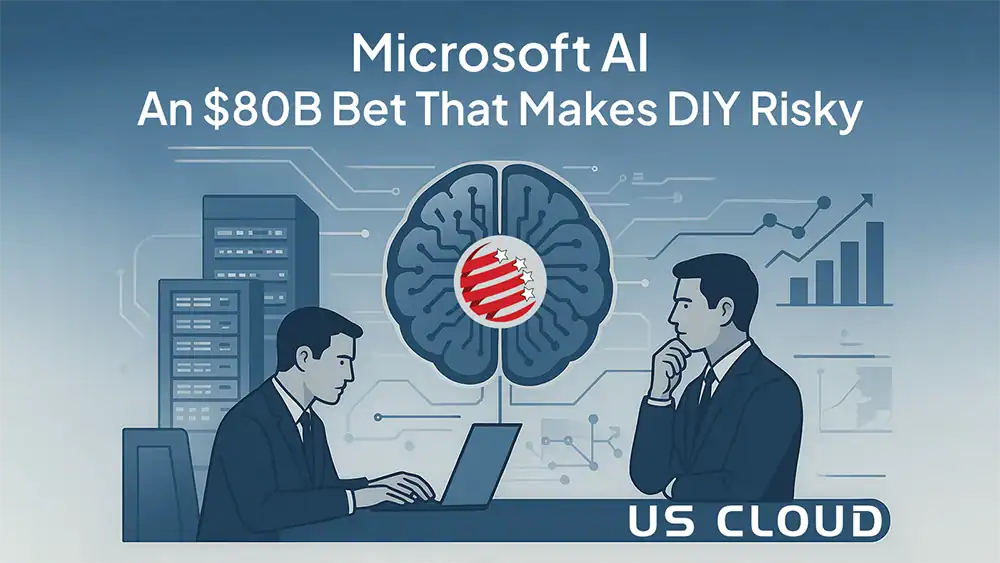
Microsoft AI: An $80B Bet That Makes DIY Risky.

Microsoft is placing an unprecedented $80 billion bet on AI infrastructure in fiscal year 2025—the largest single-year corporate investment in technology history. While simultaneously cutting thousands of positions, the company is fundamentally restructuring around artificial intelligence, creating a more complex ecosystem than any previous Microsoft platform transition.
For enterprise IT professionals and procurement leaders, this transformation creates an urgent challenge: Microsoft’s AI stack is beginning to evolve faster than internal teams can realistically master it. The company now offers multi-model options (OpenAI and Anthropic), agent marketplaces, new licensing structures, and monthly feature releases that require specialized expertise to deploy effectively. It’s a reality early adopters are experiencing firsthand.
Organizations achieving success with Microsoft AI share one common factor: they partnered with specialists who focus exclusively on this ecosystem. This guide explains why the “figure it out ourselves” approach is increasingly risky and how third-party expertise delivers faster ROI, lower costs, and reduced operational risk.
Executive Summary
- Microsoft’s $80B investment is creating unprecedented platform complexity that internal IT teams struggle to master alongside their existing responsibilities.
- Real enterprises are achieving 84% satisfaction rates with Microsoft AI—but only with proper implementation expertise and ongoing optimization.
- The myth that third-party support is an unnecessary risk or expense collapses when you calculate the true cost of DIY: failed deployments, runaway cloud costs, and opportunity cost of delayed adoption.
- Multi-model governance, consumption-based pricing, and rapid feature releases create risks that specialized partners are uniquely positioned to mitigate.
Microsoft's AI Investment: Following the Money to Understand What's Coming
When a company redirects $80 billion toward a single initiative while cutting thousands of jobs, enterprise buyers should recognize this isn’t typical product development—it’s a complete platform transformation.
CEO Satya Nadella acknowledged the seeming contradiction of significant layoffs alongside record AI spending, but the numbers tell a clear story. Despite some smaller layoffs in early 2025, Microsoft’s global headcount held steady at 228,000 as the company shifted resources from traditional software development to AI infrastructure. Affected departments included product management, legal teams—and even engineering.
The $80 billion isn’t funding headcount—it’s building data centers, developing custom AI chipsets, expanding cloud infrastructure, and accelerating platform development for Copilot, Azure AI, and enterprise AI tools.
What This Signals for Your Organization
Microsoft is betting that AI-powered automation can replace traditional software development models. For IT and procurement professionals, this creates immediate implications:
Accelerating (Not Stabilizing) Complexity
With AI-assisted development, Microsoft is starting to ship out features monthly instead of quarterly. Your team needs to evaluate new models, agent capabilities, security features, and integration options continuously—not during annual planning cycles.
Intensified Pricing Pressures
Microsoft absorbed massive infrastructure costs to capture market share. As that investment matures, expect consumption-based pricing to increase and licensing structures to evolve. Organizations without optimization expertise will see AI costs spiral.
Widening Skill Gap
Microsoft isn’t shrinking—it’s rebalancing talent toward AI strategy, implementation, and oversight. Your enterprise faces the same challenge, but you may not be able to afford 18 months to build that expertise internally while competitors are already deploying.
The Complexity Problem: Why Microsoft AI Is Different
If you’ve deployed Microsoft 365, Windows Server, or Azure infrastructure, you already know those ecosystems. Microsoft AI, however, is fundamentally different in ways that make the DIY approach increasingly risky.
Multi-Model Strategy Creates Governance Challenges
In September 2025, Microsoft announced a strategic shift: Microsoft 365 Copilot now supports both OpenAI models and Anthropic models (Claude Sonnet 4 and Claude Opus 4.1). This gives enterprises flexibility but introduces critical complications:
Data sovereignty issues: Anthropic models are hosted outside Microsoft-managed environments and subject to Anthropic’s Terms and Conditions. For regulated industries (healthcare, financial services, government), this creates compliance questions that require legal and technical expertise to resolve.
Administrative overhead: Organizations must enable access to different models in the Microsoft 365 admin center. IT teams need to understand which models to use for which tasks, how to govern access, and how to monitor usage—new expertise most internal teams haven’t developed.
Cost variability: Premium models like Claude Opus cost significantly more than base models. Without optimization strategies, teams may default to expensive models for simple tasks, generating unnecessary costs.
Three-Pillar Architecture Expands Your Attack Surface
Microsoft positions its AI offering across three pillars: cloud and AI platforms (Azure as infrastructure, Azure AI Foundry as applications server, Fabric as data platform), AI business solutions (Copilots and agents), and security foundations spanning Sentinel, Defender, and Entra ID.
This integrated approach sounds compelling in sales presentations. In practice, it means you’re not buying software—you’re buying into an ecosystem where a security misconfiguration in one layer can expose data accessed by AI agents in another layer.
Agent Marketplaces Introduce Third-Party Risk
Microsoft’s Agent Hub allows enterprises to deploy pre-built AI agents from third-party publishers. This accelerates deployment but creates new support challenges:
When an agent fails, is the issue in:
- The underlying Azure infrastructure?
- Microsoft 365 Copilot service configuration?
- SharePoint data access permissions?
- The third-party agent’s code?
- Model selection or prompt engineering?
Microsoft support handles their components. The third-party agent developer handles their code. Nobody owns the integration—except specialized partners who can troubleshoot across the entire stack.
Debunking the Myths: Why "We'll Handle It Internally" Is a Costly Gamble
The biggest barrier to engaging third-party AI support isn’t cost—it’s misconceptions about value. Let’s address the most common myths with data.
Myth 1: “Our IT Team Knows Microsoft—We Can Figure Out AI”
Reality: Microsoft AI expertise is fundamentally different from Microsoft 365 or Azure administration.
Your team may include several experts in user provisioning, Exchange configuration, and Azure VM management. That expertise doesn’t always translate to instant knowledge about:
- Prompt engineering and model selection strategies
- Multi-agent orchestration in Copilot Studio
- Data governance for AI training and retrieval
- Azure AI Foundry deployment patterns
- Security configurations spanning multiple AI services
The cost of overconfidence: Organizations that attempt DIY deployments typically risk experiencing:
- 6-12 month delays while teams learn through trial and error
- Budget overruns from inefficient resource configuration
- Low user adoption due to poor implementation
- Security incidents from misconfigured access controls
Myth 2: “Third-Party Support Is an Additional Cost We Don’t Need”
Reality: Third-party expertise typically costs less than the hidden expenses of DIY implementation and Unified Support. In fact, equal-quality Microsoft support services at US Cloud cost 50% less than support from Unified.
Calculate the true cost of internal deployment:
Data preparation: Most enterprises discover their SharePoint, OneDrive, and database architectures need significant cleanup before AI can be effective. This work takes internal resources months to complete—months where competitors are already using AI.
Integration work: Connecting Copilot and agents to line-of-business applications requires development effort. Your developers bill internally at $150-250/hour. Specialized partners have pre-built integration patterns that can reduce hours by 60-70%.
Ongoing optimization: Microsoft ships new models and capabilities monthly. Someone needs to evaluate, test, and deploy updates continuously. That can be a full-time role (or more) that most organizations underestimate.
Runaway cloud costs: Consumption-based pricing means poorly configured AI services generate unexpected bills. Optimized compute resources and model selection, for example, can result in significant Azure AI savings while still utilizing the tool.
Opportunity cost: Every month of delayed deployment is a month your competitors are using AI to improve efficiency, reduce costs, and enhance customer experience.
Myth 3: “Microsoft Support Is Sufficient”
Reality: Microsoft support handles their components—not your custom implementations or third-party integrations.
When you’re running Microsoft 365 Copilot, Azure AI agents, third-party marketplace agents, and custom developments from Copilot Studio, Microsoft support has clear boundaries. They’ll troubleshoot their services but won’t:
- Support you through figuring out which third-party integration is the problem
- Optimize your Microsoft consumption costs across services
- Advise on which models to use for your specific use cases
- Provide single-point-of-contact support across the entire stack
- Train your users on effective AI adoption
Specialized partners like US Cloud will help you troubleshoot the entire stack, providing unified support regardless of where issues originate. This eliminates finger-pointing between vendors and dramatically reduces resolution time.
What Expert Third-Party Microsoft Support Actually Delivers
Third-party Microsoft AI support isn’t a luxury—it’s a strategic investment that delivers measurable returns across five critical areas.
Cost Optimization That Pays for Itself
With consumption-based pricing, expert configuration can save more than the support contract costs. Partners experienced in Azure cost management deliver:
- Right-sized compute resources for AI workloads (typically 30-40% cost reduction)
- Optimized data storage and retrieval patterns
- Strategic model selection (cheaper models for simple tasks, premium models only when needed)
- Monitoring systems to catch runaway costs before they escalate
Proof point: One US Cloud cost optimization client reduced Azure AI costs by $1.3 million through our Azure services—more than covering their support investment.
Risk Mitigation in Regulated Industries
For healthcare, financial services, and government organizations, AI governance isn’t optional. Partners provide:
- Compliance frameworks for HIPAA, SOC 2, GDPR, and industry-specific regulations
- Security configurations spanning Sentinel, Defender, and Entra ID
- Data sovereignty solutions for multi-model deployments
- Audit trail implementation for AI interactions
Proof point: Financial services clients avoid compliance violations that can cost millions in fines and reputational damage.
Continuous Skills Development
Technology alone doesn’t drive adoption—trained users do. Partners provide:
- Role-based training for end users, power users, and administrators
- Train-the-trainer programs to build internal capability
- Office hours and ongoing support for real-world scenarios
- Best practice guidance drawn from multiple industries
Proof point: Organizations with structured training programs can achieve higher user adoption rates than those relying on self-service learning.
The Window for Strategic Advantage Is Closing
Microsoft’s $80 billion investment and fundamental restructuring around AI isn’t a multi-year roadmap—it’s happening now. The competitive dynamics are clear:
Early leaders are pulling ahead. Organizations that deployed Microsoft AI with expert support in 2024-2025 are already realizing productivity improvements, cost savings, and competitive advantages. The gap between leaders and laggards is widening monthly.
Complexity is accelerating, not stabilizing. Each new model, agent capability, and integration option adds to the ecosystem’s sophistication. The knowledge gap between specialists and generalists grows larger with every Microsoft release.
DIY risk is increasing. When Microsoft AI was a simple Copilot add-on, internal teams could reasonably manage it. With multi-model options, agent marketplaces, and continuous feature releases, the DIY approach increasingly leads to failed deployments and security incidents.
Cost optimization becomes critical. As Microsoft transitions from market capture to profit optimization, consumption-based pricing will increase. Organizations without optimization expertise will see AI costs spiral while competitors with expert support maintain efficient operations.
Take Action: Start With an Assessment
If you’re still trying to determine whether third-party support makes sense for your organization, start with a readiness assessment. US Cloud provides complimentary AI readiness evaluations that identify:
- Current infrastructure gaps that could delay deployment
- Compliance and governance requirements for your industry
- Optimization opportunities in existing Azure consumption
- Training needs across different user roles
This assessment provides concrete data to support decision-making—not a sales pitch.
The truth IT and procurement professionals need to hear: if you haven’t evaluated specialized support at US Cloud for Microsoft AI, there’s more evaluative work to be done. The complexity is real, the risks are significant, and the cost of delay compounds monthly.
The enterprises thriving in the AI era aren’t the ones with the biggest budgets—they’re the ones with clear strategies, expert partners, and commitment to continuous optimization.
Microsoft has made its $80 billion bet. What’s yours?
Talk to an expert today to take your first step towards developing a responsible AI-forward infrastructure.

AI Support Is Reshaping the Microsoft Partner Ecosystem—And Partners Are Feeling the Squeeze

The Microsoft Support Industrial Complex: How Unified Support Became a $10B Tax on Enterprise Innovation