
Microsoft Licensing Support
Microsoft Support for AI
Agentic AI Costs: What Microsoft Buyers Must Model.

Executive Summary
In August 2026, Gartner predicted that AI inference costs per agentic workflow will increase more than fivefold through 2028. Gartner describes an “Inference Paradox”: better unit economics can still produce higher overall costs because improving models enable organizations to deploy more sophisticated, resource-intensive workflows.
- The paradox. Token processing costs keep improving while agents keep getting more capable and complex, so enterprise AI is becoming less expensive and more expensive at the same time.
- Why agentic is different. A chatbot generates one answer. An agentic workflow may plan a task, retrieve company data, call applications, evaluate results, and repeat steps before producing a usable outcome.
- Gartner’s forecast. In August 2026, Gartner predicted that AI inference costs per agentic workflow will increase more than fivefold through 2028, an effect it calls the “Inference Paradox”: better unit economics can still produce higher overall costs because improving models enable more sophisticated, resource-intensive workflows.
- Microsoft exposure goes beyond tokens. Agentic AI can expand costs across Copilot Studio, Microsoft Foundry, Azure services, security, integration, and support.
- Support is the overlooked layer. If qualifying investments increase the historical Microsoft Product Spend used to price Unified Enterprise Support, that growth may affect a future support calculation.
- What the forecast does not mean. Not every Microsoft AI invoice or Unified Support quote will increase fivefold. It means price per token or per user is no longer a complete AI budget.
- The priority. Measure cost per successfully completed workflow and the value it creates, separate direct consumption from support exposure, forecast production conditions, and build controls before adoption scales.
What Gartner Forecast
Inference is the process of running a trained AI model to generate an answer, prediction, recommendation, or action. Every time an employee asks Copilot a question, a model summarizes a document, or an agent decides what step to take next, inference is occurring. Gartner’s forecast is specifically about inference cost per agentic workflow. It is not a forecast for every AI product, license, or customer bill.
The distinction matters. A chatbot interaction is usually bounded: receive a question and return a response. An agent may reason across several steps, inspect data sources, call tools, assess the result, and decide what to do next. Each step can introduce more tokens, model calls, retrieval operations, and paid services.
Gartner says routing a task to an agentic reasoning model already creates provider inference costs at least five times those of a basic chatbot interaction, with greater differences possible as complexity grows. Lower unit costs also make more ambitious use cases possible. Organizations consume more because the technology can do more.
This is the Inference Paradox: the price of an individual unit can fall while the total cost of producing an outcome rises.
Cloud buyers know this pattern. Lower compute rates do not guarantee a lower Azure bill when usage grows faster. Agentic AI brings similar consumption economics into business processes previously licensed mainly by user or application. US Cloud examined this broader shift in The Death of Microsoft Per-Seat Pricing. Agentic AI does not eliminate seat licensing, but it adds another meter: the amount of automated work performed across a growing number of workflows.
Why Cheaper AI Costs More
Agentic AI cost is driven by workflow design, not one published model rate. Two agents using the same model can create different bills based on what they must accomplish.
Several variables shape the difference:
- Planning and reasoning. An agent may break one request into many subtasks. Each reasoning cycle can require another model call and more context.
- Data retrieval. Grounding an answer in SharePoint, Microsoft Graph, an enterprise search index, or another business system can add retrieval and processing activity.
- Tool use. A workflow that reads a record, updates a system, checks inventory, routes an approval, and sends a notification performs more billable work than one that generates text.
- Retries and exceptions. Agents do not follow perfectly predictable paths. A failed tool call, unclear result, or policy conflict can cause an agent to repeat or redirect work.
- Model selection. Advanced reasoning does not need to power every step. Defaulting every task to a premium model can make routine decisions unnecessarily expensive.
- Production scale. A small pilot can conceal economics that become material when an agent serves thousands of employees, customers, transactions, or devices.
This creates a budgeting trap. A team may multiply the cost of a successful demonstration by expected users. But production can bring longer context, more integrations, stricter controls, higher availability requirements, and more exceptions. Cost governance should begin with a workflow map. Document the steps an agent can take, the services each step invokes, how often the path repeats, and what constitutes successful completion. Per-token estimates remain useful, but only as one input.
Where Microsoft Costs Grow
Microsoft customers may encounter agentic AI costs across five major commercial and technical layers.
- Microsoft 365 Copilot remains largely a user-based licensing decision for employee-facing productivity use cases.
- Copilot Studio adds consumption economics. Microsoft uses Copilot Credits to measure agent usage, and credit consumption varies based on agent design, interaction volume, and the features invoked. A single interaction may combine a generative answer, tenant grounding, actions, flows, and premium reasoning. Microsoft’s Copilot Studio billing guidance advises customers to estimate credit volume from traffic, orchestration, knowledge, and tool use.
- Microsoft Foundry and Azure can introduce inference alongside data, search, storage, networking, and related services. Microsoft advises customers to estimate component services before deployment, monitor actual costs, and configure alerts.
- Security and governance add necessary operating costs, including identity, permissions, auditing, observability, testing, and human oversight.
- Support and operations also change. IT teams may have to diagnose failures spanning Copilot, Power Platform, Azure, identity, Microsoft 365, integrations, and data sources.
AI ROI therefore cannot be judged by license activation alone. As US Cloud’s Microsoft Copilot ROI guide explains, value appears when people apply the technology to repeatable work. Agent consumption must also produce a measurable result.
The Support Cost Multiplier
Direct AI consumption is only the first layer buyers should model. The second is operating cost. The third is potential support exposure. Microsoft states that Unified Enterprise Support pricing is calculated by applying graduated rates to historical annual Product Spend. According to Microsoft’s current Unified plan details, that base can include the previous 12 months of Microsoft cloud-service purchases, Azure consumption, license-only purchases, and Software Assurance or license-plus-Software-Assurance purchases.
Some AI-related spending may therefore enter the Product Spend calculation at a future renewal. The effect depends on the purchase, Microsoft’s classification, product class, graduated rates, added services, and the customer’s agreement. Not every agent cost will have the same support impact.
Agentic AI does not automatically produce a fivefold support increase. Buyers should ask whether growing AI consumption and licensing will enlarge the support pricing base—and by how much—before approving the investment. This creates three costs to evaluate separately:
- Direct AI cost: licenses, Copilot Credits, model inference, tools, and Azure services.
- Operating cost: data, integration, security, monitoring, governance, support labor, and human review.
- Support exposure: the possible renewal effect when qualifying Microsoft purchases become part of historical Product Spend.
Separating these layers gives the CFO a more defensible forecast and the CIO a clearer operating model. It prevents an innovation budget from accumulating secondary costs omitted from the business case. Before expanding Microsoft AI, buyers should also review the cost, coverage, escalation, and accountability questions in 7 Questions After Microsoft’s FY26 Earnings.
Five Questions Before Scale
Before an agent moves from pilot to production, the buying committee should be able to answer five questions.
- What does success cost?
Calculate the cost of a successfully completed workflow, not only the average cost of an interaction. Include failed attempts, retries, incomplete work, and human intervention.
- What drives each workflow?
Document model calls, tokens, retrieval, grounding, tools, actions, flows, and other Azure services. Identify which steps vary according to complexity.
- Does every step need premium AI?
Use advanced reasoning where it changes the outcome. Apply more economical models or deterministic automation to simpler classification, routing, extraction, and validation tasks.
- Who owns the guardrails?
Assign responsibility for budgets, alerts, capacity, security, agent inventory, performance, and shutdown authority. If ownership is fragmented, cost leakage becomes difficult to identify.
- What happens at renewal?
Ask Microsoft to show how AI licenses and consumption will appear in Product Spend. Forecast the effect under several adoption scenarios, then benchmark Unified Support before the renewal window narrows.
These questions should be answered jointly by IT, Finance, Procurement, security, and the business owner. Agentic AI crosses their budgets and risk domains. The business unit may own the outcome, but IT still owns much of the platform, control, and incident burden.
Build an AI Cost Baseline
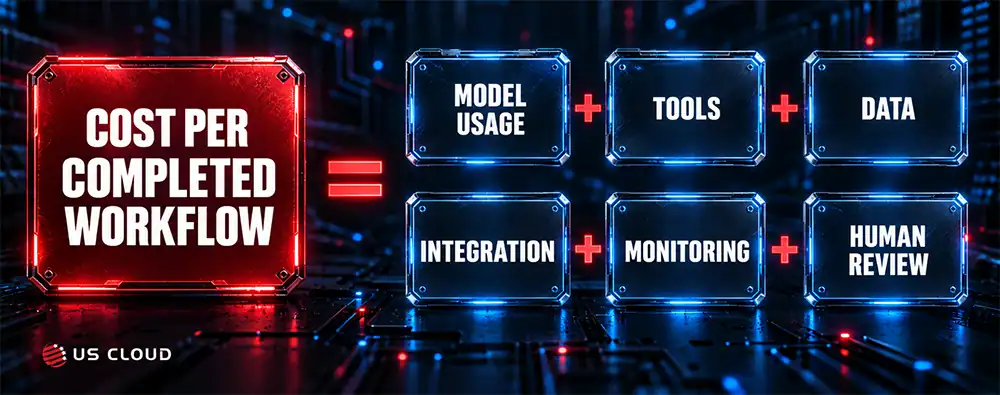
A useful cost baseline starts with a simple equation:
The baseline should capture:
- Attempted and successfully completed workflows
- Average model and tool calls per completion
- Token and Copilot Credit consumption
- Retrieval, data, and Azure service costs
- Retry, exception, and escalation rates
- Human review and remediation time
- Business value produced per successful outcome
- Expected Microsoft Product Spend at renewal
Avoid basing the budget on an average that hides outliers. A routine workflow may be inexpensive, while a small number of complex cases consume disproportionate resources. Track cost distributions by workflow type, business unit, agent, and outcome. Then test at least three adoption scenarios: controlled pilot, expected production use, and high-growth use. Include a scenario in which usage succeeds faster than expected. With consumption-priced technology, strong adoption can create financial pressure even when the program delivers value.
Cost control should match the model, context, tools, and oversight to the value and risk of the task. The goal is efficient intelligence, not minimal intelligence. Finally, connect FinOps to renewal planning. A Microsoft AI dashboard may show direct consumption without showing the later support effect. Finance needs both views to understand the full Microsoft run rate.
Act Before Support Renewal
The best time to evaluate this exposure is approximately six months before Unified Support renewal—while the organization still has time to gather requirements, compare models, and create a defensible sourcing record. Start with five actions:
- Inventory current and planned Microsoft agents, licenses, credits, and Azure AI services.
- Forecast 12 months of usage using real workflow behavior rather than license counts alone.
- Request Microsoft’s current Product Spend calculation and confirm the categories included.
- Model how expected AI growth could change the next Unified Support quote.
- Benchmark Microsoft’s support proposal against a credible independent alternative.
This is not an argument to slow useful AI adoption. It is an argument to protect its budget. An independent support model may help decouple support economics from the pace of Microsoft AI investment.
Procurement teams can use the framework in Microsoft Support Procurement: How to Prepare Before Q4 to document scope, service levels, escalation, pricing, and transition requirements before options narrow. Any savings should also have a defined purpose. US Cloud has outlined how enterprises can redirect Microsoft support savings into AI, security, and modernization. The strongest business case does not merely reduce one line item. It reallocates spending toward technology that produces better outcomes.
Agentic AI Cost FAQs
What are inference costs?
Inference costs are the expenses incurred when a trained AI model processes input and produces an answer, decision, or action. They may be measured through tokens, requests, credits, compute, or another provider-specific unit.
Why do agents cost more?
Agents can perform several reasoning, retrieval, and tool-use steps for one request. They may also retry failed work or use premium models for difficult decisions. That makes one completed workflow more resource-intensive than one chatbot response.
Will Microsoft costs rise 5x?
Gartner’s forecast does not mean every Microsoft customer bill will rise fivefold. It addresses provider inference cost per agentic workflow. The enterprise impact depends on architecture, model choice, workflow complexity, usage, licensing, and Microsoft’s billing structure.
Can AI raise support costs?
Potentially. Microsoft calculates Unified Enterprise pricing from historical Product Spend that can include cloud services, Azure consumption, and licensing. Whether a particular AI purchase changes the support calculation depends on its classification and the customer’s agreement.
How should CIOs model costs?
CIOs should calculate cost per successfully completed workflow, measure the value produced, include operating and governance expenses, and forecast whether qualifying Microsoft spend will affect the next support renewal.
Agentic AI changes how Microsoft costs accumulate. Enterprises that model the full stack early can scale useful agents, protect AI ROI, and prevent support pricing from becoming an unexamined multiplier.
Ready to understand the full cost of your Microsoft AI strategy?
Before growing AI consumption changes your next Unified Support calculation, ask US Cloud to benchmark current support spend, model renewal exposure, and compare an independent enterprise support option.