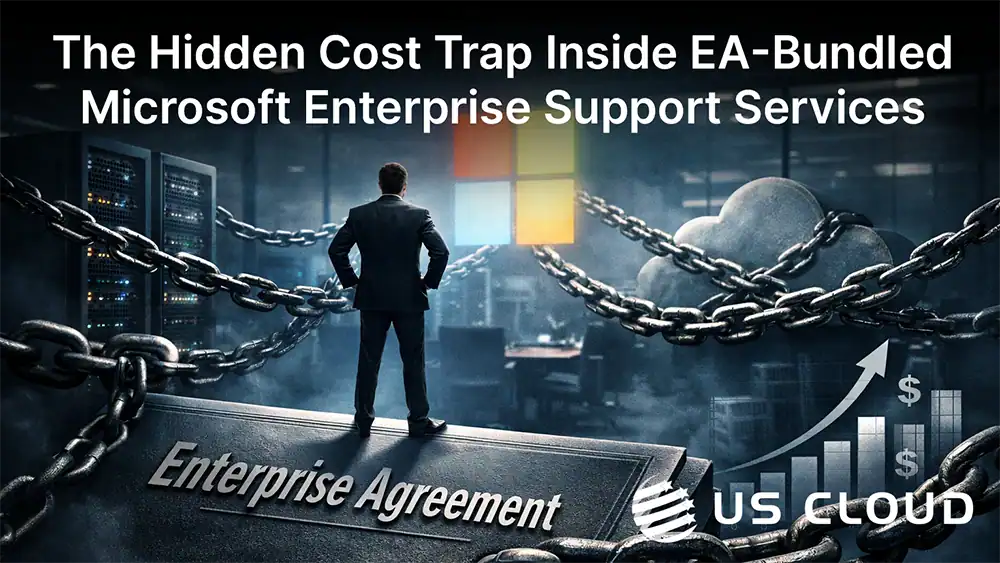
The Hidden Cost Trap Inside EA-Bundled Microsoft Enterprise Support Services.

Enterprise IT leaders are expected to balance uptime, cost discipline, and long-term scalability while managing an increasingly complex vendor ecosystem. Microsoft understands that pressure–and has engineered its enterprise support model to exploit it.
By bundling coterminous Unified Support into multi-year Enterprise Agreements (EAs) or MCA-E contracts, Microsoft presents a structure that looks efficient on the surface but ultimately traps organizations in a high-cost, low-leverage position.
For enterprises that rely on Microsoft technologies to operate, this model directly affects budget forecasting, vendor governance, and strategic flexibility—binding your trajectory to Microsoft’s roadmap by design. Below, we break down how this trap works, why escape is intentionally difficult, and how US Cloud can help organizations reclaim control before their next renewal.
Executive Summary
- Bundled Microsoft Enterprise Support services are positioned as simplified procurement but quietly eliminate negotiating leverage.
- Spend-based pricing, declining service quality, and paid add-ons drive Unified Support costs higher with diminishing returns.
- Coterminous contracts entangle licensing and support, making renegotiation slow, opaque, and high-risk.
- Early preparation third-party alternatives introduce leverage back into renewal discussions.
- Validated alternatives like US Cloud force Microsoft to compete on price, service quality, and contract terms.
- Enterprises that switch from Unified Support to US Cloud regain flexibility, reduce costs significantly, and realign support to real operational needs.
The Illusion of Convenience
Every effective trap starts with something appealing.
That’s why Microsoft Enterprise Support services are sold as a bundled “simplification.” Through a single MCA-E/EA, organizations are told they can
- Secure Microsoft licensing
- Access Unified Support for operational stability
- Scale infrastructure through cloud services
- Unlock preferential pricing tied to bundled spend
All managed through one vendor, one contract, and one renewal date.
For many enterprises, that logic initially felt sound. Centralized procurement aligned with internal processes, Unified Support was framed as a natural extension of Microsoft’s role as the original technology manufacturer, and the promise of cost savings helped justify the commitment.
But what seemed like a no-brainer was actually bait. Because once you walk into an Enterprise Agreement with a coterminous Unified Support contract, the door closes and locks behind you.
The Costly Bait-and-Switch
It doesn’t take long for most organizations to recognize that bundling Unified Support with their MCA-E/EA was a strategic misstep.
The first red flag is typically service quality. While Microsoft positions itself as the authority on its own technology, day-to-day support is typically delivered by outsourced, junior engineers. Slow response times, limited troubleshooting depth, and frequent escalations are common—particularly during critical incidents.
When downtime isn’t an option, Microsoft capitalizes on urgency by upselling “premium” add-ons: senior engineers, extended coverage hours, proactive services, and post-incident root cause analysis—each carrying additional cost.
At the same time, pricing pressure intensifies automatically. Microsoft’s Enterprise Support services are no longer priced on usage or incident volume. Instead, costs are tied directly to total Microsoft spend. As licensing grows, support costs will rise annually—even if support utilization stays flat or declines.
Over time, this model pushes Unified Support costs to an average of 4-6% of total Microsoft spend. At enterprise scale, that translates to millions of dollars per EA term—spent on support that delivers steadily decreasing value.
After one or two renewal cycles, most IT leaders reach the same conclusion: they want out.
Challenges Posed by Coterminous Renewals
Escaping or renegotiating a coterminous EA and Unified Support arrangement is not impossible—but it is deliberately difficult.
Microsoft Enterprise Support services are structurally intertwined with licensing negotiations—and when organizations attempt to separate the two, they’ll often encounter:
- Delayed or vague renewal responses that compress decision timelines
- Limited transparency into cost, making competitive evaluations difficult
- Implied risk to EA negotiations, driving pressure to preserve status quo
Microsoft understands where your priorities lie. By engineering a low-leverage, time-constrained negotiation environment, your focus is shifted away from evaluating Microsoft Enterprise Support services on their own merits and toward ensuring licensing continuity at all costs.
As a result, many organizations recognize the flaws in this model year after year—yet still remain trapped by it. Without leverage, escaping this monopolized structure and regaining control over your IT roadmap is unlikely. A core priority at US Cloud is helping enterprises create that leverage, so Microsoft is forced to compete—and you regain the ability to choose what truly serves your business.
Planning for a Power Shift
Escaping Microsoft’s coterminous contract structure requires leverage—and leverage begins with preparation. That means doing what Microsoft knows is hardest for time-constrained IT and procurement leaders: planning ahead.
Leverage is created through timing, competitive evaluation, and credible alternatives. Microsoft Enterprise Support services are intentionally bundled with your MCA-E/EA to restrict all three. But US Cloud addresses this imbalance with a structured, pre-renewal approach designed to shift negotiation dynamics.
Our renewal framework recommends starting 60 days before a coterminous renewal date. During this window, our step-by-step guide helps organizations to:
- Analyze actual support utilization
- Assess whether service levels match operational risk
- Identify contract terms that quietly restrict flexibility
Most critically, the process introduces a transparent third-party support quote with pay-as-you-go pricing and customizable service plans. This single step forces Microsoft to compete based on value rather than assumption.
For organizations facing a compressed timeline, an interim strategy still exists. Negotiating an annual Unified Support renewal and decoupled contract terms shortens lock-in and creates a defined opportunity to revisit Microsoft support under less pressured conditions.
When credible alternatives are finally on the table, renewal conversations change. Microsoft no longer controls the narrative—and must justify pricing, service quality, and contract structure for its Enterprise Support services.
Regained Freedom, Control and Flexibility
Entering renewal discussions with a thorough understanding of your contract terms and a validated US Cloud quote materially alters outcomes. Enterprises gain the ability to renegotiate with clearer service expectations, improved contractual protections, and significantly reduced costs.
Some organizations use this leverage to hold Microsoft accountable within a renewed agreement. Others choose to prepare a seamless transition away from Unified Support entirely.
For enterprises who transition their Microsoft Enterprise Support services to US Cloud, the cost savings are substantial. On average, organizations reduce support spend by 30-50%, with large-scale enterprises and Fortune 500 companies often realizing savings closer to 70%. These results highlight the inefficiencies of Microsoft’s spend-based pricing model at scale.
Beyond savings, the strategic impact of moving to a trusted third-party provider is even greater. With US Cloud, you regain full control over your IT roadmap—leveraging fully customizable, usage-based support to scale expertise up or down as needed, and paying for service aligned to operational reality, not total Microsoft footprint.
Start Planning Your Escape: Get a Quote with US Cloud
Microsoft’s coterminous support model is designed to limit options—but it only works if organizations accept it as inevitable.
With early planning, credible alternatives, and the right pricing leverage, enterprises can regain control over the cost, quality, and long-term strategy behind their Microsoft Enterprise Support services.
Start the process before your next renewal—get in touch with US Cloud for a quote.