Enterprise Guide to Microsoft Support: LSP, CSP, MSP & 3rd Party Options.

Why Your Microsoft Support Decision Has Never Been More Costly
Microsoft enterprise support is no longer a predictable line item on your Enterprise Agreement (EA). The forced migration to Microsoft Unified Support, combined with rising Copilot adoption and the elimination of legacy EA discount tiers, has created a perfect storm of cost pressure for CIOs, IT Directors, and IT Procurement teams across mid-market and enterprise organizations.
Yet despite this financial pressure, most organizations default to whoever is already managing their Microsoft licensing — a Large Account Reseller (LSP), a Cloud Solution Provider (CSP), or a Managed Service Provider (MSP) — without ever asking a critical question: does this partner actually resolve enterprise-grade Microsoft issues, or do they just open a ticket with Microsoft on our behalf?
“The vendor selling your Microsoft license is rarely the best vendor to support your Microsoft infrastructure. Specialization is not a luxury in enterprise IT — it is a requirement.”
This guide provides a structured, financially grounded comparison of the four primary Microsoft support delivery models available to enterprise IT teams in 2026 and 2027:
- Large Account Resellers and Licensing Solution Providers (LSPs / LLPs / VARs)
- Cloud Solution Providers (CSPs)
- Managed Service Providers (MSPs)
- Independent Third-Party Microsoft Support (such as US Cloud)
By the end, IT leaders will have a clear framework to evaluate which model aligns with their actual support needs, risk tolerance, and budget constraints heading into their next EA renewal.
The Current State of Microsoft Enterprise Support: The Unified Support Cost Trap
Understanding why enterprises are reconsidering their Microsoft support arrangements begins with the structural shift that Microsoft introduced with Unified Support — and what it means for organizations scaling their cloud and AI investment.
From Premier to Unified: A Pricing Model Designed to Scale With Your Spend
Under the legacy Microsoft Premier Support model, enterprises purchased a pre-allocated block of support hours based on historical incident volume. Costs were predictable, controllable, and decoupled from how much Microsoft software the organization consumed.
Microsoft Unified Support changed this entirely. Pricing is now calculated as a percentage of an organization’s total Microsoft spend — cloud and on-premises combined. This seemingly simple change has profound financial consequences:
- As Azure consumption grows, Unified Support costs grow automatically
- As Copilot licenses are added, Unified Support costs increase proportionally
- As Microsoft raises list prices on its core SKUs, Unified Support costs rise without any change in support volume or complexity
The result: enterprises regularly report 7 to 13 percent year-over-year increases in Microsoft support costs, even when their actual support needs have remained flat. Industry analysts have begun calling this the E7 ‘AI Tax’ in 2026 — the hidden cost multiplier embedded in Unified Support that activates every time an enterprise expands its Microsoft footprint.
The Procurement Dilemma
IT Procurement teams are caught between two realities. On one side, they face executive pressure to contain technology spend. On the other, Microsoft’s Unified Support is structurally difficult to negotiate — the percentage-based pricing model is intentionally opaque, and Microsoft’s account teams have little incentive to discount support costs that grow automatically with cloud adoption.
This pressure is driving enterprises to look to their existing Microsoft channel ecosystem — LSPs, CSPs, and MSPs — for support alternatives. But as this guide will demonstrate, those alternatives carry their own structural limitations that procurement teams must understand before signing.
The Bundled Support Models: LSPs, CSPs, and MSPs Compared
The three most common Microsoft channel partners — LSPs, CSPs, and MSPs — share a common structural characteristic: support is a secondary or bundled service, not their core competency. Understanding the mechanics of each model is essential to evaluating their fitness for enterprise-grade Microsoft support.
1. Large Account Resellers and Licensing Solution Providers (LSPs / LLPs / VARs)
Examples: SHI, CDW, Insight, Softchoice, Crayon
Large licensing partners occupy an important role in the Microsoft ecosystem: they facilitate volume licensing transactions, manage EA renewals, negotiate volume discounts on behalf of enterprise customers, and provide a consolidated view of Microsoft licensing entitlements. For procurement teams managing complex, multi-agreement Microsoft environments, LSPs offer genuine administrative value.
However, the LSP model has a structural limitation that becomes critical when enterprises need technical support: licensing is the product. Support is the door prize.
In practice, LSP support delivery looks like this:
- Level 1 triage handled by generalist engineers with broad multi-vendor coverage
- Complex incidents escalated directly back to Microsoft through a partner support plan
- No in-house resolution capability for Tier 3 or Tier 4 Microsoft-specific incidents
- SLA accountability diffused between the LSP and Microsoft’s own queue
Key question to ask your LSP: ‘When a critical Exchange Online outage or Azure routing failure occurs, do your engineers resolve it — or do you open a Priority Support ticket with Microsoft on our behalf?’
Best fit for: Organizations prioritizing vendor consolidation and licensing administration over deep technical resolution capability.
2. Cloud Solution Providers (CSPs)
Tier 1 examples: Accenture, Bytes, Softcat, NTT | Tier 2: Regional and boutique cloud resellers
CSPs are Microsoft-authorized partners that resell Microsoft cloud services directly and are contractually required to provide first-line technical support for the licenses they sell. This creates a baseline of support accountability that pure resellers do not have.
Despite this accountability, CSP support has predictable structural gaps for enterprise Microsoft environments:
- Support scope is typically limited to products purchased through the CSP — leaving hybrid or on-premises environments without coverage
- The focus is heavily administrative: seat management, license assignment, tenant configuration — not complex break/fix or architecture-level troubleshooting
- Tier 1 and Tier 2 CSPs often escalate complex incidents to Microsoft, meaning enterprises are still subject to Microsoft’s SLA queue even when working through a CSP
- Support quality varies significantly between Tier 1 partners (which have invested in technical depth) and Tier 2 or regional CSPs (which frequently have not)
The escalation gap is the defining risk for enterprise buyers: when a business-critical incident occurs in a complex hybrid environment, CSP support often means a ticket submission, not direct engineering resolution.
Best fit for: SMBs and enterprises with simple, cloud-only Microsoft footprints that do not require Tier 3 or Tier 4 engineering depth.
3. Managed Service Providers (MSPs)
Examples: Avanade, Capgemini, Cognizant, DXC, Rackspace
Managed Service Providers offer the broadest operational scope of the three bundled models — they take over day-to-day IT monitoring, administration, helpdesk operations, and end-user support. For organizations looking to outsource routine IT operations entirely, MSPs provide real value in standardization and operational consistency.
The limitation emerges at the boundary between routine operations and deep product-specific engineering. MSPs are generalists by design:
- Broad coverage across multiple vendors and platforms comes at the cost of deep Microsoft-specific expertise
- MSP engineers are typically certified at the administrator level, not the Tier 3 or Tier 4 engineering depth required for complex Azure, Exchange, or Active Directory incidents
- When product-specific issues exceed the MSP’s internal capability, the MSP relies on its own Microsoft partner support plan — meaning the enterprise is two layers removed from resolution
- MSP pricing models often obscure Microsoft-specific support costs within a broader managed services contract, reducing cost visibility
The core risk for enterprise procurement teams: an MSP acting as an intermediary between your organization and Microsoft engineering adds latency, reduces accountability, and increases total cost without necessarily improving resolution outcomes.
Best fit for: Organizations looking to outsource routine IT operations and end-user support, not organizations requiring rapid resolution of complex, infrastructure-level Microsoft incidents.
The Independent Alternative: Pure-Play Third-Party Microsoft Support
The independent, third-party support model represents a structural departure from the bundled alternatives described above. In this model, Microsoft support is not a secondary product — it is the core product.
What ‘Pure-Play’ Microsoft Support Actually Means
Providers like US Cloud are built around a single organizational purpose: resolving complex Microsoft incidents faster, more reliably, and at a lower cost than Microsoft Unified Support. To eliminate conflicts of interest inherent in bundled models, licensing is handled separately — often through specialized licensing partners such as Parex Technology — while engineering resources are dedicated exclusively to Microsoft technology stacks.
This specialization has concrete operational implications:
- Engineering teams are staffed at Tier 2 through Tier 4, with deep product-specific expertise across Azure, Microsoft 365, Exchange, Teams, Active Directory, Intune, and the full Microsoft portfolio
- Incident resolution is handled in-house — not triaged and escalated to Microsoft’s support queue
- Escalation paths to Microsoft engineering are available and actively maintained for situations that genuinely require them, but they represent an exception rather than the default workflow
- SLAs are financially backed and contractually enforceable — not aspirational targets dependent on Microsoft’s internal queue management
The Financial Case for Independent Support
The financial argument for independent third-party support centers on one structural distinction: pricing is decoupled from Microsoft consumption. Enterprises pay only for the support they actually need, based on their historical incident volume and infrastructure complexity — not as a percentage of their total Microsoft spend.
This decoupling has significant consequences as enterprise Microsoft environments scale:
- Copilot adoption does not automatically increase support costs
- Azure consumption growth does not trigger support cost escalation
- Microsoft price increases on core SKUs do not compound into support budget overruns
Independent third-party support consistently delivers 30 to 50 percent cost savings compared to Microsoft Unified Support for enterprise customers with comparable support volumes. For a enterprises spending $500,000 to $10 million annually on Microsoft Unified, the savings are material and budget-cycle-visible.
“Even enterprises that ultimately retain Microsoft Unified Support benefit from obtaining a third-party quote. The existence of a credible alternative gives procurement teams leverage they would not otherwise have in Microsoft negotiations.”
Engineering Depth: The Defining Differentiator
Cost savings are compelling. But for CIOs managing uptime obligations, the engineering depth question is what truly distinguishes independent support from bundled alternatives.
The critical question that separates support models is not how fast a provider responds to an incident — it is how deep their engineers can go before they have to stop and open a ticket with someone else. LSPs, CSPs, and MSPs all have a technical ceiling. Independent Microsoft support providers are specifically built to push that ceiling as high as the enterprise’s environment demands.
Side-by-Side Comparison: Microsoft Support Models for Enterprise Procurement
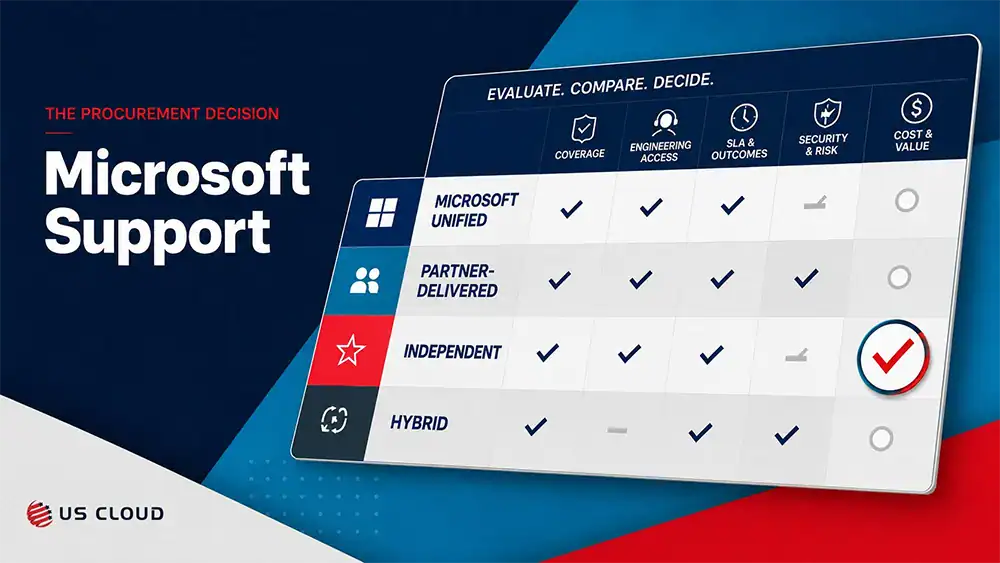
The table below summarizes the key dimensions CIOs and IT Procurement teams should evaluate when comparing Microsoft support delivery models. Use this as a starting framework for vendor evaluation and EA negotiation preparation.
| Feature / Capability | Microsoft Unified Support | LSPs / VARs (SHI, CDW, Insight) | CSPs / MSPs (Accenture, Avanade, DXC) |
Independent Third-Party (US Cloud) |
|---|---|---|---|---|
| Primary Business Focus | Software & Cloud Revenue | Licensing & Hardware | Managed Services / Cloud Resale | Pure-Play Microsoft Support |
| Pricing Model | % of Total MSFT Spend | Bundled / Tiered | Bundled / Per User | Based on Actual Support Need |
| Engineering Specialization | High (but often offshored) | Generalist (Multi-vendor) | Generalist / L1-L2 Admin | Deep Microsoft Specialists (L2-L4) |
| Resolution Model | OEM Direct | Triage & Escalate to MSFT | Triage & Escalate to MSFT | In-House Resolution |
| Cost Predictability | Low (scales with cloud usage) | Medium | Medium | High (flat rate / predictable) |
| SLA Accountability | Microsoft’s queue | Partner SLA (limited) | Partner SLA (varies) | Financially backed SLA |
| Copilot / AI Cost Impact | Auto-compounds with spend | Limited advisory | Limited advisory | Decoupled — flat pricing |
Frequently Asked Questions: Microsoft Enterprise Support
What is Microsoft Unified Support and how does its pricing work?
Microsoft Unified Support is Microsoft’s current enterprise support tier, which replaced the legacy Premier Support model. Pricing is calculated as a percentage of an organization’s total Microsoft spend — typically between 6.5 and 12 percent depending on agreement tier — covering both cloud (Azure, Microsoft 365) and on-premises software. This percentage-based model means support costs automatically increase as cloud consumption and Copilot adoption grow, regardless of whether actual support needs have changed.
What is the difference between an LSP, CSP, and MSP for Microsoft support?
Large Account Resellers (LSPs) primarily focus on Microsoft licensing transactions and volume discounts; support is a secondary bundled offering typically delivered through Level 1 triage and Microsoft escalation. Cloud Solution Providers (CSPs) are authorized to resell Microsoft cloud services and provide first-line cloud support, but typically lack coverage for hybrid or on-premises environments and escalate complex issues to Microsoft. Managed Service Providers (MSPs) offer broad IT operations outsourcing but generally lack the Microsoft-specific engineering depth required for Tier 3 or Tier 4 incident resolution, relying on their own Microsoft partner support plan for complex cases.
Can a third-party provider really replace Microsoft Unified Support?
Yes. Gartner has recognized independent third-party providers, including US Cloud, as fully capable of replacing Microsoft Unified Support for enterprise organizations. Third-party providers maintain direct Microsoft escalation paths for cases that require OEM engineering involvement, while handling the majority of enterprise incidents in-house at a lower cost and faster resolution time than Microsoft’s standard SLA queue.
How much can enterprises save by switching from Microsoft Unified Support to a third-party provider?
Enterprises that switch from Microsoft Unified Support to an independent third-party provider such as US Cloud typically achieve 30 to 50 percent savings on total Microsoft support spend. For organizations spending $500,000 or more annually on Unified Support, this represents a material budget reduction that can be reallocated to strategic technology investment.
What should CIOs ask when evaluating Microsoft support vendors?
The most important diagnostic question is: ‘When a critical Tier 3 or Tier 4 incident occurs, do your engineers resolve it — or do you open a support ticket with Microsoft on our behalf?’ Beyond this, enterprise IT leaders should evaluate: financially backed SLA commitments, engineering team depth and Microsoft certification levels, coverage scope (cloud-only versus hybrid and on-premises), pricing model transparency, and the provider’s history with organizations of comparable infrastructure complexity.
Is it worth getting a third-party quote even if we plan to stay with Microsoft Unified?
Yes. Obtaining a competitive quote from a qualified third-party provider such as US Cloud gives IT Procurement teams concrete market pricing data that can be used to negotiate better terms, discounts, or service improvements with Microsoft’s account team. Microsoft is more likely to negotiate on Unified Support pricing when a credible alternative is demonstrably available.
Strategic Recommendations for CIOs and IT Procurement Teams
As enterprise Microsoft environments grow more complex and Microsoft’s pricing model continues to evolve, the default approach of bundling support with licensing is increasingly difficult to justify on financial or operational grounds. The following four recommendations provide a practical framework for the next EA renewal cycle.
1. Decouple Support from Licensing
The assumption that the company selling the Enterprise Agreement is best positioned to support the underlying infrastructure is commercially convenient but operationally flawed. Licensing specialists optimize for volume discounts and contract terms; support specialists optimize for engineering depth and resolution speed. Evaluate them separately.
2. Audit Actual Support Utilization
Before the next renewal, IT teams should pull 12 to 24 months of ticket history and classify incidents by severity, resolution owner, and time-to-resolution. Enterprises frequently discover they are paying for comprehensive Unified Support but resolving the majority of incidents through internal resources — or they identify patterns of slow resolution in specific product areas that a specialized provider could address more effectively.
3. Obtain a Competitive Quote
Even organizations that intend to remain with Microsoft Unified Support should obtain a formal quote from an independent third-party provider. This creates verifiable market data that procurement teams can use in Microsoft negotiations. In most cases, the existence of a credible alternative is sufficient to generate meaningful concessions from Microsoft’s account team.
4. Ask the Hard Escalation Question
Before signing with any partner — LSP, CSP, MSP, or third-party — require a written answer to: ‘When a critical Tier 3 incident occurs at 2 AM on a Saturday, does your team resolve it — or do you open a ticket with Microsoft on our behalf, and we wait in their queue?’ The answer to this question reveals more about a provider’s actual support model than any marketing material will.
Conclusion: Support Is a Strategic Decision, Not a Line Item
The era of defaulting to Microsoft for enterprise support is ending — not because of vendor preference, but because the financial math of Unified Support no longer holds up under scrutiny for most enterprise organizations.
LSPs, CSPs, and MSPs offer genuine value in their respective domains: licensing administration, cloud provisioning, and managed operations. What they do not offer is the engineering depth, pricing transparency, and SLA accountability that enterprise-grade Microsoft support demands in a world where Copilot, Azure, and Microsoft 365 are mission-critical infrastructure.
For CIOs and IT Procurement leaders entering a renewal cycle, the question is no longer whether to evaluate alternatives to Microsoft Unified Support. The question is how quickly the evaluation can be completed before the next renewal window closes.
“The organizations that negotiate the best Microsoft support terms in 2026 and 2027 will be the ones that arrived at the table with a credible alternative already in hand.”