US Cloud: How Global 2000 IT Sourcing Managers Will Crush Their 2026 KPIs on Cost, Risk, and Vendor Leverage.

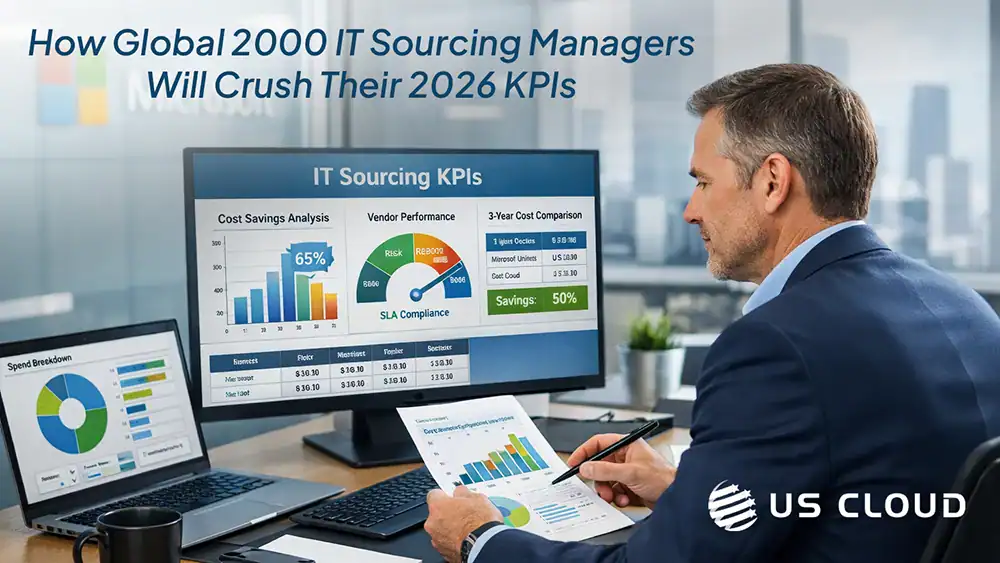
IT Sourcing Leaders in Global 2000 enterprises are under pressure from every direction in 2026:
- CFOs want hard savings and predictable budgets.
- CIOs want resilient, high-quality support for increasingly complex Microsoft estates.
- Risk, Legal, and Compliance demand reduced vendor concentration risk and stronger controls.
- Business units expect faster response, better service, and fewer outages.
Microsoft Unified Support often works directly against those goals: prices escalate, support is bundled into licensing, vendor lock-in intensifies, and the actual service quality is inconsistent and hard to measure.
US Cloud exists to flip that script.
This article walks through how US Cloud helps IT Sourcing Managers at Global 2000 firms hit their core KPIs in 2026, with a three-year view on savings, risk, and performance compared to Microsoft Unified Support.
We’ll tie US Cloud directly to four KPI categories:
- Cost & Spend Management
- Supplier Performance & Risk
- Process Efficiency & Operational KPIs
- Strategic Value & Innovation
And we’ll reinforce it with tables showing how US Cloud can outperform Microsoft Unified Support over a three-year horizon.
1. Cost & Spend Management: Turning Support into a Savings Engine
Core KPIs impacted:
- Cost Savings / Cost Reduction
- Cost Avoidance
- Total Cost of Ownership (TCO)
- % IT Spend Under Management
- Procurement ROI
1.1 Direct Cost Savings vs Microsoft Unified Support
US Cloud’s core value proposition is simple and procurement-friendly:
Replace Microsoft Unified Support and save 30–65% (often ~50%) on support over a 3-year period.
For a Global 2000 enterprise spending, say, $4M per year on Microsoft Unified Support, a 50% reduction is not “nice to have”—it’s millions of dollars of hard savings that go straight into your KPI dashboard and cost savings reports.
Table 1: Illustrative 3-Year Support Cost Comparison
(All numbers illustrative; scale to your actual Unified spend.)
| Item | Microsoft Unified Support | US Cloud Enterprise Support |
|---|---|---|
| Annual Support Cost (Year 1) | $4,000,000 | $2,000,000 |
| Annual Support Cost (Year 2)* | $4,400,000 (10% increase) | $2,060,000 (3% increase) |
| Annual Support Cost (Year 3)* | $4,840,000 (10% increase) | $2,121,800 (3% increase) |
| 3-Year Total Support Spend | $13,240,000 | $6,181,800 |
| 3-Year Hard Dollar Savings | — | $7,058,200 |
| % Savings vs Microsoft Unified | — | ≈ 53% |
*Assumes typical Unified inflation vs. more modest increases with US Cloud.
You can plug in your own numbers, but the direction doesn’t change: Unified inflates; US Cloud frees budget.
This hits multiple KPIs instantly:
- Cost Savings / Cost Reduction: Multi-million-dollar savings recognized as “hard savings” in procurement reporting.
- Cost Avoidance: Avoiding future Unified price escalations and license-tied support bundling.
- TCO Reduction: Lowering the all-in cost to support your Microsoft stack (not just licenses).
- Procurement ROI: The sourcing team can point to a single vendor decision that returns a multiple of their own annual budget.
1.2 Decoupling Support from Licensing = More Spend Under Management
Microsoft increasingly wants support bundled into licensing constructs (EA, MCA-E, etc.), which:
- Reduces sourcing’s ability to competitively bid support.
- Buries support economics inside larger licensing conversations.
- Makes it harder to track support spend as a distinct managed category.
By moving to US Cloud:
- Support is decoupled from licensing and treated as a strategic, competitively sourced spend category.
- IT Sourcing can show a higher % of spend under management and demonstrate that support is not just “cost of doing business” but a controlled, optimized spend line.
2. Supplier Performance & Risk: Reducing Vendor Lock-In While Raising Service Quality
Core KPIs impacted:
- Supplier Performance (Quality & SLA Compliance)
- Supplier Risk & Concentration
- Contract & SLA Compliance
- Service Continuity / Incident Impact
2.1 Reducing Vendor Concentration Risk
Global 2000 organizations are increasingly under pressure to reduce concentration risk with hyperscalers and mega-vendors. Relying on Microsoft for both software & support is the definition of vendor concentration:
- Same vendor for licensing, cloud, and support.
- Limited options in a dispute or outage.
- Reduced leverage at renewal time.
By adding US Cloud as your Microsoft support provider:
- You introduce a second strategic supplier into your Microsoft ecosystem.
- You preserve leverage in future negotiations with Microsoft (you’re not dependent on Unified).
- You can benchmark real-world support performance across vendors, not just accept Microsoft’s narrative.
2.2 Service Quality: Onshore Engineers & Faster Response
US Cloud competes head-to-head with Unified on support quality, not just price. Typical differentiators include:
- 100% USA (or specified region) based engineers for many enterprises.
- Deep expertise across Azure, M365, Windows, SQL, Dynamics, etc.
- Tighter response and resolution targets compared to experiences many enterprises report with Unified.
Table 2: Support Quality & Risk Comparison Over 3 Years
| Dimension | Microsoft Unified Support | US Cloud Microsoft Enterprise Support |
|---|---|---|
| Vendor Role | Manufacturer & support provider | Independent, dedicated support provider |
| Primary Model | Global, tier-based queues, offshore mix | Senior engineers, onshore-first model |
| Typical Response Times | Varies by tier/SKU; can be inconsistent | Contractual response SLAs often tighter & enforced |
| Ownership of Complex Incidents | Often bounces between internal MS teams | Single accountable provider coordinating with Microsoft as needed |
| Vendor Concentration Risk | High – same vendor for software + support | Reduced – adds independent support provider |
| Negotiation Leverage at Renewal | Limited – support tied into licensing renewal | Higher – licensing and support negotiable separately |
| 3rd-Party Support Flexibility | Discouraged narrative (“risk”, “non-compliant”) | Proactive partnership to coexist with Microsoft as needed |
For an IT Sourcing Manager’s KPI dashboard, this strengthens:
- Supplier Performance (measurable SLAs, satisfaction scores).
- Risk KPIs (more diversified supplier base, lower vendor lock-in, clearer accountability).
- Service Continuity Metrics (faster incident response = less downtime, less revenue at risk).
3. Process Efficiency: Making Sourcing & Operations Look Good
Core KPIs impacted:
- Contract / PO Cycle Time
- Cost per Purchase Event (sourcing efficiency)
- Tail/Unmanaged Spend Reduction
- Issue-to-Resolution Cycle Time (operational KPI often tracked by sourcing/finance)
3.1 Easier, Cleaner Contracting Than Unified
Unified deals are notoriously complex:
- Coterminous with EA or MCA-E terms.
- Multiple service levels and entitlements buried in Microsoft’s documentation.
- Complex “true-ups” and adjustments as usage changes.
US Cloud contracts are typically:
- Simpler, dedicated support contracts not tangled in licensing.
- Easier for Legal and Procurement to review and benchmark.
- Easier to compare apples-to-apples against internal cost and other third parties.
This helps reduce:
- Contract cycle time (requisition → signature).
- Internal review friction (fewer stakeholders trying to untangle a massive EA).
- Hidden tail spend associated with unplanned Microsoft extended support, ad hoc tickets, or “unexpected Unified add-ons.”
3.2 Operational Efficiency: Fewer Loops, Faster Resolution
From an operational perspective, support providers that actually solve issues faster reduce:
- Incident duration and business impact.
- Internal IT time spent babysitting tickets or re-explaining problems.
- The “shadow cost” of escalations and executive involvement.
As more organizations deploy AI-driven tools (Copilot, admin agents, etc.), the complex cases that reach a human will be more gnarly, cross-domain issues:
- Hybrid Azure + on-prem AD + security misconfig.
- Multi-tenant M365 policies colliding with compliance rules.
- Complex performance or availability problems.
US Cloud’s model is oriented toward high-skill humans owning complex issues, which can materially reduce:
- Issue-to-resolution cycle times for serious tickets.
- Internal engineering hours burned chasing Microsoft across silos.
For sourcing, that’s a story you can tell: not just “we saved money,” but “we made our operations more efficient”.
4. Strategic Value & Innovation: Making Sourcing a Strategic Partner
Core KPIs impacted:
- Strategic Supplier Partnerships
- Risk Mitigation & Resilience
- Business Stakeholder Satisfaction
- Innovation / Value-Added Services from Vendors
4.1 From Cost-Cutters to Strategic Co-Architects
By bringing US Cloud to the table, IT Sourcing positions itself not as “the department that says no,” but as the team that found a better way to:
- Protect budgets
- Improve support
- Reduce risk
- Preserve leverage with Microsoft
US Cloud can also act as a strategic advisor over the 3-year term:
- Helping you plan support models as Microsoft pushes deeper into AI and agent-based tools.
- Advising on where you truly need direct Microsoft involvement (e.g., certain Azure escalations) and where US Cloud can handle everything.
- Providing independent insight into Microsoft roadmap impacts on support and costs.
4.2 Multi-Year KPI Alignment Matrix
To make this real for 2026–2028, here’s how US Cloud aligns with core IT sourcing KPIs over a 3-year term:
Table 3: KPI Alignment – US Cloud vs Microsoft Unified (3-Year View)
| KPI Category | KPI | Microsoft Unified Support | US Cloud Microsoft Enterprise Support |
|---|---|---|---|
| Cost & Spend | 3-Year Hard Savings | Difficult to achieve; vendor controls price | 30–65% savings vs Unified, documented and reportable |
| Cost Avoidance | Limited; price escalations common | Avoided Unified renewals & increases; locked-in lower support baseline | |
| TCO for Support | High & inflating | Lower and more predictable | |
| Supplier Performance | SLA Compliance & Quality | Variable; dependent on queue and region | Contractual SLAs, engineer quality, and satisfaction focus |
| Supplier Risk & Concentration | High: software + cloud + support with one vendor | Reduced: independent support supplier + Microsoft | |
| Process Efficiency | Contract Cycle Time | Long; entangled with EA / MCA-E | Shorter, clean stand-alone support contract |
| Internal Ticket Handling Efficiency | More vendor-side complexity | Streamlined, single accountable support partner | |
| Strategic Value | Negotiation Leverage with Microsoft | Weak – reliant on Unified | Stronger – support decoupled; sourcing can play vendors against each other |
| Innovation & Advisory | Product-led narrative | Independent advisory focused on client interests | |
| Stakeholder Satisfaction | IT & Business Sentiment on Support | Often mixed | Higher satisfaction when cases are resolved faster and cheaper |
5. How to Tell This Story Internally in 2026
IT Sourcing Managers don’t just need outcomes—they need a narrative that lands with CFOs, CIOs, and audit/risk committees.
Here’s how to frame US Cloud internally:
- “This is a controlled, proven way to reduce our Microsoft support costs by 30–65% over three years.”
- “We’re reducing vendor concentration risk by adding an independent support provider.”
- “We’re improving service quality (SLAs, engineer quality, responsiveness) while lowering costs.”
- “We’re giving ourselves more negotiation leverage with Microsoft at every licensing renewal.”
- “We’re aligning directly to procurement’s core KPIs: savings, risk, supplier performance, and strategic value.”
6. Conclusion: US Cloud as a 3-Year KPI Accelerator
In 2026, IT Sourcing Managers in the Global 2000 are not judged just on how cheaply they buy—but on how well they:
- Manage multi-year costs
- Reduce vendor risk
- Improve support outcomes
- Enable strategic flexibility
US Cloud is a lever you can pull that impacts all four:
- It slashes Microsoft support spend over a 3-year period, feeding cost savings, cost avoidance, and TCO KPIs.
- It adds a second strategic supplier in your Microsoft universe, reducing concentration risk and giving you leverage.
- It improves support quality and responsiveness, which translates into operational efficiency and business satisfaction.
- It positions procurement as a strategic partner, not just a cost gatekeeper.
Schedule a call with US Cloud today to start vetting the Microsoft support solution that provides everything you need.

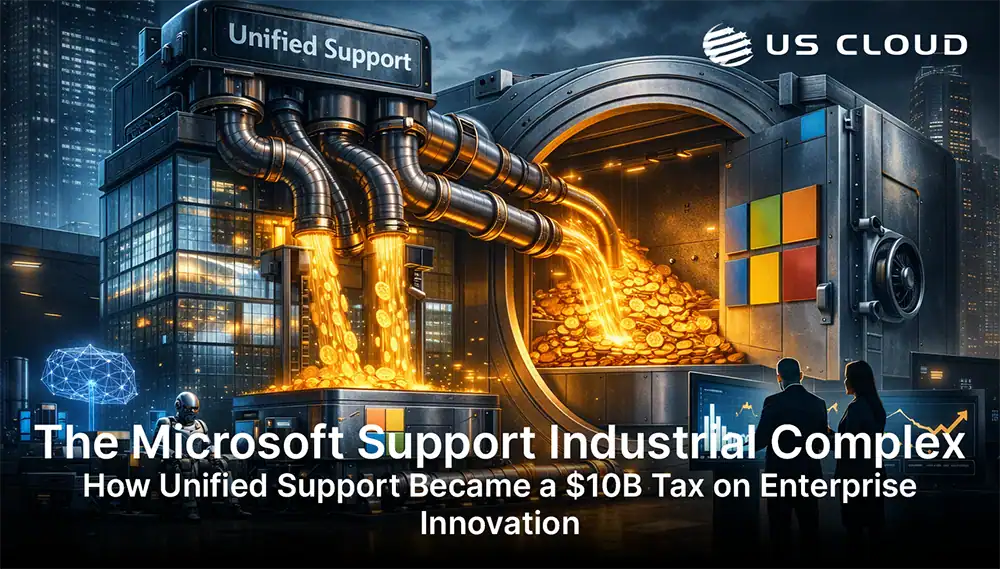
The Microsoft Support Industrial Complex: How Unified Support Became a $10B Tax on Enterprise Innovation
US Cloud vs. SHI: Choosing the Right Provider for Enterprise Microsoft Services