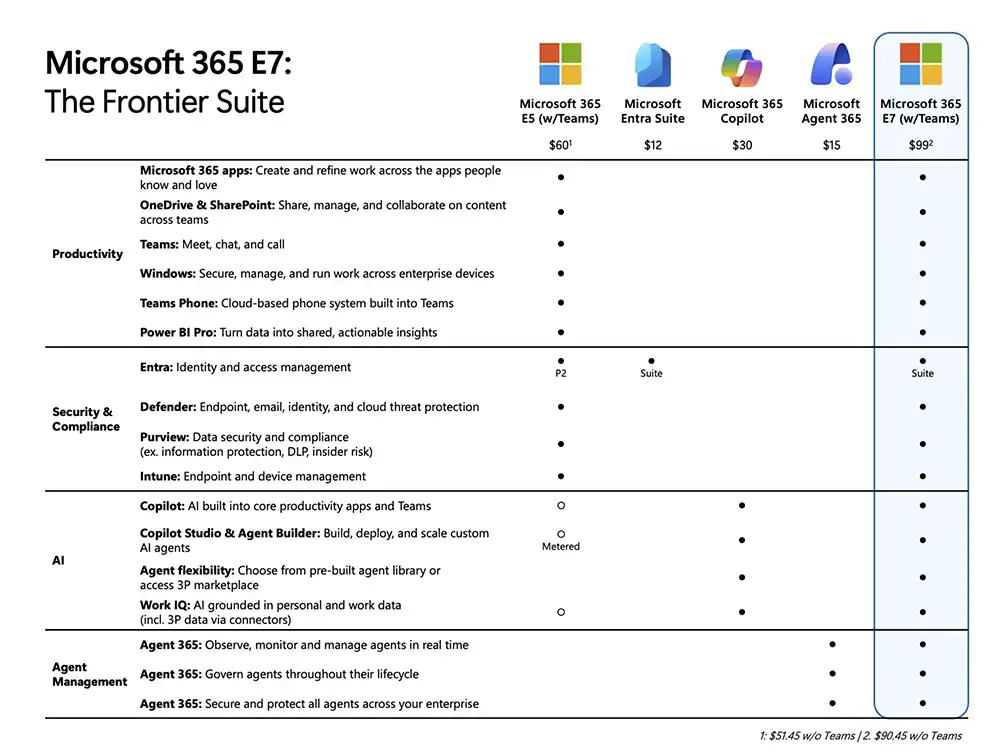
Credit: Microsoft, “Powering frontier transformation with Copilot and agents,” Microsoft 365 Blog


On May 1, 2026, Microsoft will make its Microsoft 365 E7 license generally available — and with it, quietly rewrite the economics of enterprise AI. If you are a CIO, CFO, or IT procurement leader, the clock is already ticking. M365 E7 is not just another SKU upgrade. It is a structural shift in how Microsoft intends to monetize artificial intelligence at enterprise scale, and the organizations that understand this now will negotiate dramatically better terms than those who wake up to it during their next renewal cycle.
This is not a product announcement recap. This is a financial and strategic warning — wrapped in one of the most compelling bundles Microsoft has ever brought to market.
The Microsoft 365 E7 license is Microsoft’s new flagship enterprise licensing tier, positioned above M365 E5 and designed to consolidate what previously required multiple expensive add-ons into a single per-user, per-month subscription. At its core, M365 E7 bundles:
On paper, this is a CFO’s dream. One predictable price. No more fragmented renewals. No more negotiating individual add-ons. The published entry price of $99 per user per month positions E7 as a premium but defensible investment — particularly for organizations already paying separately for E5 and Copilot licenses.
The problem is that $99 is just the entry fee.
These are not speculative figures. They represent the logical endpoint of a trajectory that Microsoft 365 E7 is specifically designed to accelerate. Microsoft is not selling you a license. It is selling you an on-ramp to a platform dependency — one that becomes structurally embedded in your operations before the pricing consequences become visible.
Traditional software costs are bounded by human usage patterns. AI agents are not. An autonomous agent handling invoice processing, IT ticket triage, or HR onboarding workflows does not clock out. Microsoft has already signaled its intent to monetize agentic compute similarly to how cloud providers charge for egress traffic and API calls. Procurement teams should model worst-case agentic consumption scenarios before signing any E7 agreement — and demand contractual caps or credit rollover provisions as a baseline negotiation requirement.
As AI agents automate functions historically performed by HR professionals — onboarding, benefits administration, policy Q&A, performance review coordination — the budget that funded those roles does not disappear. It migrates. If 10% of the Global 2000’s combined HR spend shifts to Microsoft’s platform over the next three to five years, the figure approaches $900 billion. Finance teams that treat M365 E7 as an IT expense will be blindsided when the true organizational cost becomes apparent across departments.
Microsoft’s Unified Support pricing is calculated as a percentage of total Microsoft spend. As E7 adoption deepens and agentic workloads drive up consumption-based billing, total spend grows — and Unified Support expenses grow proportionally. For organizations on three or five-year Enterprise Agreements, annual true-up clauses mean this growth is contractually baked in. The conversation about Unified Support must happen before the EA is signed.
Microsoft is releasing M365 E7 directly into its busiest 60-day renewal window. This is not coincidental. Enterprises with April or May EA renewals will face pressure to evaluate and adopt E7 under time constraints that favor Microsoft’s negotiating position. Organizations familiar with Microsoft’s release cadence will also reasonably ask whether a product launched into this window has been adequately hardened for enterprise-scale deployment — or whether early adopters are paying to beta-test a platform that will be materially more stable six months later.
Strategic recommendation: If your renewal falls in this window, seek a short-term extension rather than rushing an E7 decision. The 60 days of deliberation you gain are worth far more than any early-adoption incentives Microsoft may offer.
The most consequential aspect of Microsoft 365 E7 is not its price or its feature set. It is the pricing model precedent it establishes. Once an organization is operationally dependent on Copilot agents, switching costs become prohibitive. The transition from SaaS to utility pricing is easiest for Microsoft to execute once the customer is already embedded. Enterprises that accept E7’s current terms without negotiating future-state Copilot Credit pricing, consumption governance mechanisms, and audit rights are ceding leverage they will never recover.
The organizations that will come out of the E7 era with favorable economics are having different conversations than their peers. While most procurement teams focus on per-seat discounts, the sharper negotiators are working on:
None of these provisions are standard in a default M365 E7 agreement. All of them are negotiable — but only before signature.
Step back from the licensing mechanics and consider what Microsoft is actually building. M365 E7 is not a product. It is an infrastructure play — the enterprise equivalent of locking workloads into a cloud provider before usage-based billing kicks in at scale.
The IDC projection of 1.3 billion AI agents by 2028 is not a forecast about technology adoption. It is a forecast about dependency creation. Gartner’s finding that 40% of enterprise applications will integrate task-specific AI agents by 2026 — up from under 5% in 2025 — describes a transition so fast that most governance frameworks, budgeting models, and procurement playbooks will not keep pace.
Microsoft 365 E7 is designed to be the vehicle through which enterprises make that transition — on Microsoft’s terms, at Microsoft’s pace, within a pricing architecture that Microsoft controls. The transition from SaaS to utility pricing is easiest to execute once the customer is already embedded. Enterprises that accept E7’s current terms without negotiating future-state credit pricing, consumption governance mechanisms, and audit rights are ceding leverage they will never recover.
You are not buying software. You are buying into an AI platform economy — one where the entry price is fixed, the operating costs are variable, and the switching costs grow with every agent you deploy.
“Don’t let a fixed license turn into an uncapped utility bill. The time to govern agentic consumption is before the first agent goes live — not after the first true-up.”
Microsoft 365 E7 represents a genuinely compelling value proposition for enterprises ready to commit to AI-native operations. The consolidation of E5, Copilot, and autonomous agents into a single license removes real friction and enables real transformation. The technology is powerful. The platform is mature. The integration depth across the Microsoft ecosystem is unmatched.
But the economics require scrutiny that the marketing does not invite. The $99/user/month headline price is an entry fee into a consumption model designed to scale with your AI ambition — without the guardrails that enterprise finance teams need to plan, budget, and govern effectively.
The organizations that thrive in the E7 era will be the ones who said yes to AI-native operations and also said: not without contractual governance, not without consumption caps, not without the leverage that only exists before the ink dries.
May 1 is coming. The question is not whether to adopt Microsoft 365 E7. The question is whether you will adopt it on your terms — or Microsoft’s.
Microsoft 365 E7 is Microsoft’s most comprehensive enterprise licensing tier, generally available May 1, 2026. It bundles M365 E5, Microsoft Copilot, Microsoft 365 autonomous Agents, Teams Phone, Microsoft Defender, Purview compliance tools, and Entra ID Premium P2 into a single per-user, per-month subscription.
The published Microsoft 365 E7 price starts at $99 per user per month. However, organizations deploying agentic AI workloads via Copilot Studio or Microsoft Foundry will incur additional Copilot Credit consumption charges, which can push effective per-user costs above $200 per month.
Copilot Credits are Microsoft’s consumption-based billing unit for autonomous AI agent activity. Each agent trigger, reasoning model execution, or multi-step agentic task burns credits — creating variable costs layered on top of the fixed E7 seat price.
Microsoft 365 E7 vs E5: E7 includes everything in M365 E5 plus Microsoft Copilot AI integration, Microsoft 365 autonomous Agents, and the Copilot Credits consumption model. E7 is designed specifically for organizations committing to agentic, AI-native enterprise operations.
Microsoft 365 E7 general availability date is May 1, 2026 — coinciding with Microsoft’s busiest 60-day Enterprise Agreement renewal window.
Key negotiation points include: Copilot Credit multiplier rates, agentic consumption caps, credit rollover provisions, independent audit rights, multi-year credit pricing locks, and Unified Support percentage caps. None are standard in default E7 agreements, but all are negotiable before signature.