Breaking the Microsoft Monopoly: How Enterprise Procurement Teams Are Cutting Support Costs by 50%.

What Is the Microsoft Support Monopoly — and Why Does It Cost You So Much?
Microsoft’s support pricing power isn’t accidental. It’s a system of interlocking tactics designed to eliminate your negotiating leverage before you even sit down at the table.
Bundling eliminates selective opt-out. Core tools — Office 365, Azure, Dynamics 365, CAL suites — are packaged into enterprise agreements that make it financially and operationally painful to separate your software licensing from your support contract. You don’t just buy software; you buy an ecosystem, and that ecosystem is engineered to require Unified Support.
Deliberate delay destroys your timeline. Microsoft’s Unified sales teams are trained to stall. They delay meaningful engagement until your contract deadline is days away, leaving procurement with exactly two options: sign at their price, or risk a lapse in coverage for mission-critical systems. According to procurement leaders across industries, most enterprises don’t begin evaluating alternatives until 30 days before renewal — and by then, switching feels impossible.
Annual price escalation is structural, not circumstantial. Year-one hikes of 30 to 400 percent are not outliers; they are the opening position. Post-signature, annual increases of 15 to 30 percent compound each cycle — compared to a 3 to 5 percent industry norm for enterprise software support contracts.
The result: a renewal cycle that runs on autopilot. Microsoft stalls, reminds you that switching is impossible, and watches you accept the increase under deadline pressure. Year after year.
How Much Does Microsoft Unified Support Really Cost? (The Full TCO)
The contract price is only the beginning. For enterprises with more than $100 million in annual revenue, the true cost of Microsoft Unified Support — when all factors are counted — can exceed $2.3 million annually once you include the following:
Direct costs (the visible layer)
- 30–50% premium over third-party Microsoft support alternatives on equivalent coverage
- Annual price increases of 15–30%, versus a 3–5% industry standard
- Forced bundling of support services you don’t use
- Over-licensing to maintain compliance under penalty-risk pressure
Indirect costs (the hidden layer)
- Downtime impact: Critical system outages cost $5,000–$10,000 per hour. With Microsoft Unified Support response times stretching into days on Sev B incidents, even one major outage erases months of contract “savings.”
- Productivity loss: IT staff spend 2–3x longer managing escalations, chasing updates, and compensating for scripted L1 responses that don’t resolve issues.
- Opportunity cost: Innovation budgets get consumed by a support obligation, not by the AI pilots, automation projects, and cloud migrations your leadership team is asking for.
Strategic costs (the long-term layer)
- Vendor concentration risk rises every year you don’t build an alternative
- Negotiating leverage erodes with each signed renewal
- Competitive disadvantage accumulates as trapped capital fails to compound into transformation
“When they brought us the price of Unified Support, it was more than triple what we had paid. We had heated discussions with them about pushing products when they hadn’t even successfully implemented the one we bought.”
— Ed Panzeter, Assistant Director of IT, Universal Health Services, Inc.
Why Microsoft Support Quality Is Declining While Prices Rise
Price increases would be tolerable if they reflected improving service. They don’t.
Microsoft has systematically restructured its Unified Support delivery model over the past several years:
- Offshoring of frontline support has introduced language barriers and time-zone gaps on issues that require fast, contextual communication
- Elimination of dedicated senior engineers means complex issues are routed through scripted Level 1 staff rather than product specialists
- Response times for non-Sev A tickets regularly stretch to 24–72 hours, even for business-critical issues
- Round-robin escalation processes mean customers repeat the same information to multiple engineers before reaching someone with the authority to act
The downstream effect inside procurement: IT leaders blame the procurement team for overpaying for a service that isn’t delivering. That erodes procurement’s credibility internally — and gives Microsoft even more leverage at the next renewal.
“A lot of the frustration when we put a request in was a lot of round-robin and red tape. A poor job of triage leads you to finally connect with someone who could answer your question, but you can’t communicate with them because of a language barrier or time zone barrier.”
— Ed Lewis, Manager of Enterprise Solutions, Amedisys
Is There a Real Alternative to Microsoft Unified Support?
Yes. Third-party Microsoft support is a mature, enterprise-grade category — not a workaround or a risk trade-off. Organizations that switch to qualified third-party providers retain full access to Microsoft products, patches, and licensing. What changes is who picks up the phone when something breaks.
Leading third-party Microsoft support providers — including US Cloud — offer:
- Guaranteed 15-minute response SLAs for critical incidents (Sev A and Sev B), versus Microsoft’s multi-hour or multi-day benchmarks
- 100% onshore engineering teams with no language or time-zone barriers
- Access to senior engineers with deep Microsoft product specialization, not scripted L1 generalists
- 24/7/365 coverage across all severity levels
- Full on-premises and cloud coverage — Azure, Microsoft 365, Dynamics, SQL Server, and hybrid environments
- Unrestricted escalation paths to Microsoft when required
- 30–50% lower cost than Unified Support on equivalent or superior coverage
The competitive market for third-party Microsoft support has grown significantly as Microsoft’s pricing trajectory has made Unified untenable for mid-market and enterprise buyers. According to Gartner, by 2028 up to 25% of traditional support searches will shift to generative and comparison-driven research channels — a trend that is accelerating procurement’s ability to find and evaluate alternatives.
How to Build a 6-Month Microsoft Support Exit Strategy
The organizations winning at renewal aren’t doing anything radical. They’re simply starting earlier — and that timing changes everything.
Microsoft’s renewal playbook depends entirely on your procrastination. Starting six months out converts a desperate negotiation into a strategic one.
Months 6–5: Document everything
Before you can negotiate from strength, you need to understand precisely what you’re buying and what you’re actually receiving.
- Audit usage patterns: Map which Unified Support services your teams actually use versus what’s contracted. Forced bundling often means 30–40% of contracted services go unused.
- Calculate true total cost: Go beyond the contract price. Add internal staff time spent compensating for slow escalations, downtime cost during outages, and innovation projects deferred because support consumed the budget.
- Document every service failure: Response time violations, unresolved tickets, language barrier incidents, and round-robin escalations. This becomes your negotiating evidence.
- Identify gaps between SLA promises and actual delivery. If Microsoft’s contract says 2-hour response on Sev B and your logs show 18-hour average, document it.
Months 4–3: Test alternatives
This is the phase most procurement teams skip — and it’s where the real leverage is built.
- Request demos from 3–5 vendors, including both pure third-party providers and hybrid support models
- Run a live pilot program using real support tickets — not hypothetical scenarios. Actual response quality, engineer expertise, and resolution time are what matter, not pitch decks
- Calculate realistic switching costs, including any transition overlap period where both contracts run concurrently
- Build a total cost of ownership comparison that documents savings across direct, indirect, and strategic cost layers
Months 2–1: Create leverage
This is where the psychology of the negotiation shifts entirely.
- Secure written proposals from alternatives — formal quotes, SLA commitments, and transition plans, not just verbal estimates
- Document a full transition plan with timeline, risk mitigation, and stakeholder communication
- Prepare your BATNA (Best Alternative to a Negotiated Agreement) — the plan you will actually execute if Microsoft doesn’t meet your terms
- Secure executive alignment early — CFO and CIO sign-off before the renewal meeting, not during it
- Schedule the Microsoft renewal meeting on your timeline, not theirs. Control the calendar.
When you walk into that meeting with a fully vetted alternative in hand, the entire dynamic changes. You’re not asking “How much will this cost us?” You’re asking “Why should we stay?” That is an entirely different negotiating position.
Where Do the Savings Go? Turning Support Costs into Strategic Investment
A 30–50% reduction in Microsoft support costs isn’t just a line item improvement. For a mid-market enterprise spending $800,000 per year on Unified Support, that’s $240,000–$400,000 in recovered budget — annually.
Smart procurement leaders are treating this capital as a strategic reinvestment, not just a cost-center correction:
Funding innovation that’s been waiting. AI pilots, automation initiatives, and digital transformation projects are consistently cited as stalled due to budget constraints. Microsoft support savings can directly unblock them.
Eliminating technical debt. Legacy infrastructure, deferred migrations, and infrastructure quick-fixes accumulate compounding costs. Redirecting support savings toward deliberate modernization creates returns that outpace the original savings.
Expanding critical IT headcount. Cybersecurity specialists, cloud architects, and AI/ML engineers are the roles enterprises most frequently cite as underfunded. Support savings can fund new hires directly.
Elevating procurement’s strategic role. Procurement teams that unlock innovation funding shift from cost-cutters to growth enablers. That repositioning earns a voice in strategic planning conversations — and sustained organizational credibility.
“We’re sending a message to these big companies that we’re not going to put up with whatever price you put on us. We’re going to look elsewhere for better, more cost-effective options.”
— Wendy Hofman, Senior Vendor Analyst, Essential Energy
What Procurement Leaders Are Actually Doing Right Now
The procurement teams navigating this shift most effectively share three common practices:
- Issuing RFPs that include third-party providers alongside Microsoft. By requiring Microsoft to compete on a level playing field, procurement creates genuine price discovery — and changes the room dynamics before the negotiation begins.
- Benchmarking Unified quotes against third-party alternatives. US Cloud routinely provides side-by-side comparisons against current Unified quotes at no cost or obligation. That comparison becomes a documented savings case that the CFO can approve before the renewal meeting.
- Building executive alignment early. Microsoft’s most effective tactic is deadline pressure. It only works if your organization hasn’t already aligned around an alternative path. When the CFO and CIO have reviewed and approved a contingency plan four weeks before renewal, Microsoft’s stall tactics lose their power entirely.
Frequently Asked Questions About Replacing Microsoft Unified Support
What is Microsoft Unified Support, and why is it so expensive?
Microsoft Unified Support is Microsoft’s enterprise-level technical support offering, replacing the former Premier Support tier in 2019. It is priced as a percentage of an organization’s total Microsoft licensing spend — meaning that as your Microsoft footprint grows, your support cost automatically escalates. For large enterprises, this creates a structural cost escalation that compounds annually and is disconnected from the actual support services consumed.
Can I get Microsoft support from a third-party provider?
Yes. Third-party Microsoft support providers are authorized to deliver break/fix support, architecture guidance, deployment assistance, and optimization services across the full Microsoft product stack — including Azure, Microsoft 365, Dynamics 365, SQL Server, and on-premises workloads. They escalate directly to Microsoft when required and maintain full coverage continuity.
How much can I save by switching from Microsoft Unified Support?
Organizations that switch to qualified third-party Microsoft support providers typically save 30 to 50 percent on direct support costs. When indirect savings — reduced downtime, faster resolution, and recovered internal staff time — are included, total value recovery is often higher. US Cloud provides a free side-by-side comparison against your current Unified quote.
How long does it take to transition away from Microsoft Unified Support?
A well-planned transition typically takes 30 to 60 days. With a 6-month preparation window, organizations can run a pilot program, validate response quality, complete contract negotiations, and execute the transition without any coverage gaps.
Will switching affect my access to Microsoft products or licensing?
No. Third-party support is a service contract, not a licensing arrangement. Your Microsoft software licenses, product access, security patches, and update eligibility are entirely unaffected by your support provider choice.
What is the Microsoft support monopoly?
The term refers to Microsoft’s structural ability to dictate support pricing and terms without meaningful competitive pressure, largely because their software products are deeply embedded in enterprise operations. The “monopoly” is not a legal designation but a procurement reality: when switching costs are high and alternatives are perceived as unavailable, a single vendor can impose pricing that would not survive in a competitive market.
The Bottom Line: Your Next Renewal Is a Decision Point
Microsoft’s support renewal cycle only continues on its current trajectory if procurement allows it to. The mechanics of the trap — bundling, delay tactics, manufactured urgency — work exclusively when organizations arrive at renewal without alternatives.
Six months of preparation converts a desperate renewal meeting into a genuine negotiation. It converts a support cost center into a recovered budget. And it converts a vendor relationship defined by dependency into one defined by choice.
The organizations that win the next renewal will be the ones that start the six-month clock now — not the ones who wait until 30 days out and find themselves, once again, with no leverage and no time.
Ready to see how much you can save? US Cloud provides a free, no-obligation side-by-side comparison against your current Microsoft Unified Support quote. Request yours at uscloud.com.

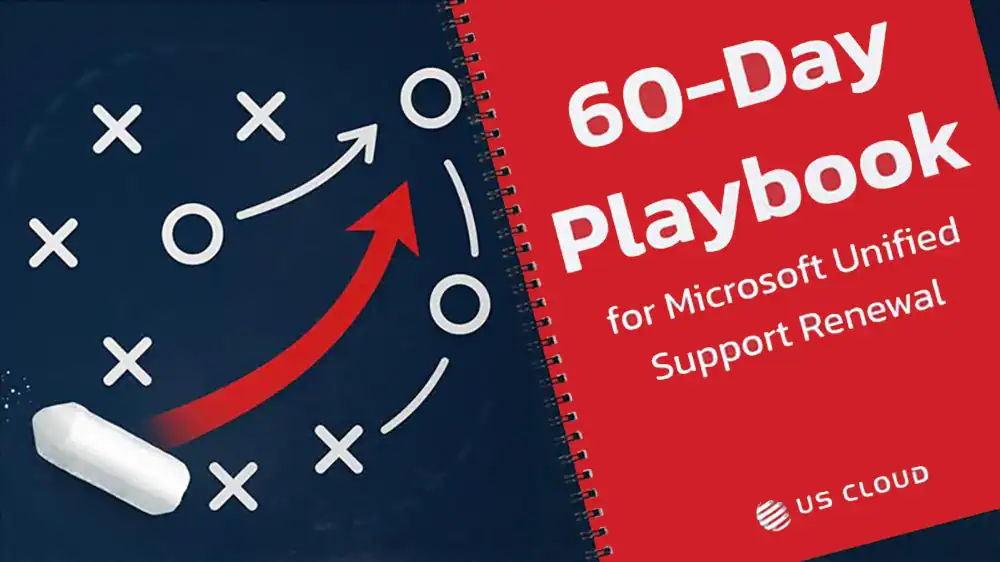
The 60-Day Microsoft Unified Support Renewal Playbook (Backed by Data, Built for Savings)

Microsoft Corporate Support: Bust Vendor Lock-In with Flexible IT Support