Azure discount levels increase with higher annual spend commitments.



To optimize the terms and conditions of their growing Azure contracts, enterprise IT sourcing, procurement and vendor management teams must carefully negotiate consumption estimates, discounting and concessions.
As enterprises renew their rapidly growing Azure contracts, most are finding their discounts have disappeared. In order to regain prior discount levels, appropriate negotiation strategies must be applied.
Enterprise sourcing and procurement teams need to calculate the total cost of their large Azure deal to include costs of any migrations, support, training, and price step ups in multi-year agreements.
Look closely at consumption estimates to make sure optimization efforts are realistic. Use a Microsoft Azure Consumption Commitment (MACC) amendment to avoid wasting unused prepayments.
Pursue all possible discounts to optimize Azure value, growth and workloads Concessions include Azure consumption discount (ACD), Azure credit offer (ACO) and service-specific discounts.
Ask Microsoft for additional Azure incentives to mitigate: price increases, Unified enterprise support, renewals, migration funding and support for your enterprise’s cloud initiative.
Cloud infrastructure and platform services (CIPS) customers seeking advanced concessions on cloud deals will achieve 15% of savings on their spend.
75% of organizations will double their savings by leveraging FinOps rather than securing a commitment discount within MACCs.
20% of enterprises will use third-party support to cut their Microsoft Unified Support costs by 50% in order to offset Azure TCO.
For those enterprises looking to gain leverage, Azure buyers may prepay for overestimated consumption and later forfeit those prepayments for unused commitments. Azure buyers beware, underestimating could reduce leverage during negotiations. Enterprise clients must understand all Azure options to gain the greatest discounts and avoid hidden costs.
Microsoft’s main Azure negotiation vehicle is through the Microsoft Azure Consumption Commitment (MACC) amendment. The MACC is usually signed for a three- or five-year term (plus an additional one year grace term), and has no minimum commitment. However, enterprises have indicated during negotiations that Microsoft requires a minimum Azure contract value of $1 million a year. Enterprises spending less than $1M per year on Azure are moved to the lower tier Microsoft Customer Agreement (MCA).
Along with volume commitments to obtain leverage, clients will be able to use other negotiation variables, such as the types of migrations, competition, publicity amendments, third-party support, or duration of deals.
Before starting the Azure negotiation process with Microsoft, enterprise sourcing and procurement teams should know and analyze all possible deal options to improve their leverage and pricing. During the MACC negotiation with Microsoft, it is critical to have accurate Azure consumption estimates as well as a complete understanding of all Azure direct and indirect costs. Enterprises should seek all discounts and have awareness of lesser-known concessions – see image below.
Sourcing and procurement teams should take the proper time to reduce and optimize their enterprise’s Azure spend. Volume licensing as well as advanced incentives on mitigation of price adjustments, enterprise support, renewals, migration funding and support for cloud initiatives are available with enough lead time and preparation.
This is the foundation of your Azure negotiation with Microsoft. Enterprises should not overcommit to an Azure buy they will not be able to consume. Nor should sourcing and procurement teams under commit when they could have used the additional valuable leverage.
Enterprises must take advantage of what makes their Azure consumption unique by understanding the variables that can ultimately lower the cost of your large Azure deal.
Forecasting Azure cloud consumption over the next 3 to 5 years is difficult.
During the presales phase, Microsoft and/or third-party cloud architects are often hired to assist enterprises with estimating Azure costs. Often these presales estimates result in much higher projected cloud consumption than anticipated, but sometimes they conversely provide aggressively low numbers to compete against Amazon Web Services (AWS) and Google Cloud Platform (GCP) offers.
These unrealistically low estimates do not reflect the costs of a full production implementation. It can be difficult to project actual Azure consumption in the first and second years of usage. The large variance with these proposals is due to assumptions that were built into the estimate that may not be reflective of your initial years. Having a complex migration, evolving requirements and building up cloud maturity are examples where Azure consumption forecasting is a difficult exercise.
The lowest Azure consumption estimate done by enterprise sourcing and procurement teams assumes the full use of three-year Reserved Instances (RIs), Savings Plans and all Azure Hybrid Benefits (Microsoft’s bring your own license program on Azure).
The combination of these mechanisms can decrease costs by 50%. However, these savings vary based on the RIs, Savings Plans and bring your own license (BYOL) ratios and rules, whichdiffer between Azure multitenant and Azure dedicated hosts.
Most enterprises don’t start off with RIs because they want to ensure that they have identified a steady-state workload before committing. Azure cloud buyers may not have Hybrid Benefits for all the licenses they will be using in Azure, especially if they are running unlimited VMs on-premises, as this does not translate to the Azure multitenant environment. Make sure to include those optimization efforts in your forecast to counter Microsoft’s strategy to force you make larger commitments.
MACC latter years of optimization efforts are equally important as migrations have been completed. Before committing to a MACC renewal, sourcing and procurement teams should work closely with enterprise IT architects or specialized third parties to fully optimize the post-migration steady-state. These efforts can impact run rates by 20% to 40%, and it’s critical to have a clear understanding of this prior to making Azure renewal commitments.
Most enterprises negotiating large Azure prepayment deals with Microsoft no longer place Azure as prepayments into their Enterprise Agreement (EA/EAS/SCE).
Doing so requires prepaying at least annually (or for the entire term), so any unused amount is forfeited at the end of the 3- or 5-year term. As a reminder, a MACC does not require any amount to be prepaid. Microsoft enterprise customers use the Server and Cloud Enrollment (SCE) or the MCA direct as the master Azure contract along with the MACC amendment, which allows for the committed sum to be used over the term of the agreement without an annual target.
Enterprises should take a conservative approach to their Azure commitments to avoid wasted IT budget, even if they have a 12-month grace period under MACCs. Consider the three- or five-year commitment only when you are fairly certain of consuming all Azure funds before the end of the contract.
Azure Deal Variable 1: More Workloads. Azure enterprise buyers can make commitments not only based on a certain amount of money to consume but also based on the migration of high-value core components of their IT to Azure. Enterprises could commit to key projects with Azure as a CIPS preferred platform, which could have a positive impact on the ACD. This scenario gives Microsoft more predictability over your usage and long-term dependency upon Azure. It could also indicate higher confidence in the purchase and use of Azure strategic offerings. Examples of enterprise IT key Azure workloads include:
Carefully review the language proposed by Microsoft for any workload migrations commitment, including commitment to migrate over a predefined planning period, and validate whether that is achievable.
Azure Deal Variable 2: More Spend. Although your enterprise may have taken a conservative estimate of your Azure spend, do not waste negotiation leverage if there is a high chance that you will exceed that estimate. You could include in your agreement an amendment that will state that a different type of ACD will apply if you hit certain levels of spend. An example would be:
You could also combine this mechanism, which will reward you next year, with the ACO model, as described later in this document, to reward you for the past year.
Azure Deal Variable 3: Azure Competitors. Competing CIPS vendors such as Amazon’s AWS or Google’s GCP are strong competitive threats to Microsoft’s Azure. Although Microsoft has increased its feature set for Azure to be more competitive with AWS, most enterprises with use multiple cloud providers for different workloads or applications.
Enterprise sourcing and procurement teams should bid all proposed workloads and commitments to multiple cloud providers. Compare CIPS vendors on rates, metrics, how discount is applied and rules about marketplaces in order to build leverage.
Azure Deal Variable 4: New vs. Renewal. ACD levels that were available five years ago when spending $10 million per year on Azure are now available only to customers with an annual Azure spend of at least $30 million a year. Expect discount ranges to fall further over time with Azure AI uptake. To mitigate this risk, enterprises should negotiate renewal discounts into their contract (see below).
Enterprises at the lower end of Azure spend ($0.5 to $1 million per year) can expect minimal discounts on their Azure deals. In those negotiations with Microsoft, sourcing and procurement teams may still want to leverage their “first-time buyer” position to negotiate more significant discounts on their Microsoft Enterprise Agreement contract.
Azure Deal Variable 5: Brand Publicity. To be able to reference your brand, logo or name is valuable to Microsoft. This concession is also valuable to Enterprise IT as it will ultimately create some distractions during the course of the agreement. You do not need to have a worldwide-known brand to gain Microsoft’s interest. You could be visible in a specific industry such as Azure Industry Cloud offerings, that Microsoft needs to market to. Keep in mind that your enterprise’s CISO may want inclusion in the decision process due to security risks of making your CIPS vendor public.
Azure Deal Variable 6: Five-Year Azure Deals. Although getting a five-year term under the EA (instead of the standard three-year term) for an M365 E5 deal is considered a concession from Microsoft, it is entirely different for an Azure Consumption Commitment. Microsoft places a premium on five-year Azure deals because:
Microsoft will propose MACCs over five years for a bigger ACD, even though the annual commitment may be comparatively similar. Enterprises should carefully assess the impact of a longer commitment – overall financial commitment and a longer lock-in term.
Azure Deal Variable 7: No Commitment With Discounts. In some cases Microsoft will offer “no financial commitment” deals to early adopters (of certain Azure services within an industry or region) that extend discounts based on an executive promise of migrating Enterprise IT workloads to Azure. These no commitment Azure accounts tend to be limited to organizations that are strategic brands or industries and represent a sizable long-term revenue potential.
MACC amendments have specifics you must analyze and understand before signing:
Contracting Vehicle: MACC is available in the EA, EAS, EES, SCE and the Microsoft Customer Agreement (MCA) direct with Microsoft (not under the CSP option). Enterprise sourcing and procurement teams still favor MACCs under EA/EAS/SCE because of the price ceiling protection attribute included in these types of agreements.
What Azure spend counts toward the commitment: This includes all Azure spend (inclusive of discounts) on each monthly invoice, including Azure RIs, Azure Marketplace preferred solutions and any Azure prepayments made.
Difference between Azure commitment and consumption: Your commitment will be the net billed by Microsoft, after the application of discount (if you have one such as described in the Pursue Multiple Discounts — Combine Based On Your Use Case section). So make sure your Azure estimate takes into account that your enterprise will have to consume a retail value that is higher than your commitment.
Example – a $150 Million MACC commitment, over three years, with a 20% ACD, will mean a consumption, without discount, of $187.5 Million.
Unused Azure Commitments: At the end of the MACC term, any unused Azure commitments will be billed via an Azure prepayment, which enterprises will have up to 12 months to spend (grace period). Your Azure Consumption Discount (ACD) is not applied to this shortfall unless you negotiate a new MACC, with a new ACD that will apply to the shortfall amount.
Note – Marketplace purchases cannot be paid against any shortfall invoice (prepayment). However, you could purchase, before the end of the grace period, reservations in order to avoid any loss of this prepayment.
Azure Reservations: Reservations are prepurchased (but not prepaid) Azure services (such as VMs or block blob storage). Microsoft sells Azure reservations at reduced rates but will not apply the ACD on a reservation. Your use of reservations will debit a commitment, but will not be discounted.
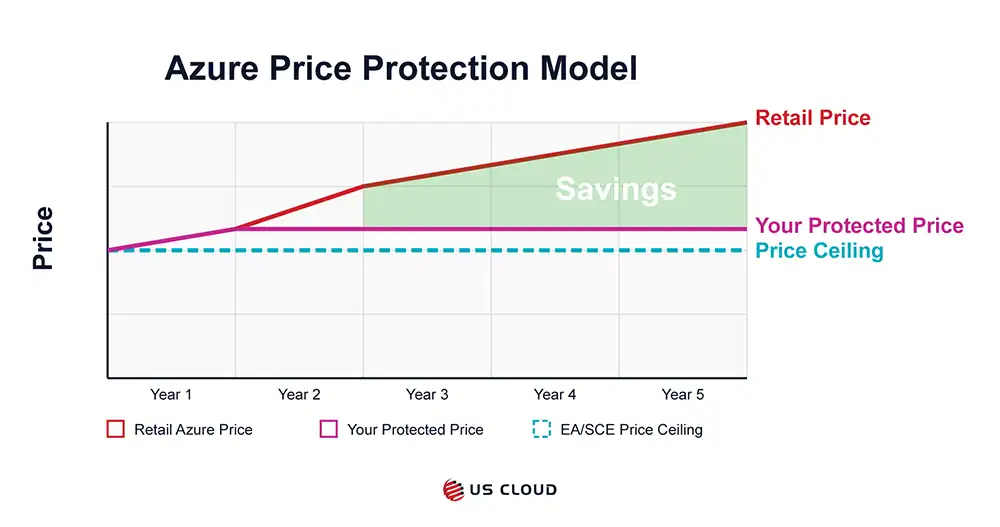
Price cap protection: MACC under the EA/EAS/SCE (not under MCA) creates a price ceiling protection. The price you pay for Azure services during your MACC term will be the lesser of the then-current list price (minus the discount if you have one) and the retail price at the time of signing the MACC. So if the Azure retail price were to increase, your discount would be applied to the new higher rate, but your rate would cap out at the ceiling you started with at signing.
Assess Azure Commitment Discounts (ACD): Here are the expected discount ranges based on annual Azure spend, but note that there are many variables (of which discounts are only one negotiated concession) that can have an impact on your enterprise’s Azure negotiations with Microsoft. This is an approximate benchmark and is subject to adjustments as program offerings and market conditions change. Also remember that the ACD does not apply to pre-discounted offerings, like Reservations or Saving Plans.
Microsoft will take into account the size of your immediate commitment, but also the potential for Azure consumption growth. The ACD and Microsoft’s negotiation flexibility will also depend on the deal variables listed in the previous section.
Use Consumption Credits (ACO) and Tiered Discounts as Azure Usage Grows: The most commonly negotiated discount method is based on making a commitment, with a promised consumption rate over a set term in exchange for a discount percentage for Azure cloud services. However, this does not address an enterprise’s long-term Azure growth potential. In a tiered discount approach, Microsoft can apply a monetary credit to the Azure invoice when a migration (consumption) target level has been reached. The more the enterprise consumes, the more credits it receives. These additional Azure credits will then be applied to the next invoice. Microsoft will label them as “Azure Commitment/Consumption/Credit Offers” (ACOs) in your proposals. Here are examples of ACOs you may negotiate with Microsoft.
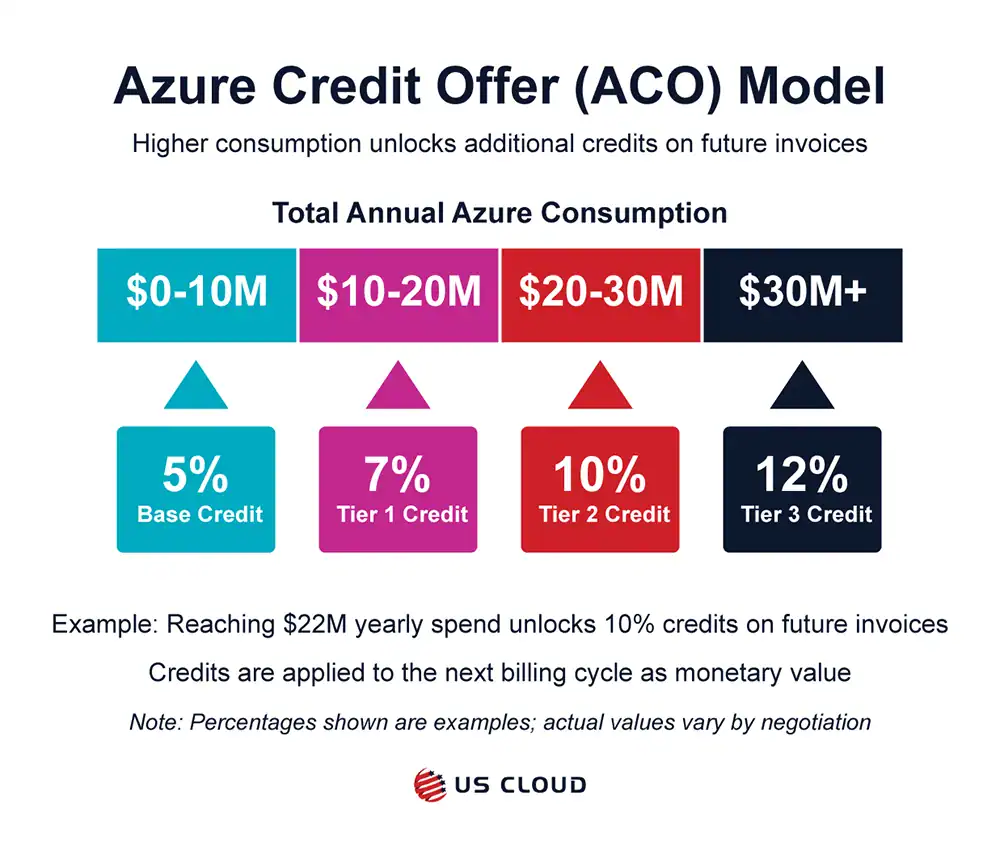
Service-Specific Azure Discounts: The ACD will be the most common discount applied to Azure cloud services, but enterprises should also look into service-specific discounts. Examples would be:

| Term | Definition |
|---|---|
| MACC | Microsoft Azure Consumption Commitment |
| ACD | Azure Consumption Discount |
| ACO | Azure Credit / Consumption / Commitment Offer |
| ECIF | End Customer Investment Funding |
| EA | Enterprise Agreement |
| MCA | Microsoft Customer Agreement |
| CSP | Cloud Solution Provider |
| CCOE | Cloud Center of Excellence |
| RI | Reserved Instance |