Which Microsoft Support Partner Model Fits Your Business.

요약
Choose your partner model by the work you want to own: the customer relationship, the support queue, the contract, and the renewal.
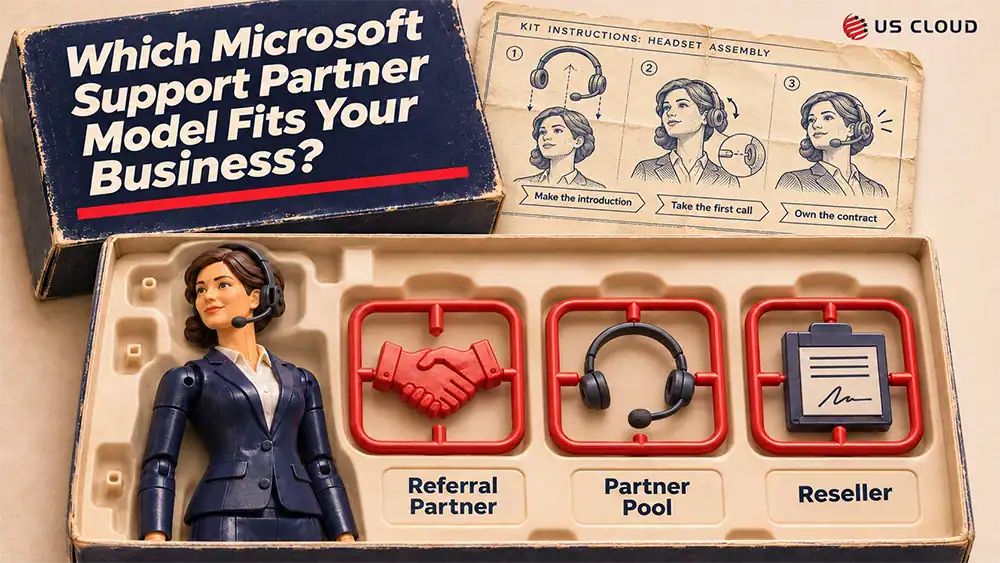
- US Cloud offers three partner programs: Referral, Partner Pool, and Reseller / White Label.
- Referral: you make the introduction, US Cloud manages sales and support, and you earn eligible commissions on new business and renewals.
- Partner Pool: you stay the customer’s first call and escalate tough Microsoft cases to a shared pool of US Cloud hours.
- Reseller / White Label: you contract with the customer, add your margin to US Cloud pricing, and choose Powered by US Cloud or White label delivery.
- Margin on the quote is only half the math. Price the hours your team spends on intake, updates, and renewals before you call a deal profitable.
- Next step: bring one real account to a partner-fit conversation with US Cloud.
A customer asks whether you can help with Microsoft support. Your seller hears new revenue. Your service manager hears another queue. Your finance lead asks what the margin looks like. All three have a point, and the partner model you pick decides how that argument ends.
Plenty of enterprise customers feel Microsoft Unified Support cost pressure at renewal time, and the partner who already owns the relationship is in a great spot to bring them a better option. US Cloud is an independent Microsoft enterprise support alternative that helps organizations lower Microsoft support costs, reach senior Microsoft engineers, improve accountability, and create renewal leverage without replacing a single Microsoft product. US Cloud customers typically save 30% to 50% compared with Unified Support.
So the real question for you is how much of that customer relationship you want to own. US Cloud offers three program paths. Referral lets you make the introduction and earn a commission. Partner Pool lets you extend your support team. Reseller / White Label lets you sell a customized offering under your own agreement, at your own margin.
Before you pick a program, answer one simple question: who on your team picks up the customer’s late-night call? Answer that honestly and the right model gets a lot easier to spot.
Start with your customer promise
Write down, in one sentence, what you want your customer to experience. For example: “Our service desk stays your first call, and we bring in senior Microsoft engineers when you need them.” Compare that with: “We help you choose the right support and introduce you to the team that delivers it.”
Both are solid promises. They come with very different staffing, customer expectations, and commercial terms. Trouble starts when sales sells the first promise and operations staffs for the second. That gap shows up fast, usually in the middle of a critical incident or a tense renewal call.
So ask your service lead what happens today when a Microsoft issue goes past your team’s depth. Does a senior engineer drop billable project work to dig in? Does an account manager chase another provider? Does the customer go find help on their own? Each of those answers costs you something: margin, momentum, or a little piece of the relationship.
Then ask your customers what they value about working with you. Some want one familiar contact for everything. Others want your advice during procurement and direct access to a specialist afterward. Build around the relationship your customer actually wants you to own. A branded service nobody asked for is an expensive way to learn that lesson.
US Cloud’s partner overview lays out the ways to work together. Use it to start the conversation about who does what, then pressure-test the arrangement against your real customer promise. Include the uncomfortable parts, like unresolved cases, billing questions, and renewal objections. If your customers are enterprises weighing a full Unified replacement, our take on partner-delivered Microsoft support is worth a read too.
Compare the three programs
Each program sets up a different relationship between your business, US Cloud, and the customer. Branding is a separate choice that lives inside the reseller program, so settle the program first and the logo second.
Referral. You introduce the customer to US Cloud and decide how involved you want to be in the sales process. US Cloud manages the sales and support relationship. Eligible commissions on new business and renewals are paid under the partner program terms once the customer pays. This fits partners who want a revenue stream from Microsoft support without running a support operation.
Partner Pool. You stay the customer’s primary support contact and buy a shared pool of hours. When your team needs deeper Microsoft expertise, it escalates the case to US Cloud. Usage is tracked by customer, so you can see which accounts draw on the pool. If a case needs Microsoft escalation, US Cloud can manage it at additional cost or hand it back to your existing escalation path.
Reseller / White Label. You sell a customized Microsoft support offering under your own agreement. You receive US Cloud’s pricing, add your margin, and contract directly with the customer. US Cloud provides the agreed backend services, and delivery can be split based on what your team already does well. The white-label overview covers the branded option in more detail.
Resellers then pick one of two delivery options. With Powered by US Cloud, you sell alongside US Cloud, and US Cloud is visible as part of the engineering or delivery team. With White label, US Cloud works behind the scenes and engages as a resource from your team, so your customer sees your brand from first call to renewal.
White label takes more operational planning. Expect to work through ticketing-system integration, case routing, identity, and a clear split of responsibilities. Sort out how your people and systems will work together before you present the branded offer. Putting your logo on the service is the easy part.
| Program | Who owns the customer relationship | Commercial model | Best fit when |
|---|---|---|---|
| Referral | US Cloud manages sales and support | Eligible commissions on new business and renewals | You want Microsoft support revenue without running incidents |
| Partner Pool | You stay the primary support contact | You buy a shared pool of hours, tracked by customer | Your desk is strong but complex cases eat senior time |
| Reseller / White Label | You contract with the customer | US Cloud pricing plus your margin | Customers want one accountable support offer under your brand |
| Program comparison at a glance. | |||
Three partners, three fits
Here’s how this plays out for three common partner types.
The MSP with a strong help desk. It has a capable desk and a steady trickle of complex Microsoft cases that eat senior engineering time. Before: a senior engineer gets pulled off a billable migration project for two days to chase a stubborn issue, the project slips, and the customer notices both. After: the desk stays the customer’s first call, escalates the tough case to a shared Partner Pool, and the engineer stays on the project. Branding is already settled here. Capacity and case routing are the real decisions.
That MSP should bring case history to discovery. Which issues consumed senior time? Which customers generated them? Were they routine support, project work, or recurring problems that need a separate fix? Buying a pool before you answer those questions leaves your margin to chance.
The CSP whose customers want one accountable name. Its customers keep asking for a single support offer they can hold someone to. It has account managers, a service intake process, and good reasons to sell under its own name. Reseller / White Label makes sense here, as long as the team can deliver the customer-facing work it plans to promise. The payoff is real: your brand on the service, your contract with the customer, and your seat at the table when renewal comes around.
The LSP with great renewal relationships. It shines in licensing conversations and has zero appetite for managing incidents. Referral may fit nicely. The LSP introduces the customer, picks its level of sales involvement, and lets US Cloud manage the sales and support relationship. Its homework is confirming commission eligibility and payment terms. A resale-margin forecast has no place in a referral plan.
Treat these as illustrations. They aren’t eligibility rules. Plenty of CSPs run mature service desks, and an MSP may want a different setup for one particular account. Your acronym belongs on the intro slide. Your operating reality should pick the model.
Map who does the work
Before you compare proposals, map six activities: selling, contracting, activation, case submission, customer communication, and renewal. Give each one a named owner and a column for open questions.
For selling, decide who qualifies the opportunity and who approves any service claims your sellers make. For contracting, identify the parties involved and the document that sets scope. For activation, decide who confirms that customer contacts can actually use the service. A welcome email does not prove access works.
Case submission deserves its own decision. Your customer might contact your desk, a provider portal, or an agreed combination. Confirm the authorized route and who catches incomplete or misdirected requests. Hold off on promising integrations until they’ve been validated.
Customer communication covers both technical facts and business updates, and those can have different owners. A US Cloud engineer can work the problem while your account team tells the customer what happens next. Someone has to connect the two, and in a partner-owned relationship, that someone is usually you.
For renewal, name the person who gathers service evidence and opens the commercial conversation. Skip this step and your original seller shows up with a renewal quote while the customer is still waiting on an answer about last quarter’s incident. That is how good accounts start shopping around.
Price the role you keep
A provider quote covers the provider’s offer. The work your team keeps needs its own line in the math, and since every model changes that work, every model changes your deal economics.
Here’s the workload each program typically leaves with you:
- Referral: qualification and whatever level of sales involvement you choose. No support operation to run.
- Partner Pool: you stay the primary support contact and track consumption by customer.
- Reseller / White Label: your own customer agreement and commercial offer. White label adds integration and identity planning.
Now put numbers to it. The example below uses made-up round figures to show the math, so swap in your own.
| Line item | Before: quote-only view | After: full-role view |
|---|---|---|
| Price to customer | $125,000 | $125,000 |
| Your cost for the support offer | $100,000 | $100,000 |
| Margin on the quote | $25,000 | $25,000 |
| Your team’s time (14 hrs/month x 12 months at a $90/hr internal cost) | Not counted | $15,120 |
| Margin you actually keep | $25,000 (on paper) | $9,880 |
| Illustrative example only. Figures are hypothetical and do not reflect US Cloud pricing. | ||

Same deal, very different story. A $9,880 margin can still be a smart deal if it protects a strategic account and sets up a strong renewal. It just shouldn’t come as a surprise.
Build your own version using your team’s recent experience. How many hours do these activities take, and which roles do them? Use an internal cost rate, not your customer billing rate. Keep commissions and other deal-specific costs visible too.
Then stress-test a busy month. If one complex incident doubles coordination time, does the offer still make money? If the answer depends on an account manager working for free, fix the assumptions.
More customer ownership can support a more valuable offer and stickier renewals, but that ownership comes with work that should be funded. A lighter role might be the smarter fit even if another model looks shinier on a revenue slide. Bring your estimate to the program conversation. It gives both teams something concrete to tune: fewer duplicate handoffs, cleaner reporting, and a service promise your people can actually deliver.
Test the awkward handoffs
The best model comparison includes a dress rehearsal. Pick a realistic customer situation and walk it through the proposed setup before anyone calls the operating plan finished.
Start with an ordinary request. The customer needs help, the primary contact is available, and the issue is clearly in scope. Who submits it? What information goes with it? Who tells the customer it’s moving? You’ll uncover basic access and routing questions fast.
Then change one thing. The customer calls after hours. Your usual account manager is out. The issue involves another vendor. The customer asks whether a response commitment also guarantees a fix. Each twist tests a different assumption.
You don’t need a dramatic outage simulation. A short conversation with the real contact list and the approved service description will expose a missing owner. Write down the gap, assign the fix, and confirm it’s done.
Rehearse a commercial curveball too. The customer wants to add a business unit or expand coverage. Who assesses the request, approves the new scope, and explains any pricing change? Expansion revenue is great news, as long as your model can handle it.
Finish by asking three people on your customer-facing team to explain the arrangement in plain language. Three different answers means it isn’t ready to sell. Better to find that out with your own team than in front of a customer.
Bring a fit brief to the call
The most productive program-fit conversation starts with one real account and a short brief. Bring:
- The customer’s support need and current contact model
- What you know about their Microsoft environment
- Their buying timeline, including any Unified Support renewal date
- The role your business wants to own
Be upfront about what’s still open. Maybe White label fits your commercial goals, but the ticketing integration still needs a plan. Maybe Partner Pool fits your service desk, but you haven’t decided how Microsoft escalations will be handled and funded. Put those decisions on the table.
Ask US Cloud to walk through the arrangement using that same account. Request current definitions, commercial responsibilities, the service access process, scope, and communication boundaries. Bring sales and operations to the same call so neither team inherits the other’s assumptions.
Afterward, write down your provisional choice, the evidence behind it, and a named owner for every open item. A model can look promising and still need more discovery. Nobody hands out prizes for calling an unfinished decision final.
Aim to walk away with three things: a clear customer promise, a workable split of responsibilities, and margin your service team believes in. Got an account in mind? Let’s walk through it together.
자주 묻는 질문
Can different customers use different arrangements?
Customer needs vary, so it’s a fair question. Availability and eligibility need to be confirmed with the US Cloud program team. Evaluate the operating and commercial requirements for each arrangement you’re considering instead of assuming one agreement covers every customer.
Does white label remove our service workload?
It brings senior Microsoft engineering into a partner-branded offer, and your customer-facing responsibilities still need owners and funding. Review intake, communication, account management, and renewal before deciding how much capacity your team needs.
Who contracts with the reseller customer?
Under Reseller / White Label, you do, under your own agreement. US Cloud supplies the agreed backend services. Define the delivery split, choose Powered by US Cloud or White label, and then document account-specific access, communication, and billing procedures.
How do partners earn under Referral?
Eligible commissions on new business and renewals are paid under the partner program terms after the customer pays. Confirm eligibility and payment terms with the program team before you forecast anything.
What should we do first?
Pick one representative customer and complete the responsibility map. Then start a partner-fit conversation with US Cloud using that account. A real account will get you far more useful answers than a debate about program names.