
Microsoft-ondersteuning voor ondernemingen
Ondersteuning door derden van Microsoft
Microsoft Support Cost Reduction for Private Equity EBITDA Growth.

Private equity firms should stop treating Microsoft Unified Support as an inherited cost of doing business. A support agreement deserves the same competitive scrutiny as any other material operating expense. Renewing it without testing the market gives away control before the negotiation begins.
For operating partners, value creation leaders, and portfolio CFOs, the opportunity is straightforward: evaluate whether an independent Microsoft support provider can deliver the required coverage and accountability at a lower total cost. Sustainable reductions in operating expense can improve EBITDA, provided the savings survive implementation costs and operational validation.
Q4 makes that decision more immediate. Portfolio companies are finalizing budgets, defending margin targets, and making commitments that will carry into the next year. Support costs should enter that process with a current benchmark and a named decision owner. An incumbent relationship is not a substitute for a business case.
Samenvatting
- Treat Microsoft Unified Support as a competitive sourcing category. A portfolio company’s commitment to Microsoft technology does not remove the need to evaluate its support model.
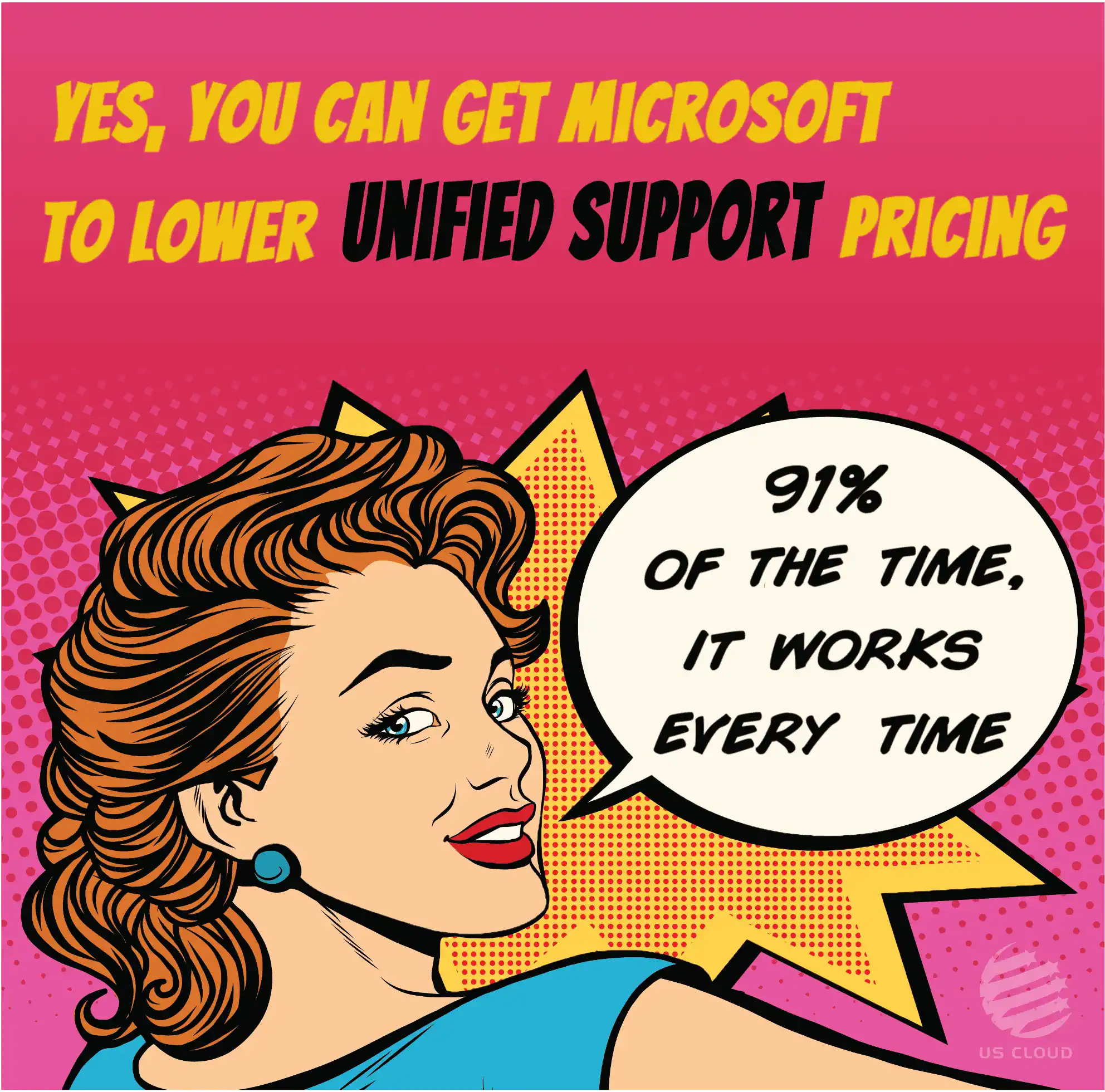
- Test the savings opportunity against comparable coverage. US Cloud advertises 30% to 50% savings versus Microsoft Unified Support; an individual company’s result depends on its baseline, requirements, and proposed agreement.
- Calculate net recurring savings before claiming EBITDA improvement. Include retained services, additional capacity, and incremental operating costs. Separate first-year transition expenses from the ongoing run rate.
- Protect the operating company while improving portfolio economics. Validate engineering coverage, incident ownership, escalation arrangements, security requirements, and transition readiness before approving a change.
- Apply valuation multiples only to sustainable earnings improvements. Illustrative enterprise value increases are not guaranteed exit proceeds or immediate equity gains.
- Act before the next renewal commitment. Request a scoped comparison while the buying committee still has time to make and defend a choice.
Challenge the Support Default
Microsoft support cost reduction belongs in the private equity value creation plan because support is both an operating expense and a business continuity decision. It should have an accountable owner, a measurable service standard, and a price the company can explain.
The structural problem begins when those questions stop being asked. A portfolio company depends on Microsoft technology. Its leadership then assumes that buying support directly from Microsoft is the natural extension of that dependency. Over time, the renewal becomes an administrative event rather than a sourcing decision.
That assumption deserves a challenge. Choosing the software platform and choosing the organization that handles day-to-day technical support are different decisions. They require coordination, but they should not be collapsed into one automatic approval.
For a PE operating partner, the first question is whether the current arrangement earns its budget. How much does it cost? Which services does the business use? What happens when a production issue crosses technologies or vendors? How much work does internal IT still perform to keep a case moving?
Those questions change the conversation. Finance gets a clearer view of value. IT gets an opportunity to define the service experience it needs. Procurement gets criteria for a credible comparison.
Across a portfolio, repeat that discipline. A familiar vendor name should never exempt a material expense from review. If Unified remains the strongest option for a particular company, the evidence should make that clear. If an independent provider offers a stronger combination of cost and service, the company should have a practical path to choose it.
Examine What Drives the Bill
A meaningful Microsoft Unified Support cost review starts with the pricing basis in each company’s actual proposal. When support pricing is tied to eligible Microsoft spending, technology investment can influence the support bill even when support demand does not rise at the same pace.
The commercial question is whether growth in the Microsoft estate produces proportional value from the support agreement. More Azure consumption, additional subscriptions, or an acquisition may expand the business’s technology footprint. That does not, by itself, establish the right price for the support services it needs.
Ask procurement to show how the renewal quote was calculated. Identify the spending categories included, applicable rates or tiers, minimum commitments, adjustments, and any separately priced services. Avoid applying one generic percentage to every company in the portfolio. The contract and quote are the basis for the comparison.
Then compare the economics with actual demand. Review incident volume, severity, engineering effort, proactive work consumed, and the internal time spent coordinating support. Ticket count alone is inadequate. Ten difficult production incidents can require more expertise than a much larger number of routine requests.
An independent model creates another way to purchase that expertise. US Cloud describes an hours-based approach that lets customers purchase support capacity and add hours as needed. That makes capacity planning and consumption visibility important parts of the evaluation.
Neither a percentage-based model nor an hours-based model should escape scrutiny. Ask how each behaves when the company acquires a business, experiences an incident surge, or changes its technology footprint. Budget predictability comes from clear terms and credible assumptions.
Build a Defensible EBITDA Case
Microsoft support savings can improve EBITDA when they reduce expenses included in that measure and are not offset by new operating costs. EBITDA means earnings before interest, taxes, depreciation, and amortization. The finance team should determine how the proposed change affects its reported and adjusted measures.
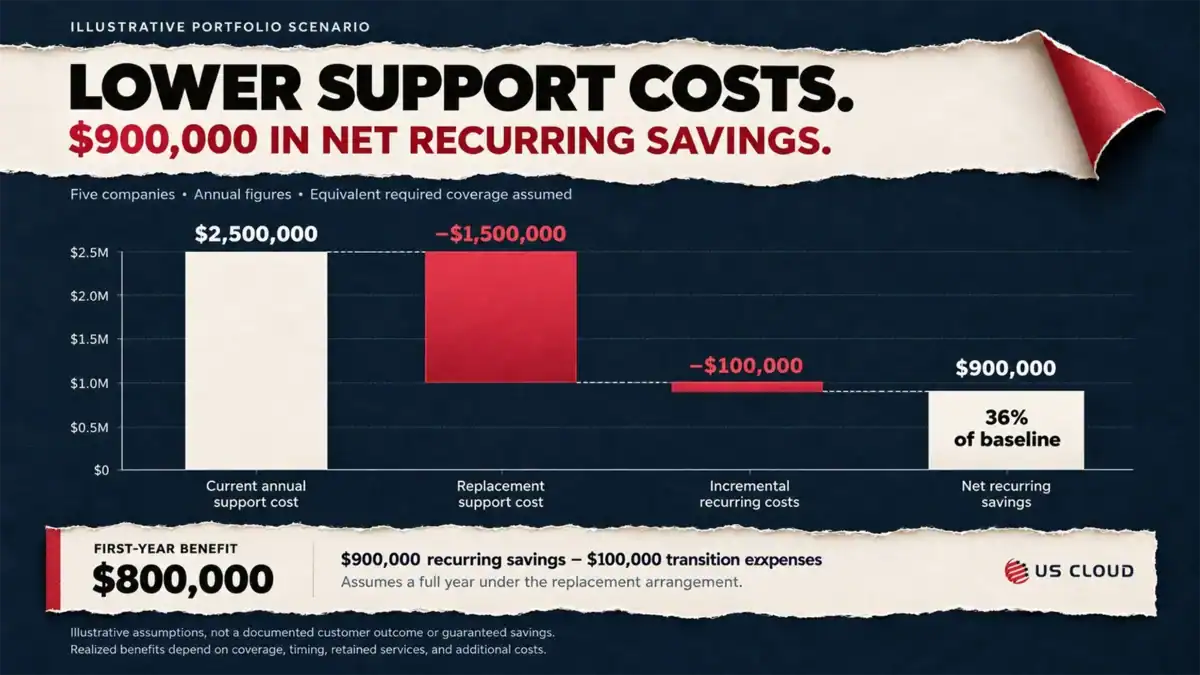
Start with a simple operating model: comparable current annual support cost minus replacement support cost minus incremental recurring costs equals net recurring savings. Model one-time expenses separately. This keeps the business case tied to what the company can retain.
Consider an illustrative portfolio of five companies with combined annual support spending of $2.5 million. Assume equivalent required coverage is available for $1.5 million, with another $100,000 annually for retained services or incremental operating needs. The result is $900,000 in net recurring savings, or 36% of the original support baseline.
If transition expenses total $100,000 and the new arrangement operates for a full year, the illustrative first-year benefit falls to $800,000. A later start date, overlapping agreements, or cancellation restrictions would change that result. None of these figures represents a documented customer outcome.
A simplified valuation sensitivity shows why recurring savings attract operating partners’ attention:
The $9 million figure assumes buyers recognize the full recurring benefit and the valuation multiple remains unchanged. It is an illustrative enterprise value effect, not a guaranteed sale price or equity distribution. Debt, cash, transaction terms, taxes, and other factors influence equity proceeds. For separate portfolio companies, evaluate each company’s savings at its own relevant multiple before aggregating the results.
Keep reinvestment explicit. If the company redirects all support savings into additional expensed operating initiatives, those dollars may create strategic value without increasing EBITDA by the same amount. Similarly, reduced ticket-chasing time creates capacity; it becomes a hard-dollar saving only when associated spending is avoided or reduced.
A defensible model is more persuasive than an inflated headline. It tells the investment committee what changes, when the benefit starts, and what must remain true for the savings to endure.
Protect the Operating Company
A cheaper support agreement fails the value creation test if it leaves the company with weaker coverage or greater internal burden. The CIO must be able to defend the service model with the same confidence the CFO brings to the economics.
Start with the actual Microsoft environment. Confirm coverage for the workloads and dependencies that matter to the business, including cloud, identity, collaboration, databases, and hybrid systems where applicable. Map exclusions and identify any services that must remain with Microsoft or another provider.
Next, examine accountability. The most useful support comparison follows a difficult incident from intake through resolution. Who engages first? When does the company reach an engineer qualified to investigate? Who coordinates other vendors? Who communicates with the internal team when the issue remains open?
A response commitment answers only part of that question. It is not a promise that service will be restored within the same period. Compare time to qualified expertise, escalation ownership, communication cadence, and total time to resolution alongside the initial response standard.
Microsoft escalation also needs a documented route. Identify the applicable entitlement, the party that opens and manages the case, any additional costs, and responsibilities while Microsoft works on its portion of the issue. An independent provider’s operational assistance should not be confused with control over Microsoft’s product fixes or cloud infrastructure.
Security validation must match each company’s environment. Review access controls, data handling, engineering locations, relevant assurance reports, and contractual obligations. A staffing-location claim alone does not establish compliance with every regulatory requirement.
This is how PE firms protect the value they intend to create. Require operational evidence before counting the savings. Include the IT director and security team early enough that their questions shape the proposal instead of becoming late-stage objections.
Scale Portfolio Buying Power
Portfolio-wide Microsoft support sourcing should standardize evaluation while preserving accountability at each operating company. That is where an operating partner can add value beyond a single negotiation.
Build a common view of renewal dates, support costs, covered workloads, service requirements, and decision owners. The exercise exposes where contracts can be benchmarked now and where a later renewal creates a better transition opportunity.
A shared evaluation framework also prevents inconsistent comparisons. Every company should examine the same core categories: scope, expertise, response commitments, escalation, security, pricing, and transition responsibilities. Local requirements then determine which additional questions need answers.
Ask prospective providers whether a portfolio framework or master services agreement can simplify purchasing. Confirm which entities can participate, how orders are executed, how pricing is determined, and who remains responsible for payment and service governance. Any volume discounts, shared capacity, rollover provisions, or onboarding terms belong in the agreement. Do not assume they exist because companies share a sponsor.
The same discipline matters during acquisitions and divestitures. A new portfolio company may have different tenants, contractual restrictions, or security obligations. A departing company may need to retain support under separate terms. Address those situations before they create a service or financial dispute.
Start with the companies where the opportunity is both material and actionable. High support spend, an approaching renewal, clear internal sponsorship, and documented service needs make a stronger starting point than a portfolio-wide deadline imposed without context.
The strategic benefit is repeatability. Each review improves the sponsor’s understanding of support economics and makes the next company’s evaluation more informed. Buying power becomes more useful when it is supported by a consistent standard of evidence.
Make Support Earn Its Budget
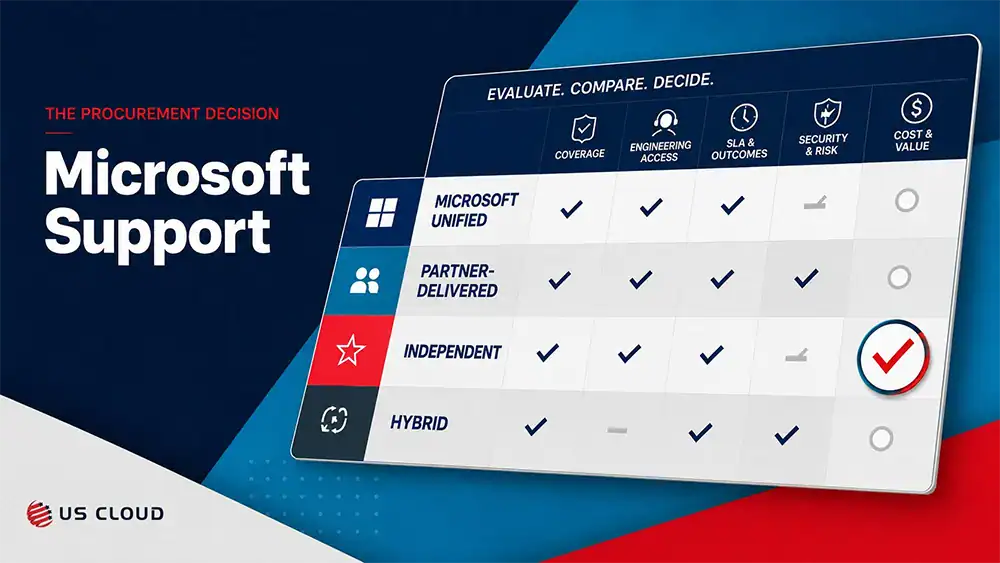
Microsoft support should compete for its place in the portfolio’s operating budget. The right test combines price, coverage, accountability, and continuity. Every renewal approved without that test leaves a material business decision insufficiently examined.
US Cloud is an independent third-party provider of Microsoft enterprise support serving organizations that include Fortune 500 and Global 2000 companies. We give buyers an alternative to evaluate against their current Unified arrangement. Put that alternative through the same scrutiny you would apply to any provider responsible for business-critical systems.
Before the next renewal is approved, bring the relevant portfolio CFOs, IT leaders, and procurement owners into a support cost review. Start with annual spending, renewal dates, covered workloads, and recent support history. Use those inputs to request a comparable proposal and test the potential net savings.
Book a call with US Cloud to review your portfolio’s Microsoft support costs and request a scoped replacement quote. Ask for the coverage comparison, commercial assumptions, and transition requirements your committee needs to make the decision.
Make the next renewal a deliberate investment decision. Put a credible alternative on the table before the budget is committed.
Use Q4 to Secure the Decision
Q4 is the time to make next year’s support costs visible before they become approved commitments. The objective is a decision the business can execute, with sufficient evidence for Finance, IT, Procurement, and the sponsor.
For companies roughly six months from renewal, establish the baseline and launch the comparison now. Define the required service outcomes, collect support history, and identify the approval steps. That preparation preserves room to negotiate and investigate alternatives.
For companies four weeks from renewal, concentrate on the unresolved decision requirements. A useful package includes the scoped quote, coverage comparison, service commitments, security evidence, relevant references, and transition responsibilities. Assign owners and dates to remaining questions.
For companies two weeks from renewal, determine whether the necessary reviews and implementation preparations can be completed responsibly. A competitive quote can still provide market context. It does not justify skipping an essential approval or assuming a transition will finish on an arbitrary timetable.
The first 100 days after an acquisition offer another natural review window. Put Microsoft support on the value creation agenda alongside other recurring expenses. Establish the opportunity and decision path even if the existing contract means financial benefits will begin later.
After a change, track the results at company level. Compare actual spending with the approved baseline, monitor support consumption and service outcomes, and reconcile any additional costs. Finance should validate the savings; IT should validate that the operating model performs as expected.
This turns support sourcing into a governed value creation initiative. The board sees more than a proposed discount. It sees an accountable decision, an implementation plan, and a way to verify the outcome.
Private Equity Support FAQs
Can Microsoft support savings improve EBITDA
Yes, when lower support spending reduces expenses included in EBITDA and is not offset by other operating costs. Calculate net recurring savings, distinguish one-time transition expenses, and account for when the change takes effect. A vendor discount alone is not the same as a realized earnings improvement.
How much can a portfolio company save
US Cloud advertises 30% to 50% savings versus Microsoft Unified Support. [1] Use that range to frame an evaluation, then build the business case from a scoped quote. Coverage, capacity, retained services, and transition costs determine the company’s net benefit.
Does changing support mean replacing Microsoft
The proposed change concerns who delivers technical support for the company’s Microsoft environment. It does not require a platform replacement. Review the company’s licensing, support entitlements, dependencies, and commercial arrangements individually before making claims about their treatment following a support change.
Can several portfolio companies use one agreement
Ask the provider to propose a structure for the participating legal entities. A common framework may simplify purchasing, but entity participation, ordering, pricing, capacity allocation, and divestiture provisions must be negotiated and documented. Shared ownership does not automatically establish shared contractual rights.
How quickly can savings begin
Savings begin when costs are removed or reduced under the applicable agreements. Renewal dates, notice requirements, overlapping coverage, approvals, and onboarding readiness determine timing. A first-100-days evaluation can identify the opportunity without implying every company can realize a full-year benefit immediately.
Should the sponsor require every company to switch
The sponsor should require a defensible evaluation. Each operating company still needs a support model that fits its environment and risks. Standardize the evidence required for a decision, then choose the provider and timing that satisfy the company’s financial and operational requirements.