
마이크로소프트 라이선싱 지원
마이크로소프트 AI 지원
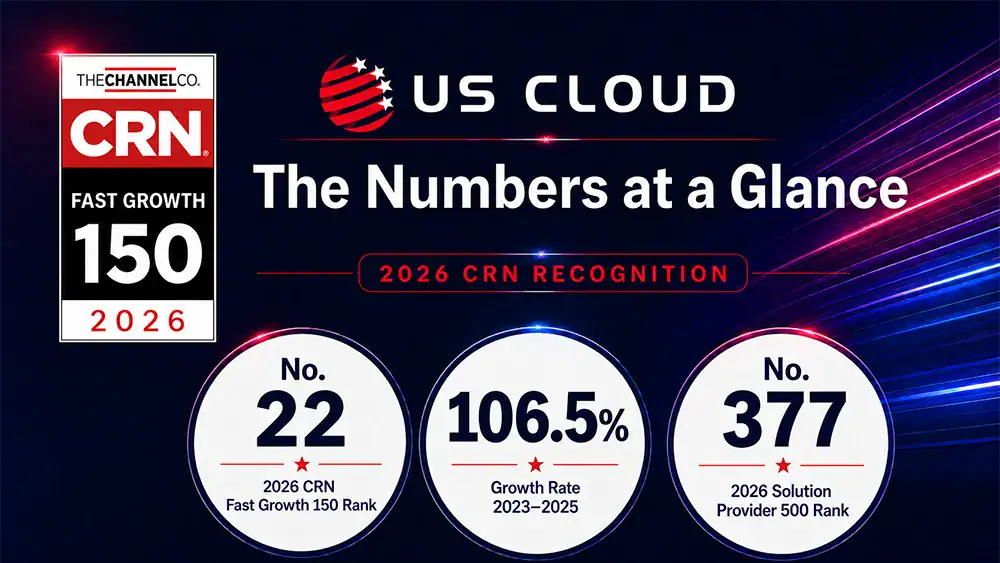
US Cloud Ranks No. 22 on CRN’s 2026 Fast Growth 150 List.


요약
US Cloud earned two 2026 CRN growth recognitions: No. 22 on the Fast Growth 150 and No. 16 on the Solution Provider 500 Fast Growth list after posting 106.5% growth from 2023 through 2025. US Cloud also ranks No. 377 on CRN’s broader 2026 Solution Provider 500, which recognizes leading North American solution providers by revenue.
For enterprise technology and finance leaders, I think the more useful story is what sits behind those numbers:
- No. 22 on the 2026 CRN Fast Growth 150 list, recognizing 150 of North America’s highest-performing and fastest-growing solution providers.
- No. 16 on the 2026 CRN Solution Provider 500 Fast Growth list, with 106.5% growth from 2023–2025.
- US Cloud also ranks No. 377 on CRN’s broader 2026 Solution Provider 500, which recognizes leading North American solution providers by revenue.
- One of the biggest challenges we told CRN we are seeing from customers is straightforward: AI initiatives without additional IT budget.
- US Cloud is responding by expanding areas such as Microsoft software licensing optimization, Copilot training, and Copilot consulting, alongside its core Microsoft enterprise support capabilities.
- The financial lesson is bigger than the ranking: enterprises increasingly need to find savings inside their existing Microsoft estate if they want to fund AI, cloud, security, and modernization without allowing technology costs to expand unchecked.
Growth is a useful signal. It is not a substitute for a business case. The numbers matter most when we can connect them to the financial problems enterprises are trying to solve.
The Story Behind the Rankings
The newest recognition places US Cloud No. 22 on the 2026 CRN Fast Growth 150 list. CRN says the honorees achieved notable sales growth over the previous two years. Separately, CRN reports that US Cloud grew 106.5% from 2023 through 2025, placing us No. 16 on its 2026 Solution Provider 500 Fast Growth list. US Cloud also ranks No. 377 on CRN’s broader 2026 Solution Provider 500.
The three rankings provide different signals. The broader Solution Provider 500 is fundamentally a measure of scale. The Solution Provider 500 Fast Growth ranking adds velocity within that established cohort. The Fast Growth 150 recognizes high-growth technology integrators, value-added resellers, managed service providers, and IT consultants across North America.
Scale plus growth is worth recognizing. But from my perspective, the more interesting question is not, “How fast did US Cloud grow?” It is, “What are enterprises buying more of, and why?”
That gets us much closer to what the ranking really means for a CIO, CFO, procurement leader, or technology team making decisions about Microsoft. Enterprise technology budgets are being asked to do more at the same time. Organizations are expanding AI. Azure continues to grow in strategic importance. Microsoft 365 is deeply embedded across the workforce. Security and identity requirements keep evolving. Licensing decisions are becoming more complicated. And every new capability creates another cost that Finance eventually has to absorb.
The old answer—add another line to the IT budget—is getting harder to defend. That is why I see our CRN Fast Growth 150 recognition as part of a broader shift toward Microsoft investment optimization.
What Is the Fast Growth 150?
The annual CRN Fast Growth 150 highlights top-performing and fastest-growing technology solution providers in North America. The 2026 list recognizes 150 technology integrators, value-added resellers, managed service providers, and IT consultants that achieved notable sales growth over the previous two years.
CRN has framed this year’s Fast Growth 150 around a changing technology market, particularly the rapid expansion of AI. The Channel Company says the honorees’ business acceleration reflects future-focused strategies and advanced technology expertise, especially across artificial intelligence, security, and cloud computing.
That context matters. AI is creating opportunity, but it is also creating a financial constraint. Enterprises rarely receive a blank check because a new technology becomes important. More often, technology leaders are told to identify how they will fund the next priority inside an already substantial IT portfolio.
That is exactly the problem we are seeing. In information we provided for CRN’s 2026 profile, we identified “AI initiatives without IT budget” as the biggest new customer challenge we have seen emerge over the past year. We also identified Microsoft Copilot training and consulting as an area where we are building our AI services business and Microsoft software licensing optimization services as a significant change to our business model.
Put those three answers together, and the growth story becomes much clearer. Enterprises want AI. They need expertise to deploy and adopt it. But they also need to find the money.
What Is the Solution Provider 500?
The CRN Solution Provider 500 is an annual ranking of leading technology integrators, service providers, and IT consulting organizations in North America. Ranked by services revenue, the list gives buyers a view of provider scale. US Cloud ranks No. 377 on the 2026 Solution Provider 500.
CRN’s separate Solution Provider 500 Fast Growth ranking adds a growth lens to that established cohort. US Cloud ranks No. 16 on the 2026 list after recording 106.5% growth from 2023 through 2025.
US Cloud was also named to CRN’s Solution Provider 500 in 2025. That recognition established US Cloud among the significant North American technology solution providers measured by CRN and reinforced the company’s ability to operate at enterprise scale.
The three 2026 CRN distinctions answer different questions. The broader Solution Provider 500 signals scale. The Solution Provider 500 Fast Growth ranking measures recent velocity within that established cohort. The Fast Growth 150 recognizes high-growth technology providers across the North American channel.
That is an important distinction because an enterprise should never evaluate a provider using only one dimension. A company can grow quickly without having meaningful scale. Another can have significant revenue but little momentum. The combination gives buyers another data point when they are assessing whether a provider is responding successfully to changes in customer demand.
It is also why this recognition should not simply repeat the story of US Cloud’s 2026 Inc. 5000 recognition. Our Inc. 5000 recognition measures a different period and a different peer group: US Cloud ranked No. 2,021 among America’s fastest-growing private companies after recording 169% three-year revenue growth. That article appropriately focuses on sustained organizational growth, scale, and staying power.
CRN gives us a more technology-specific lens. The Fast Growth 150 and Solution Provider 500 Fast Growth rankings examine how rapidly technology solution providers are growing while the underlying market is being reshaped by AI, cloud, services, and changing customer requirements.
For me, that creates a more useful conversation about where enterprise technology dollars are moving.
Why Are Enterprises Looking for More Value From Their Microsoft Spend?
Microsoft is not a single line item inside most large organizations. It is an economic system. There is Microsoft 365 licensing. Azure consumption. Security. Identity. Data. Copilot. Power Platform. Technical support. Consulting. Migration work. Training. Adoption programs. Additional AI consumption. And the internal labor required to manage all of it.
US Cloud’s enterprise services now span support, consulting, licensing, migration, security, and cloud cost optimization. That expansion reflects what buyers increasingly need: not another isolated technology service, but a clearer way to understand whether their total Microsoft investment is producing the value they expected.
This is where Finance and IT need the same baseline. Before adding another Microsoft expense, I would want to know what the organization is already spending, what is actually being used, what can be optimized, what is contractually fixed, and which dollars can realistically be redirected.
That is especially important with AI. If an organization wants to fund Copilot but receives no incremental AI budget, the problem becomes a capital-allocation exercise. The money has to come from somewhere. That might mean eliminating unused licensing. It might mean improving Azure cost governance. It might mean restructuring support economics. It might mean avoiding a blanket Copilot deployment in favor of a phased rollout tied to adoption.
Usually, the answer is a combination. The goal is not indiscriminate cost cutting. The goal is to remove low-value spend so the organization can fund higher-value work.
Microsoft Licensing Optimization Is Becoming a Funding Strategy
One reason we identified Microsoft software licensing optimization as an important change in our business is that licensing can no longer be treated simply as a procurement event. It is becoming part of technology portfolio management. Every unused license represents budget that cannot be spent somewhere else. Every unnecessarily high service tier creates the same problem. So does buying capacity ahead of actual demand.
Individually, those decisions can look small compared with an enterprise technology budget. At scale, they compound. This is why I prefer to evaluate Microsoft spend using a current-state versus future-state model.
The current state should show what the enterprise is paying today across the major Microsoft cost categories and what business value it receives. The future state should show what changes after optimization: the licenses removed or right-sized, support expense changed, cloud costs reduced, services consolidated, or adoption increased.
The difference is not automatically “savings.” Some of it may become savings. Some may be reinvested. That distinction matters.
If a company reduces a Microsoft cost by $1 million and then deploys the entire $1 million into an AI program, Finance did not reduce total IT spending. But the organization may have substantially improved the return produced by that same budget. That is a very different—and often more strategic—financial outcome.
The Copilot Business Case Does Not End With the License
The same discipline should apply to Microsoft Copilot. Buying a license is easy to measure. Realizing value from it is harder.
US Cloud’s Copilot consulting work focuses on areas including use-case evaluation, implementation, adoption, workflow alignment, training, and ongoing optimization. Those steps matter financially because the cost of an unused AI license is obvious. The cost of a lightly used license is less obvious but can be just as important.
If 10,000 employees receive a technology and only a fraction incorporate it meaningfully into their day-to-day work, the organization does not have an AI deployment problem. It has a return-on-investment problem. Finance should therefore connect AI licensing decisions with adoption metrics.
- How many licensed users are active?
- Which roles use Copilot consistently?
- Which workflows have actually changed?
- Where is measurable time being saved?
- Which use cases justify expanding the deployment?
Those are the questions that turn AI from an expenditure into an investment thesis. CRN’s broader analysis of its 2026 Fast Growth companies makes a similar market-level point: AI is requiring solution providers to develop new skills and services because customers increasingly need help moving beyond experimentation toward business value.
That is where the market is heading, and it is an important part of where US Cloud is investing.
Microsoft Support Should Be Part of the Same Financial Model
Support should not sit outside this analysis. Microsoft support is an operating expense. It deserves the same financial scrutiny as licensing, cloud consumption, consulting, and AI. The question is not simply whether an alternative costs less. The question is whether the enterprise can change the cost without creating an unacceptable change in service quality, technical coverage, or risk.
At US Cloud, we guarantee at least 30% savings against a Microsoft Unified quote. From a financial perspective, that makes support a line item worth benchmarking. Suppose an enterprise can materially reduce support expense while still meeting its technical and operational requirements. Those dollars now have another potential use.
- They can remain as OpEx savings.
- They can help offset a Microsoft licensing increase.
- They can help pay for Copilot.
- They can fund an Azure initiative.
- They can be invested in security.
What matters is that the organization makes the decision intentionally. Support spend should be measured by business value, not by the assumption that last year’s model automatically belongs in next year’s budget.
A Better Way to Build the Microsoft Business Case
When I evaluate Microsoft economics, I want the business case to fit on one page before anyone builds a 30-tab spreadsheet.
- Start with the baseline: what are we spending today?
- Then identify recoverable spend: where are we paying for capacity, licensing, services, support, or cloud resources that are not producing sufficient value?
- Next calculate redeployable budget: if we optimize those costs, how much cash can realistically be directed toward higher priorities?
- Finally, define realized value: what financial or operational outcome must the new investment deliver to justify that reallocation?
That sequence prevents a common mistake. Enterprises often start by asking, “How much will AI cost us?” I would add another question: “What existing technology spend can we make work harder before we expand the budget?”
How much will AI cost us? What existing technology spend can we make work harder before we expand the budget?
That is not an anti-investment position. It is disciplined capital allocation. And it is increasingly important as the Microsoft environment expands.
What Fast Growth Means
A ranking should never make a sourcing decision for you. US Cloud’s No. 22 Fast Growth 150 ranking—and its No. 16 Solution Provider 500 Fast Growth ranking—do not prove that we are automatically the right provider for every Microsoft environment. A 106.5% growth rate does not prove an individual customer’s ROI. And an award does not replace technical validation, financial modeling, reference checks, security reviews, or a detailed evaluation of service requirements.
That is exactly how I would want a finance or procurement team to approach the recognitions. Treat them as evidence, not a conclusion. Together, CRN’s rankings show that US Cloud has achieved meaningful scale within the North American technology channel while also recording substantial recent growth.
- Then pressure-test the model.
- Compare the economics.
- Validate the assumptions.
- Determine what you are paying today.
- Identify what changes under an alternative.
- Quantify the savings.
- Account for transition costs.
- Define the service requirements that cannot be compromised.
- And determine what you will do with any budget you recover.
If the business case survives that process, then you have something worth acting on.
Growth Creates More Opportunity to Reinvest
From inside US Cloud, I see the CRN recognitions as validation of a market need we have been watching develop for years. Enterprise organizations want more control over Microsoft economics. That started with support. It increasingly extends into licensing, cloud optimization, proactive consulting, and AI. Our responsibility is to make sure growth translates into stronger capabilities in those areas rather than simply a larger organization.
That means continuing to invest in the expertise required to help clients evaluate Microsoft spending quantitatively. It means helping enterprises deploy technologies such as Copilot with a clear adoption strategy. It means developing services that identify unnecessary cost before renewal. And it means continuing to give companies a credible alternative when they evaluate Microsoft Unified Support.
Growth is useful when it creates more capacity to solve those problems. Everything else is just a number.
자주 묻는 질문
What is US Cloud’s ranking on the 2026 CRN Fast Growth 150 list?
US Cloud ranks No. 22 on the 2026 CRN Fast Growth 150 list. The recognition places US Cloud among North America’s highest-performing and fastest-growing technology solution providers.
What is the CRN Fast Growth 150 list?
The annual CRN Fast Growth 150 recognizes 150 technology integrators, value-added resellers, managed service providers, and IT consultants in North America that achieved notable sales growth over the previous two years.
What is US Cloud’s 2026 CRN Solution Provider 500 ranking?
CRN materials provided to US Cloud identify the company as No. 377 on the 2026 Solution Provider 500. The Solution Provider 500 Fast Growth ranking separately places US Cloud No. 16 based on 106.5% growth from 2023 through 2025. The broader Fast Growth 150 ranks US Cloud No. 22.
Why is US Cloud growing?
CRN’s company profile provides several useful indicators of current customer demand. US Cloud identified AI projects without incremental IT budget as a major emerging customer challenge, Microsoft Copilot training and consulting as an area of AI services expansion, and Microsoft software licensing optimization as a significant recent business-model development.
Those priorities reflect a larger enterprise requirement: organizations need to optimize their existing Microsoft investment while finding ways to fund AI and other new initiatives.
How is the CRN recognition different from US Cloud’s Inc. 5000 recognition?
The rankings measure different things. US Cloud’s 2026 Inc. 5000 recognition is based on three-year revenue growth among eligible privately held U.S. companies; US Cloud ranked No. 2,021 with 169% three-year growth.
CRN’s Fast Growth 150 focuses on two-year sales growth among leading North American technology solution providers. Its Solution Provider 500 Fast Growth ranking examines growth within the Solution Provider 500 cohort. The Inc. 5000 spans eligible privately held U.S. companies across industries, so the recognitions provide different views of US Cloud’s growth.
What services does US Cloud provide for enterprise Microsoft customers?
US Cloud provides enterprise Microsoft services that include independent Microsoft support as an alternative to Microsoft Unified Support, consulting, licensing optimization, migration services, security services, cloud cost optimization, and Microsoft Copilot consulting.
Turn Microsoft Cost Optimization Into an Investment Strategy
I appreciate CRN recognizing US Cloud No. 22 on the 2026 Fast Growth 150 and among the fastest-growing companies on the 2026 Solution Provider 500. But I would not ask an enterprise to choose us because of a ranking. I would ask them to run the numbers.
If your organization is preparing for a Microsoft renewal, expanding Copilot, reviewing licensing, evaluating Microsoft Unified Support, or trying to fund new AI initiatives without materially expanding the IT budget, establish the baseline first.
Understand what you spend today. Determine where value is being realized. Identify what can be optimized. Then decide where the recovered dollars can produce a better return.
The goal is to make every Microsoft dollar work harder. Talk with US Cloud to benchmark Microsoft costs and redirect budget toward higher-value technology priorities.