
기업용 Microsoft 지원
마이크로소프트 제3자 지원
Microsoft Support Procurement: How to Prepare Before Q4.

How Procurement Should Evaluate Microsoft Support Before Q4
Q3 gives procurement teams valuable time to prepare before renewal pressure builds. If Microsoft support renews in Q4 or early next year, use this window to benchmark costs, define RFP requirements, review contract timing, and evaluate alternatives.
Microsoft support is often treated as part of the broader Microsoft relationship, but licensing, Azure, Copilot, AI, and enterprise support are separate sourcing decisions. That distinction is becoming more important. Gartner projects third-party providers could represent 25% of the Microsoft support market by year-end 2028, up from 15% in 2023, and reported that roughly 80% of recent Microsoft support inquiries involved dissatisfaction with price, quality, or both.
That does not mean every enterprise should leave Microsoft Unified Support. It means procurement should make renewal a decision, not an assumption.
요약
Procurement should evaluate Microsoft support independently before renewal enters its final stages. A defensible Microsoft support procurement process should:
- Establish the current cost and service baseline.
- Define future Microsoft requirements.
- Compare providers against identical criteria.
- Validate engineering and escalation capabilities.
- Review security and entitlement risk.
- Model three-to-five-year economics.
- Require references and evidence before approval.
Organize the process into five steps: assess fit, issue an RFP, analyze risk, check references, and run a proof of concept where appropriate. The objective is not simply a lower quote. It is a sourcing decision leadership can defend.
Why Evaluate Microsoft Support?
Microsoft product adoption and Microsoft support-provider selection solve different problems. The product decision determines which technology the enterprise uses. The support decision determines who provides engineering expertise, manages critical incidents, owns escalation, measures service performance, and remains accountable when something goes wrong.
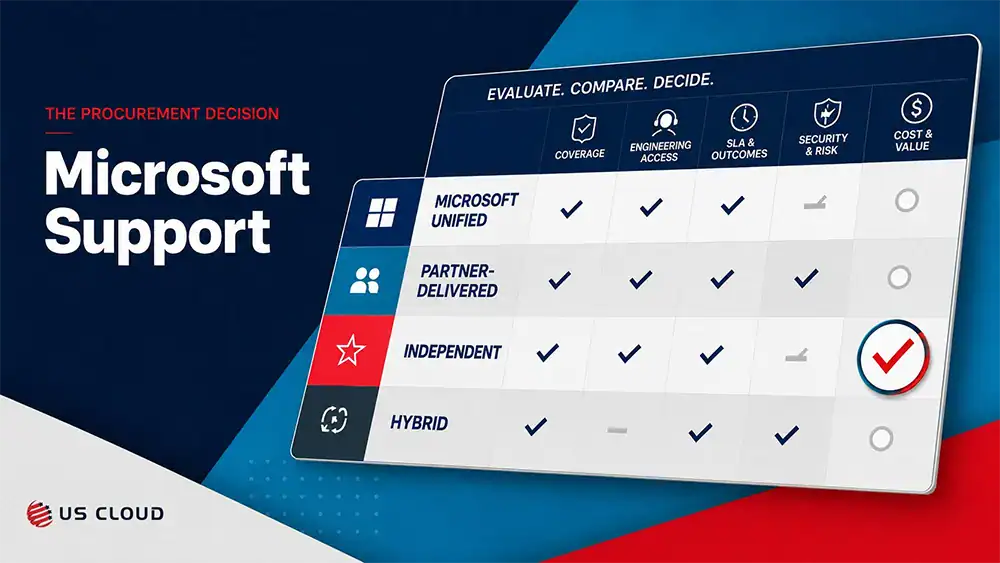
Microsoft Unified Support may still win that evaluation. Procurement should establish why rather than allowing incumbent status to answer the question automatically. Compare Microsoft Unified, partner-delivered, independent, and hybrid support against the same enterprise requirements. Gartner similarly recommends proactively evaluating alternative providers and estimates credible third-party options may save 30% to 60% versus Microsoft direct support, depending on the organization and required services.
Forrester also identifies commercial flexibility, cost control, and negotiation leverage among the reasons enterprises consider independent software support. Benchmark first. Decide second.
Build Your Support Baseline
A support-provider comparison should begin with your own data, not a sales presentation. Document the current agreement, renewal and notice dates, annual fee, pricing structure, covered workloads, exclusions, severity definitions, escalation rights, supplemental fees, and 12–24 months of incident history. Also identify the hidden operational cost. How much time does your IT team spend routing cases, collecting logs, repeating technical context, coordinating multiple vendors, requesting updates, or pushing stalled escalations forward?
That labor belongs in the baseline. Procurement should also understand current Microsoft Unified Support pricing before trying to compare proposals or model renewal alternatives.
Asset visibility is equally important. Flexera’s 2026 ITAM research highlights persistent challenges around visibility, software spend, licensing, cloud services, and governance. If procurement does not know what is deployed, entitled, covered, and business-critical, writing a precise support RFP becomes much harder.
Buyer takeaway: You cannot benchmark Microsoft support accurately until you know what the enterprise pays for, uses, and manages internally.
Plan for Future Microsoft Needs
Do not evaluate support only against today’s Microsoft environment. A multi-year agreement should reflect what the enterprise expects to operate during the contract term.
That could include Azure expansion, Microsoft Fabric, Copilot, Power Platform, Entra ID, Defender, Sentinel, Purview, Intune, Dynamics 365, hybrid infrastructure, data modernization, AI workloads, acquisitions, divestitures, or legacy-system retirement.
A single incident may cross several of those platforms. An Azure problem could ultimately involve identity, networking, SQL Server, security, Microsoft 365, endpoints, or a third-party application.
That makes “we support Azure” an incomplete answer. ISG’s 2026 Microsoft AI and Cloud Ecosystem research illustrates how Microsoft environments increasingly span productivity, business applications, Azure managed services, professional services, data, and AI. As Microsoft AI adoption expands, procurement should evaluate whether the support model can keep pace with the future environment, not simply today’s order form.
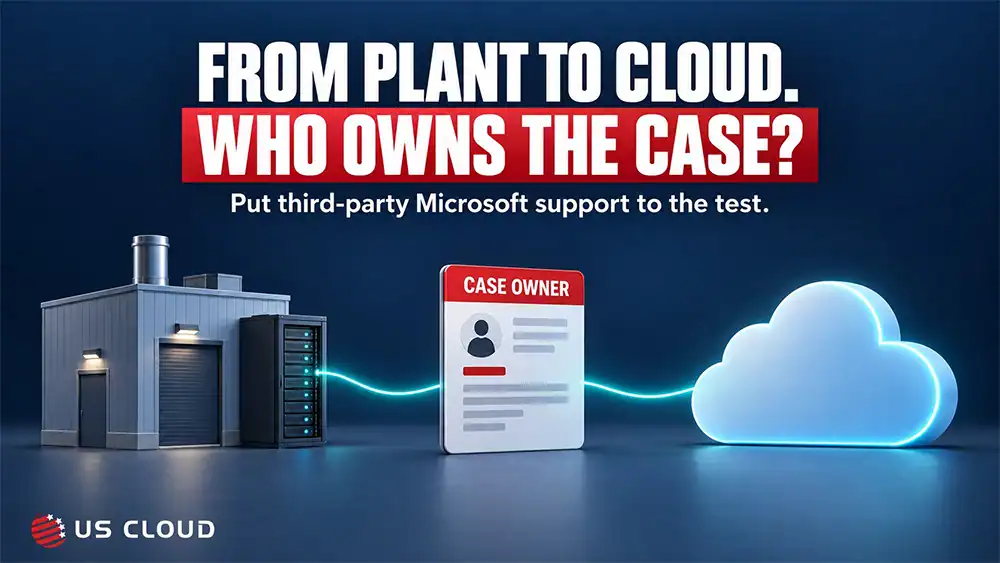
Who Owns Microsoft Escalations?
Fast initial response does not tell procurement who owns a critical incident after the first handoff. A case may move from a service desk to an engineer, between technical teams, and eventually to Microsoft.
Who owns the outcome throughout that process?
Require providers to document L2/L3/L4 and architect access, critical-incident resources, employee versus contractor delivery, Microsoft-only scenarios, escalation mechanisms, additional charges, and ownership after Microsoft becomes involved.
The goal should be simple: technical work can move without accountability moving back to the customer. This is especially important when internal resources are already constrained. HDI’s State of Service Management in 2026 found that 63% of surveyed organizations described themselves as understaffed.
Procurement teams that need additional context can review how Microsoft escalation management works and what should be defined during provider evaluation.
Measure Microsoft Support SLAs
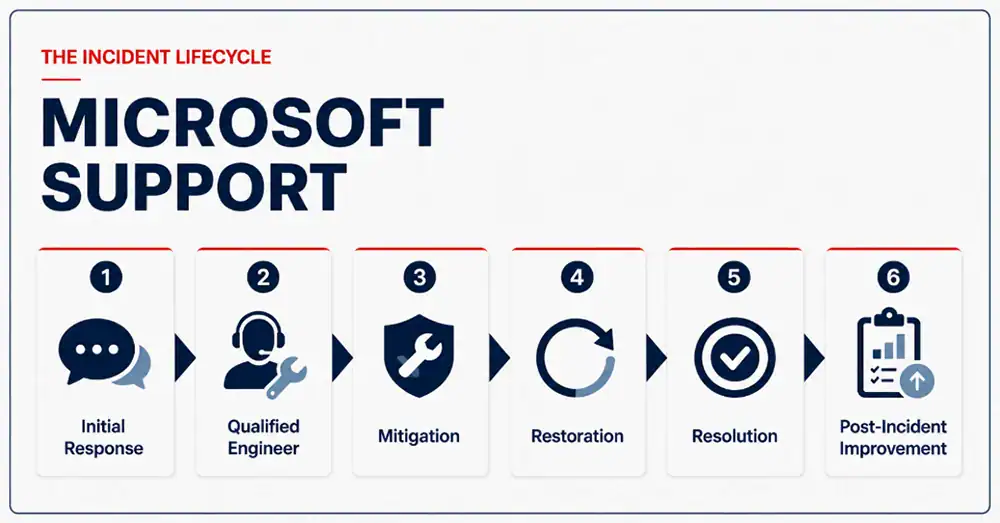
A 15-minute response SLA can sound impressive. But what happens in minute 16? Procurement should evaluate the entire support lifecycle:
Initial response measures acknowledgment. Engineer engagement measures access to expertise. Mitigation and restoration show when business impact is reduced. Resolution addresses the underlying problem. Measure those stages separately rather than relying only on an initial-response SLA.
Business stakeholders should also define maximum tolerable downtime, user impact, regulatory exposure, communication requirements, and escalation thresholds. When comparing vendors, procurement can use response and resolution time as separate evaluation criteria instead of treating them as interchangeable.
Response tells you when someone answered. Restoration tells you when the business recovered.
Assess Supply Chain Risk
Microsoft support procurement is also a vendor-risk decision. Support providers may interact with remote sessions, diagnostic files, credentials, logs, ticketing platforms, configuration information, and sensitive architecture details. Verizon’s 2026 Data Breach Investigations Report found that 48% of breaches involved a third party, reinforcing the need to account for third-party dependencies in cybersecurity and operational resilience.
Procurement should evaluate:
- Privileged access and remote-support controls
- Data residency and retention
- Diagnostic-file handling
- Ticketing and collaboration platforms
- Subcontractors and fourth parties
- Security incident notification
- Vulnerability remediation
- Business continuity and disaster recovery
A useful RFP question is: Who else can touch our systems or data while delivering this service? That question should apply whether evaluating Microsoft, a partner, or an independent Microsoft support provider.
Review Microsoft Entitlements
Do not cancel first and investigate second. Changing the support model can affect operating assumptions around versions, downloads, product keys, portals, tools, documentation, escalation services, or other contractual benefits.
Procurement should bring legal, IT, and ITAM/SAM into the process to document what the enterprise retains, what changes, and what must be replaced. Review:
- Installed and entitled versions
- Updates and downloads
- Product keys and media
- Support-linked tools
- Portals and documentation
- Cancellation provisions
- Audit exposure
- Reinstatement implications
Forrester recommends feasibility analysis and careful review of technology strategy and risk before moving to independent support. A lower support fee does not create value if an overlooked contractual dependency creates cost somewhere else.
Model Microsoft Support Costs
First-year price is one number. Total support cost is another. Procurement should compare three-to-five-year economics across viable support paths, including:
- Base fees
- Annual increases
- Ticket or hour limitations
- 선제적 서비스
- After-hours charges
- Escalation costs
- Spend-linked pricing
- Internal labor
- Transition costs
- Exit or reinstatement exposure
Then compare four scenarios side by side:
- Renew Microsoft
- Renegotiate Microsoft
- Select an alternative
- Use a hybrid model.
The FinOps Foundation’s 2026 research shows FinOps expanding beyond public cloud toward SaaS, licensing, AI, data centers, and broader technology-value decisions. Its research also emphasizes influencing decisions before commitments are made, not only analyzing costs afterward. Gartner’s 30%–60% savings estimate makes benchmarking worthwhile, but that percentage should not become the business case by itself.
Ask one more question: What exactly is included in that number?
Build a Microsoft RFP
Every provider should answer the same requirements. Otherwise, procurement may end up comparing one vendor’s “premium support” with another’s “direct access,” even though those terms represent different capabilities. A Microsoft support RFP should normalize the comparison across:
- 업무량 커버리지
- Engineering access
- Microsoft escalation
- SLAs and reporting
- Security and privacy
- 가격 책정
- Contract terms
- 참고 문헌
- Proof of concept
- Transition and exit
Material claims should require material evidence. If senior engineers handle critical incidents, define senior. If Microsoft escalation is included, document how it works. If reporting is promised, request a sample. If services cost extra, make those charges visible.
Do not compare marketing language. Compare evidence against identical requirements.
Validate Microsoft Support Claims
A polished proposal tells you how a provider sells. References and a proof of concept tell you more about how it operates. Speak with at least three comparable customers and, where appropriate, conducting a 60–90-day POC across three to five representative workloads.
Include a critical incident, cross-workload issue, recurring problem, and scenario that may require Microsoft involvement. Measure:
- Time to qualified expertise
- Diagnostic quality
- 소유권
- 커뮤니케이션
- Microsoft escalation
- Documentation
- Customer effort
A Microsoft support proof of concept can help procurement validate those capabilities before making a broader commitment. References should answer similar questions: What happened when the relationship was genuinely tested?
Use Pass/Fail Gates First
Price should not compensate for a mandatory failure. A provider may score well on cost and account management but lack a required security control, 24/7 capability, or acceptable escalation process.
Establish pass/fail gates first. Examples include:
- Required workload coverage
- Acceptable security controls
- 24/7 critical engineering
- Defined Microsoft escalation
- Auditable SLA reporting
- Legal cancellation rights
- Acceptable exit terms
- Successful POC performance
Only providers that clear those gates should enter weighted scoring. Weighted scoring compares acceptable providers. It should not make an unacceptable provider look acceptable.
Prepare for Microsoft Support Q4
Q3 is not the time for manufactured urgency. It is the time to do the work that becomes harder once Q4 pressure starts.
Pull ticket history. Review the contract. Confirm notice dates. Inventory workloads. Map upcoming Azure, Copilot, security, data, and AI changes. Validate entitlements. Define business-impact requirements. Start benchmarking.
Begin the baseline 12–18 months before renewal when possible, followed by RFP development, validation, negotiation, and transition. If less time remains, compress the framework deliberately rather than skipping it. And if changing providers becomes the preferred path, understand the Microsoft support transition before the final contract is signed.
Do not arrive at the negotiation with only one fully understood option. That is where leverage disappears.
Make Microsoft Support Renewal a Decision
Microsoft may remain the right support provider. An independent provider may be a better fit. A partner-delivered or hybrid model may solve specific requirements better than either. The sourcing process should determine the answer.
The goal of competitive Microsoft support procurement is not change for its own sake. It is to establish which support model provides the strongest combination of cost, engineering capability, accountability, security, operational performance, commercial flexibility, and future-state fit.
The best outcome is knowing why the organization selected the provider it did and having the evidence to defend that decision.
Ready to evaluate your Microsoft renewal?
Frequently Asked Questions About Microsoft Support Procurement
Is Microsoft Unified Support required for enterprise Microsoft customers?
No, not as a general rule. Gartner’s Microsoft Product Support Services research states that organizations are not required to purchase Microsoft support in order to receive security fixes, product updates, or maintenance, although individual products, entitlements, contracts, and support requirements should always be validated for the specific environment.
When should procurement start evaluating Microsoft support alternatives?
Ideally, begin 12 to 18 months before renewal. That allows enough time to establish the baseline, confirm entitlements, issue an RFP, complete security and legal reviews, speak with references, conduct a POC where appropriate, negotiate, and plan transition.
What should be included in a Microsoft support RFP?
A Microsoft support RFP should cover workload and geographic coverage, service scope, engineering access, critical-incident ownership, Microsoft escalation, SLAs, reporting, security, privacy, pricing, contract terms, references, proof of concept, transition, and exit requirements. Every provider should answer the same requirements.
How should procurement compare Microsoft Unified Support with third-party support?
Use identical business, technical, financial, and risk criteria. Compare total cost, workload coverage, engineering depth, escalation ownership, operating performance, security, entitlements, contract flexibility, references, transition, and evidence—not simply the providers’ published packages.
What should a Microsoft support proof of concept test?
Test representative workloads and realistic incidents, including a critical problem, a cross-workload issue, a recurring case, and a scenario that could require Microsoft escalation. Evaluate engineering quality, response, restoration, ownership, communication, escalation, reporting, and customer effort. The procurement framework recommends a 60- to 90-day POC across three to five representative workloads where feasible.
Can evaluating third-party support help even if we ultimately renew with Microsoft?
Yes. A competitive process can establish market pricing, clarify requirements, expose contract gaps, document credible alternatives, and create negotiation leverage. Forrester specifically identifies alternative third-party support proposals as a source of leverage in negotiations with large software vendors.