
Microsoft-Support für Unternehmen
Microsoft-Support durch Drittanbieter
Microsoft Buyouts and Your Unified Support Renewal.

Microsoft’s voluntary exit offer gives enterprise buyers a reason to revisit a familiar decision: renewing Unified Support. Before approving another year, ask who will support your environment, how continuity will be maintained, and what your own case history shows. A renewal deserves more justification than familiarity.
Zusammenfassung
- Microsoft’s voluntary exit offer concerns eligibility; the number of employees who will leave remains unknown.
- The reviewed reporting does not establish a reduction in Unified Support staffing or performance.
- Buyers should verify engineering coverage, customer knowledge transfer, and responsibility for open cases.
- Compare initial response with service restoration, resolution, and the internal work required to get there.
- Request a scoped support comparison before renewal pressure limits your choices.
What Microsoft Announced
On October 26, 2026, Reuters reported that approximately 60,000 Microsoft employees were eligible for voluntary buyouts. Citing a source familiar with the matter, Reuters also reported that commercial business, marketing, and security units were excluded. Those details do not establish whether a particular Unified customer’s support team will change. The offer covers 27% of Microsoft’s reported June 30 global workforce. Microsoft employees in Windows, Copilot, AI-related functions, and other business units are eligible for the voluntary buyouts.
In Microsoft’s announcement, Chief People Officer Amy Coleman explained that participation varies with each organization’s priorities, customer commitments, and workforce needs. The company described a voluntary, time-limited program in participating teams across Canada, India, the United Kingdom, and the United States.
Microsoft employees eligible for the voluntary exit offer have until the first week of December 2026 to make their decision. Participants will leave December 31, according to GeekWire and CRN reports. The reported year-end departure date makes now a practical time to confirm support contacts, open-case ownership, and specialist coverage entering 2027.
Five Support Risks to Review
This significant shift in Microsoft’s employee count raises the question: who is protecting your Unified Support performance? There are five potential impacts on Unified Support to consider.
- Loss of experienced escalation engineers. Critical troubleshooting depends on specialized product knowledge.
- Longer high severity incident resolution times. Escalation bottlenecks could extend outages, further disrupting operations.
- Increased case handoffs. Changes in case ownership could require customers to repeat diagnostics or explain their environment again unless handovers preserve that knowledge.
- Reduced value relative to Unified pricing. Customers may face a deteriorating cost-to-service ratio if service delivery and quality weakens.
- Greater dependence on automated troubleshooting. Automation may improve efficiency but may not solve unusual enterprise problems. If support workflows change, how will customers reach a qualified engineer when automated troubleshooting does not resolve the issue?
Unified Enterprise pricing is tied to historical Microsoft product spend. Buyers should therefore evaluate the engineering coverage and service outcomes they receive alongside the renewal price.
Questions to Ask Before Renewal
Before your next renewal, ask Microsoft how the voluntary exit program could affect the people and expertise supporting your organization. Move the renewal discussion from broad confidence to a short set of questions your provider can answer.
- Are Unified Support delivery or escalation teams participating in voluntary exits? Gain clarity on how direct staffing will be impacted.
- Will named customer success account managers (CSAMs), escalation managers, or technical specialists change? Confirm how the handover process for diagnostic history, pending actions, and customer commitments will work in the event of a Microsoft personnel change.
- How will senior engineer coverage be maintained across technologies? Ask how Microsoft will maintain experienced engineer coverage across the technologies your business depends on.
- What were our last 12 months’ median and P90 resolution times by severity? Review resolution times (not initial response times) by severity over the past 12 months, including the median and the 90th percentile (the time within which 90% of cases were resolved).
- What contractual protections apply if support performance declines? Clarify which contractual remedies, escalation rights, or other protections apply.
- How will performance be reviewed? Agree on definitions, reporting frequency, and a process for investigating deterioration in your own case history.
Give each unanswered item an owner and a due date within your evaluation schedule. A written response can reveal whether the answer is complete, conditional, or dependent on another team. That makes it easier for Procurement and IT to resolve the same issue together.
Apply this standard to an independent provider, too. Ask about engineering availability, security requirements, subcontracting where applicable, and the responsibilities your organization retains. A credible provider should be able to explain its delivery model without asking the buying committee to fill in the gaps.
Measure Beyond First Response
Microsoft service evaluations need further scrutiny than initial response time. A support dashboard can look healthy while an incident remains expensive. An engineer may respond promptly, yet the business may still wait for specialist involvement, a viable workaround, or a permanent correction.
Microsoft’s Unified Service Descriptions explicitly identify published response targets as initial response targets. Read the terms applicable to your purchased services and distinguish that first milestone from the outcomes your business needs.
For your next renewal review, ask IT to separate five moments: case submission, qualified engineering engagement, mitigation, service restoration, and final resolution. The intervals reveal where work is progressing and where it is waiting. They also prevent a quick acknowledgment from standing in for the entire support experience.
Examine six to twelve months of case history by severity and workload. Compare typical restoration times with the longest incidents. Where the sample is large enough, the median and 90th percentile help show both normal performance and the slower end of the experience. With only a few critical incidents, review them individually instead of presenting unstable percentages.
Keep definitions consistent. Record whether clocks include weekends, time awaiting customer action, or periods when service was restored but the root cause remained open. Include unresolved cases so that a report of completed tickets does not conceal the work still waiting. Visit US Cloud’s resource center for our free Procurement Guide, which outlines a practical framework for evaluating Microsoft support providers.
Do not assume a longer case proves a staffing problem. Complexity, third-party dependencies, and customer availability can change the timeline. Use the data to locate the delay, then investigate its cause.
Count the Work Your Team Does
The support invoice captures only part of what the organization spends. Internal engineers may collect the same evidence repeatedly, explain the environment to new contacts, chase updates, and translate technical uncertainty for executives.
Some customer participation is necessary. Your team controls access, understands business impact, and approves changes. The review should identify avoidable coordination work alongside those legitimate responsibilities.
Consider an illustrative insurer whose claims staff cannot reliably access an application dependent on Microsoft identity services. The first response arrives within target. Over the next day, internal engineers brief several contacts and resend diagnostic material while a business manager asks when processing can resume.
The useful questions concern elapsed disruption, engineering progress, and duplicated effort. How many handoffs occurred? Did the next engineer inherit the diagnostic history? Who communicated the recovery plan? Which tasks genuinely required the customer?
A healthcare organization could apply the same review to collaboration or identity disruption. A financial institution might focus on a database incident affecting a reporting deadline. The business consequences differ, so the review should use the organization’s own incident records and impact estimates.
Keep internal labor costs separate from estimated business losses. Avoid turning every hour a ticket remains open into an hour of total business downtime. A credible support business case reflects the interruption that actually occurred and the people who actually worked on it.
Evaluate a Unified Replacement
You can continue using Microsoft technology while evaluating a different provider for enterprise support. The decision should start with the service your environment requires, including the circumstances in which Microsoft itself must participate.
US Cloud provides a Microsoft Unified Support replacement for global enterprises. Our Microsoft engineering model gives buyers a concrete place to begin evaluating technical experience and access to senior engineers. The next step is to validate coverage against your workloads, operating hours, regions, and security requirements.
Ask us to show how an incident moves through engineering, how the customer stays informed, and how cases requiring Microsoft involvement are handled. Independent support does not mean identical internal Microsoft access. Verify the actual escalation route, prerequisites, responsibilities, and exclusions in the proposed arrangement.
Keep product and licensing entitlements distinct from support services. Document which Microsoft relationships and benefits are governed by existing agreements and which depend on a particular support purchase. That distinction lets the committee evaluate a replacement without assuming every benefit automatically transfers or disappears.
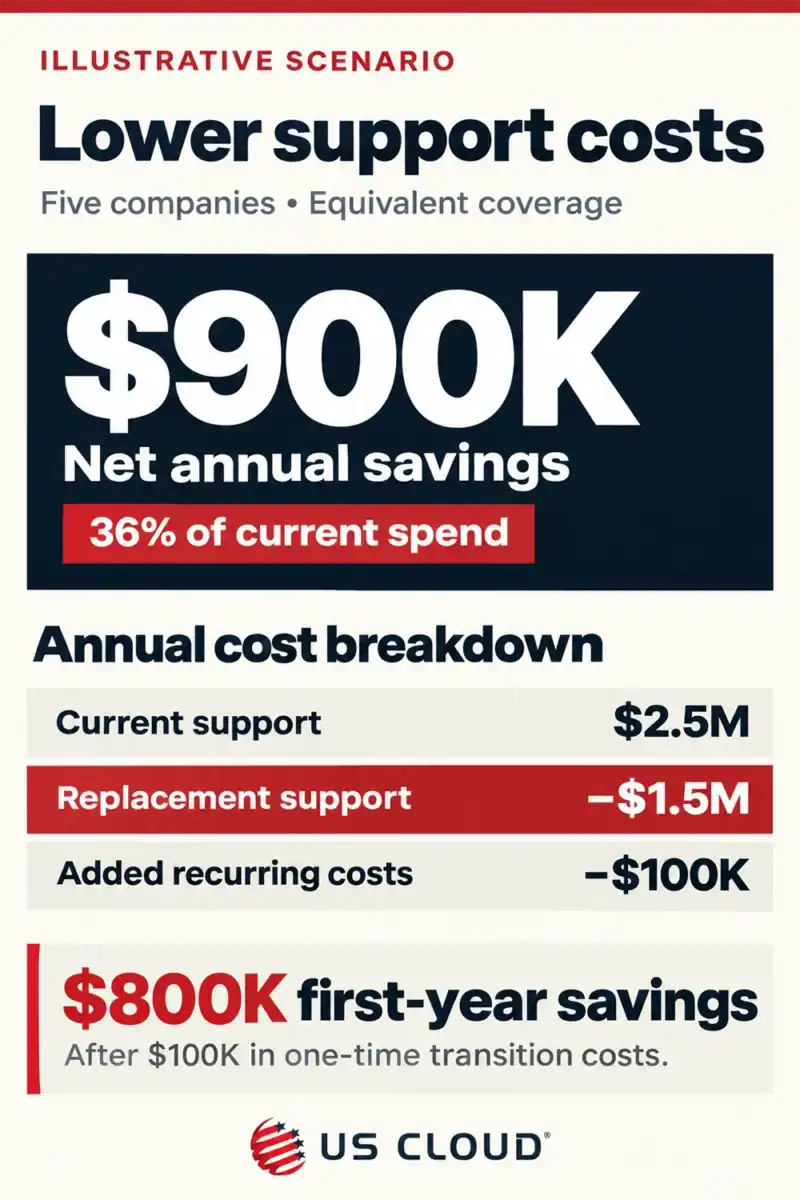
Use our US Cloud versus Unified Support comparison to organize the commercial review, then request terms for your environment. Compare current and proposed scope, expected demand, additional charges, transition effort, and customer responsibilities. A lower headline price has limited value if the comparison leaves essential work unpriced.
Enterprise references and Gartner and Fortune 500 proof can inform your evaluation. Follow that research with questions about an environment comparable to yours. Recognition helps establish a reason to evaluate; the proposed service must still satisfy your requirements.
Review Before Renewal
Year-end planning gives CIOs and Finance a reason to review recurring support commitments together. Use the actual renewal date to set the pace. Your contract, approval process, and transition requirements matter more than an arbitrary December deadline.
If you have several months, establish the performance baseline now. Request continuity answers, validate an alternative, and allow time for technical, security, and commercial review. The strongest position is having a qualified choice before the renewal becomes urgent.
If renewal is four weeks away, focus on the unresolved decisions: coverage, engineering access, escalation requirements, price, and transition readiness. Give each stakeholder the evidence needed to approve or reject the proposal. Ask providers to address those specific questions in the next review meeting.
With two weeks remaining, be explicit about what can be completed safely. A competitive quote can still inform the commercial decision, but it does not prove that onboarding is ready. Where replacement cannot be validated in time, document the remaining work and begin the next evaluation earlier.
The October announcement does not need to predict a support failure to justify action. It gives buyers a current reason to test whether their assumptions still hold. Strong performance should survive that review. Weak performance should produce a corrective plan or a different purchasing decision.
Bring US Cloud your renewal date, workload requirements, and recent case history. Request a scoped comparison of engineering coverage, escalation responsibilities, transition requirements, and cost. Make the next commitment with evidence in hand.
Häufig gestellte Fragen
Do Microsoft’s buyouts confirm Unified Support cuts?
No. The announcement and reporting reviewed for this article do not establish how many Unified Support personnel will leave or whether customer service will change. Eligibility figures describe the offer’s scope, not completed departures. Ask Microsoft for information specific to your purchased support.
What should we measure before renewal?
Review qualified engineering engagement, mitigation, restoration, resolution, handoffs, and internal coordination effort. Segment cases by severity and workload, use consistent definitions, and examine unresolved cases. These measures help explain your experience; they do not independently establish why performance changed.
Does changing support mean leaving Microsoft?
An independent support evaluation concerns who delivers the support service around your Microsoft environment. Review licensing entitlements, purchased support benefits, and escalation prerequisites separately. Require the proposed provider to document what it handles and when Microsoft involvement or customer action is necessary.
Can we compare providers without committing to switch?
Yes. A scoped quote and technical review let your organization evaluate service fit and cost before choosing. Include transition requirements in that evaluation. The result may support replacement, a better-informed renewal, or a documented plan for the next contract cycle.