Microsoft Unified Support vs. Third-Party Support: How to Compare 2027 Bids.

A third-party Microsoft support bid comes in $180,000 below the Unified renewal. Finance wants to put the savings into next year’s budget. The service desk lead has one question: “Does that price include the people who spent three nights getting our order system back online?” Until somebody can answer, the committee has a price difference. It still has work to do before it can book a saving.
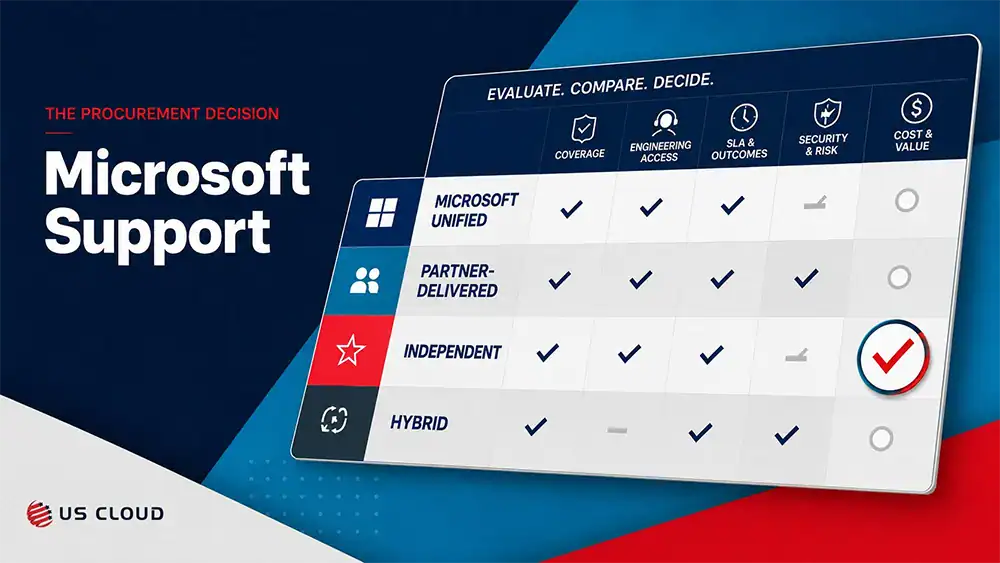
I’d start with the incidents behind last year’s bill. Give Microsoft and the independent provider the same description of the work, ask each to price it, then change one assumption that matters to your business. By the time the 2027 award reaches the CFO, the recommendation should say what the company will spend, who will do the work during an outage and which change would make the other bid a better choice.
Executive summary
- Give both bidders the same twelve months of support demand. Include work your employees performed after the vendor responded.
- Compare first-year cash costs and recurring costs separately. Put a dollar value on retained services and likely overages before reporting savings.
- Replay one difficult incident with both providers. Ask the person who would be on call to explain the handoff.
- Record the conditions of approval. If a critical workload has no confirmed escalation route, assign someone to close the gap before signature.
Rebuild the year from tickets
Start with the service desk export and the vendor’s case list. Match the records by case number where possible. One outage can generate dozens of internal requests and a single vendor case. Counting each employee’s report as a separate engineering incident will inflate the work you ask bidders to price. The opposite problem occurs when an engineer spends a weekend on a recurring issue and never opens a vendor ticket. Ask the service desk lead to identify those exceptions.
For each incident, capture the workload, business impact, time of day, provider hours if available and the action that restored service. A case coded “Microsoft 365” tells a bidder little. A record showing that users at three facilities lost access after an identity policy change gives the bidder something to scope. Remove tenant identifiers, credentials and personal information before sharing examples. A short incident narrative is often enough for pricing.
Pay particular attention to the last useful action. Did your administrator roll back a change? Did the support engineer isolate a configuration error? Did Microsoft need to repair a hosted service? A case forwarded to Microsoft is evidence of a referral. Read the closure notes before deciding that only Microsoft could have resolved it. Where the notes are inconclusive, mark the dependency unknown and ask the incident owner what evidence survives.
Then bring next year into the picture. A factory moving to a second shift needs evening coverage even if every ticket in the export arrived before five. Put that requirement alongside the historical count, with the start date and affected workloads. Both bidders can now distinguish an observed pattern from a change you expect them to accommodate.
Give both bidders one scope
Send a short statement of work with the ticket summary. Name the tenants, business units, supported products and service hours. Include planned acquisitions or divestitures where they affect coverage. Ask each bidder to mark every requirement included, separately priced or excluded and to point to the corresponding contract provision. Use the US Cloud Microsoft support RFP for the underlying questions. The completed responses become the starting point for reconciling differences in the offers.
Be specific about proactive work. Suppose last year’s agreement included architecture reviews, but IT used the time for a single identity assessment before a migration. Ask the identity lead whether a comparable assessment is needed in 2027, when it must happen and what the deliverable should contain. A separately priced review may be reasonable. An allowance no one can schedule before the migration has little value to that project.
Do the same for products near the end of their supported life. “Windows Server covered” leaves room for disagreement about a particular version. Ask whether the proposed service includes troubleshooting, help with a workaround or access to a specific update. Have your licensing owner verify any separate entitlement you intend to retain. An engineer’s willingness to investigate a problem does not establish your right to receive a security update.
Reconcile the two prices
Microsoft’s Unified Enterprise plan details explain how it calculates price using historical product spend by class. An annual agreement has a fixed price for that year. Purchases during the term can affect a subsequent calculation. Ask Microsoft to reconcile the renewal quote to the spend period, product classes, graduated rates and adjustments it used. That gives Finance a way to investigate an increase even when service desk volume stayed flat.

For an independent bid, find out what consumes the quoted capacity. If two engineers work on a case for an hour, how many hours come off the balance? Does an after-hours call use the same rate? Can a project draw from the pool reserved for incidents? Ask for a sample monthly statement showing those entries. Two providers can quote the same hourly rate and produce different invoices for the same weekend.
Consider an illustrative annual Unified quote of $600,000 and an independent bid of $420,000. The initial difference is $180,000, or 30%. In this example, IT still needs a separately purchased $36,000 service, and Finance expects $24,000 in additional engineering hours. The alternative now costs $480,000 a year. The recurring saving is $120,000, or 20% of the Unified quote. These are hypothetical bids. Substitute your prices and include only costs that differ between the options.
Suppose a one-time transition also costs $30,000. First-year savings fall to $90,000, or 15%. If additional hours cost $250 each, another 360 hours beyond the allowance already modeled would use up the first-year advantage. That is a question the service desk can answer: could a planned migration plausibly add 360 chargeable hours? If so, ask the bidder to price that scenario before the committee meets.
Replay a difficult incident
Choose one case where ownership changed while a business process was down. For a manufacturer, that might be a night shift unable to release orders after a warehouse application loses access to its database. Give both bidders the symptoms known at the time. Withhold the eventual fix until the end. You want to learn what they would do with the information the shift supervisor actually had.

Start the clock at the first report. Ask who answers, who can begin diagnosis, who can authorize a configuration change and who gives the plant manager the next update. Then introduce a complication: the engineer believes the fault may be in a Microsoft-hosted service. Who can open that case under the proposed arrangement? What permissions must your staff provide? Who stays on the call while Microsoft investigates? Record any step that depends on a customer administrator being available overnight.
Compare those answers with the written service levels. A first response, an engineer joining the bridge, a workaround restoring production and permanent resolution are four different events. US Cloud’s service level agreements describe response and escalation commitments. Ask each bidder to identify the clock its contract covers, the events that pause it and any remedy. For the other milestones, request actual examples with timestamps and severity definitions.
The replay can also expose a perfectly good offer that does not fit your operation. If a provider requires your database administrator to approve a change at 2 a.m., and that person is on call only during month-end close, you have a staffing decision. Give IT the chance to cost additional coverage or negotiate a different approval process before procurement gives the bid full credit.
Verify who handles the data
Return to the same incident and ask what the engineer would collect. A database trace can reveal account names or fragments of a transaction. A memory dump may contain material your security team would restrict. Give the bidder a realistic constraint: the plant can share a redacted trace through an approved portal, and any broader collection needs approval. Ask the engineer to walk through the next step under those conditions.
Distinguish the location of the engineer from the location of the evidence. Request details on storage, permitted access, retention, deletion and subcontractors. Follow one diagnostic file through a Microsoft escalation as well. Who decides that it can leave the original case system? Can your team redact it first? Use the Microsoft support vendor checklist to organize the answers, then have Security review the specific terms governing your environment.
Let the security owner define which gaps prevent an award. An unsigned statement about domestic staffing may be easy to resolve in contracting. A workflow that requires uploading restricted data to a destination your organization cannot approve is a different matter. Give the bidder the opportunity to document a workable route. Until Security accepts it, keep the affected workload out of the savings calculation or include the cost of covering it elsewhere.
What if our ticket history is incomplete?
Use the period you can verify, then sample high-impact incidents with the people who worked them. Identify missing months or workloads in the bid request. If the missing period includes a seasonal peak, ask bidders to quote both the observed demand and a higher-volume case. Ask Finance which scenario it is prepared to fund.
How should we treat a last-minute Unified discount?
Put the revised price into the same calculation and confirm that coverage, term and payment schedule still match. In the example above, a $100,000 first-year discount would put Unified at $500,000 against the alternative’s $510,000 first-year cost. Verify whether the discount repeats before extending that conclusion into year two.
What should we bring to a bid review?
Bring the renewal quote, an anonymized ticket summary and the list of services IT would need to keep or replace. If you have only one hour, spend it on the workload with the greatest uncertainty and the incident your team could least afford to repeat. Those answers will tell you where a written clarification can change the decision.
Write the award recommendation
Keep the recommendation short enough for the CFO and CIO to review together. Lead with the year-one cost difference, the recurring difference and the demand assumption that matters most. In the example above, the decisive number is the 360 additional hours that erase first-year savings. Attach the ticket sample and model so a reviewer can change the rate or hours without asking Procurement to rebuild the analysis.
Give IT a separate line for dependencies. Name the service that must stay in place for a Microsoft-only action, the person who can invoke it and the cost included in the bid comparison. If the independent provider can manage that route, document its obligations. If the customer must open the case, identify an authorized contact and a backup. Where product-team involvement is frequent and essential, the case for retaining Unified may be stronger even at a higher annual fee.
Finally, tie the purchase order to a start date the service desk can support. Verify notice dates in the current agreement, assign owners to open incidents and agree who handles a case spanning the cutover. Before retiring the old contact route, have an authorized employee use the new one outside business hours. Record who answered and whether they could find the account. This is a small test with a concrete outcome the person approving the transition can verify.
If your 2027 Unified quote is on the table, bring those three items to US Cloud. Ask us to price the same scope, identify any customer-owned escalations and show where your first-year savings would break even.
Domande frequenti
What if our ticket history is incomplete?
Use the period you can verify, then sample high-impact incidents with the people who worked them. Identify missing months or workloads in the bid request. If the missing period includes a seasonal peak, ask bidders to quote both the observed demand and a higher-volume case. Ask Finance which scenario it is prepared to fund.
How should we treat a last-minute Unified discount?
Put the revised price into the same calculation and confirm that coverage, term and payment schedule still match. In the example above, a $100,000 first-year discount would put Unified at $500,000 against the alternative’s $510,000 first-year cost. Verify whether the discount repeats before extending that conclusion into year two.
What should we bring to a bid review?
Bring the renewal quote, an anonymized ticket summary and the list of services IT would need to keep or replace. If you have only one hour, spend it on the workload with the greatest uncertainty and the incident your team could least afford to repeat. Those answers will tell you where a written clarification can still tip the outcome.