
Assistenza Microsoft per le aziende
Supporto aziendale unificato Microsoft
US Cloud Earns Fifth Inc. 5000 Honor in 2026.

Sintesi esecutiva
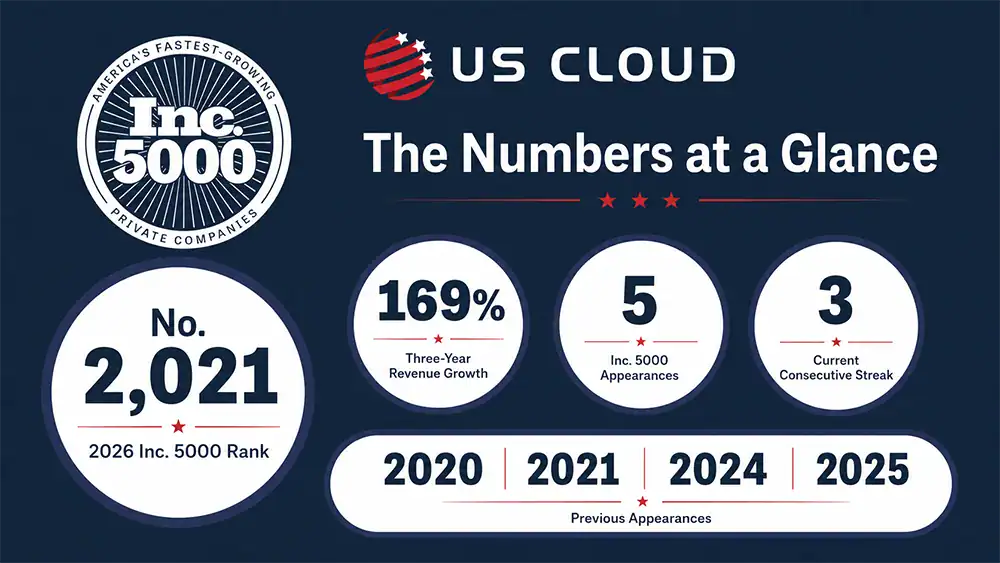
US Cloud has been named to the 2026 Inc. 5000, ranking No. 2,021 with 169% three-year revenue growth. The recognition marks US Cloud’s fifth appearance overall and third consecutive year among America’s fastest-growing private companies.
For enterprise leaders, the significance goes beyond growth. US Cloud’s continued expansion reflects increasing demand for an independent alternative to Microsoft Unified Support and the company’s ability to scale the expertise, infrastructure, and operational discipline required to support complex Microsoft environments.
Punti chiave:
- 169% three-year revenue growth, exceeding the 130% median growth rate among 2026 Inc. 5000 honorees.
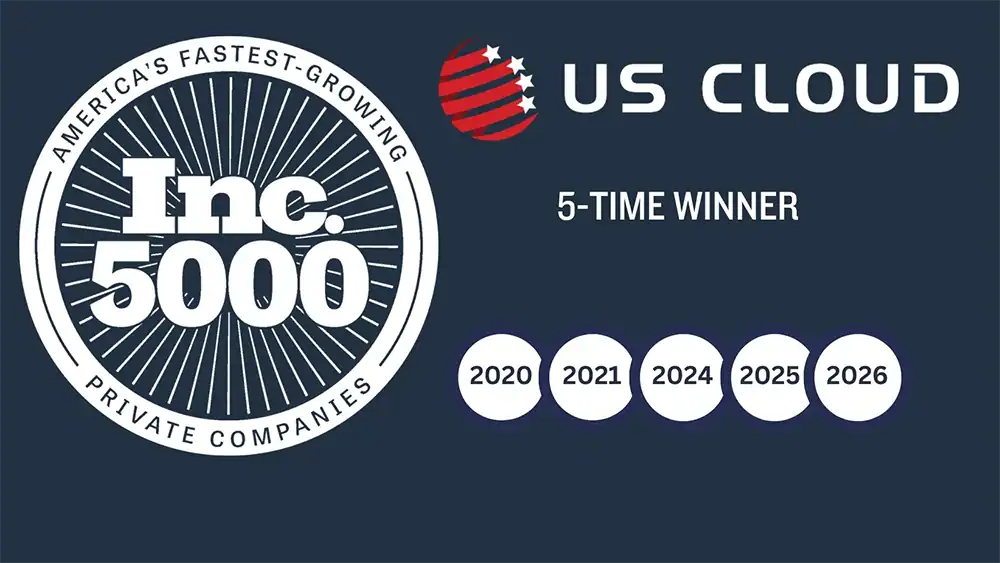
- Five Inc. 5000 appearances, including three consecutive recognitions from 2024 through 2026.
- Continued investment in senior Microsoft expertise, service delivery, escalation capabilities, and enterprise support infrastructure.
- Growing enterprise interest in evaluating Microsoft support based on cost, service quality, accountability, continuity, and business fit rather than treating renewal as a default decision.
For US Cloud, the recognition is less about growth for its own sake and more about demonstrating the scale, maturity, and staying power enterprises should expect from a long-term Microsoft support partner.
Introduction
Growth is worth celebrating. But for an enterprise support company, growth matters most when it strengthens what clients can rely on. That is why I am proud to share that US Cloud has once again been named to the Inc. 5000, ranking No. 2,021 in 2026 with 169% three-year revenue growth. This is our fifth appearance on the list and our third consecutive recognition, following our 2024 and 2025 rankings.
For our team, the recognition is meaningful. For enterprise clients evaluating their Microsoft support strategy, I believe what sits behind the growth matters even more.
It reflects an organization that is continuing to scale its people, processes, and capabilities around a very specific mission: giving enterprises a credible, independent option for Microsoft support.
What Is the Inc. 5000?
The Inc. 5000 is Inc. magazine’s annual ranking of the fastest-growing privately held companies in the United States. For the 2026 list, companies are ranked based on percentage revenue growth from 2022 through 2025. The median three-year revenue growth rate among 2026 honorees was 130%. US Cloud’s 169% growth exceeded that list-wide median. Inc. 5000 alumni over the program’s history include companies such as Microsoft, Meta, Chobani, Oracle, and Patagonia.
The Numbers at a Glance
What Five Inc. 5000 Appearances Say About US Cloud
One appearance on a growth list can reflect a particularly strong period. Repeated recognition tells a broader story.
US Cloud has now appeared on the Inc. 5000 five times, including three consecutive years from 2024 through 2026. For me, that matters because enterprise support is not a short-term relationship. Organizations evaluating a support provider need to consider not only what that company can deliver today, but whether it is building the capacity to support them several years from now.
That distinction is particularly important in Microsoft environments. Enterprise technology estates rarely become simpler. Microsoft 365, Azure, security, identity, collaboration, data, and AI increasingly intersect. As those environments evolve, the organizations supporting them must continue investing in technical expertise, escalation capabilities, service delivery, and the processes required to operate consistently at scale.
Repeated Inc. 5000 recognition does not prove that a company is the right support provider for every enterprise. Nor should an award replace a review of engineering capabilities, security, service levels, customer references, financial stability, or business continuity.
But it can contribute to that evaluation. For executives, sustained growth can provide another indicator that a potential partner is gaining market traction while building an organization capable of supporting a larger and more demanding customer base. The important question is whether that growth is being converted into better capabilities for clients.
That is the standard we apply to ourselves at US Cloud. Growth gives us the resources to invest further in the people, systems, and processes behind enterprise Microsoft support. Our responsibility is to make sure clients continue to feel the benefit of those investments as we scale.
What This Growth Means to Enterprise Buyers
When CIOs, CFOs, procurement leaders, and boards evaluate a strategic technology provider, growth alone should never make the decision. It can, however, be one indicator of something enterprises care deeply about: staying power.
Microsoft support touches business-critical infrastructure across Microsoft 365, Azure, Teams, security, identity, data platforms, and other workloads. Organizations considering an alternative support model need confidence that the provider they choose can operate at enterprise scale and continue investing in the capabilities required to support increasingly complex environments.
That is the significance I see in another Inc. 5000 recognition. We are not trying to become broader for the sake of becoming bigger. We are scaling around the same specialized mission that created US Cloud: providing enterprise organizations with an independent Microsoft support option built around expertise, accountability, flexibility, and measurable value.
Scaling Without Losing the Service Model
There is an important distinction between growth and scale. Growth is adding revenue and clients. Scale means doing so without compromising the experience that created the growth in the first place.
For US Cloud, that means continuing to invest in Microsoft expertise, support infrastructure, escalation capabilities, service delivery, and the operational discipline required by large and complex organizations. It also means protecting something that is easy for rapidly growing companies to lose: accountability.
From a client’s perspective, scale should be visible in the consistency of the support experience. Critical issues should still have clear ownership. Escalation paths should remain defined and responsive. Clients should continue to have access to experienced Microsoft engineers who understand both the technology and the business impact of an incident. Processes should become more repeatable as ticket volume grows—not more difficult to navigate.
That matters because enterprise support is ultimately tested under pressure. When a business-critical Microsoft workload is disrupted, clients should not have to wonder who owns the issue, how it will be escalated, or whether the provider has the resources to stay engaged through resolution.
Growth should strengthen those capabilities. As US Cloud expands, our responsibility is to make sure that additional scale translates into greater technical depth, stronger operational resilience, and a consistently high level of service for the organizations that depend on us.
Enterprise support should not become less personal as the provider becomes more successful. Clients should still know who owns an issue. Escalations should still move with urgency. And leadership should still be accountable for the quality of the relationship. Those principles matter more to me than the ranking itself.
Why Independent Microsoft Support Is Growing
The Microsoft environment inside the average enterprise is becoming more complex. Azure consumption is expanding. Microsoft 365 remains deeply embedded in business operations. Copilot and AI workloads are creating new dependencies. Security, identity, collaboration, cloud infrastructure, and data workloads increasingly intersect.
As that footprint grows, enterprises are asking a reasonable question: Does the support model we have today still fit the business we have today? For many organizations, benchmarking Microsoft Unified Support against an independent alternative is becoming part of normal sourcing discipline. That does not mean every enterprise should replace Microsoft Unified Support. It means support should be evaluated the way executives evaluate any other significant enterprise commitment: against cost, coverage, service quality, accountability, continuity, and business requirements. Our continued growth is one indication that more organizations are willing to conduct that evaluation.
Five Questions Enterprise Buyers Should Ask
I would never recommend choosing a Microsoft support provider because it received an award. Recognition such as the Inc. 5000 can be a useful indicator of growth and market traction, but enterprise buyers should go deeper. The more important question is whether a provider has the maturity, expertise, and operating model to support your organization over the long term. Here are five questions I believe every enterprise buyer should ask.
1. Can this provider support an organization of our size and complexity?
Look beyond broad claims about enterprise experience. Ask for examples involving organizations with comparable Microsoft environments, geographic reach, regulatory requirements, and operational complexity. A provider that works well for a smaller organization may not necessarily have the processes, staffing depth, or governance required for a large enterprise.
2. How are critical incidents and escalations handled?
When a business-critical issue occurs, ownership matters. Understand who takes responsibility for the incident, how escalation paths work, when senior engineers become involved, and how the provider communicates during high-severity events. Enterprise support should make accountability clearer, not add another layer of uncertainty.
3. What level of Microsoft expertise will we actually have access to?
Evaluate the engineering model, not just the company credentials. Ask who will work your cases, what level of Microsoft experience they bring, and how easily your team can reach experienced technical resources when an issue becomes complex. Access to the right expertise can be just as important as response time.
4. How will continuity be protected during transition and beyond?
Changing a major support model should be handled with discipline. Ask how the provider approaches onboarding, knowledge transfer, escalation readiness, service continuity, and communication with your internal teams. The goal should be to reduce operational risk before the transition begins, not solve for it afterward.
5. What evidence can the provider show that it can perform over time?
Review customer references, service-level commitments, security and compliance practices, operational processes, and evidence from organizations similar to yours.
This is where repeated recognition such as the Inc. 5000 can become relevant. It is one more data point when assessing a provider’s maturity, trajectory, and ability to keep investing as its customer base grows. It should never replace due diligence. It should be included in it.
Growth Creates a Responsibility to Keep Investing
At US Cloud, our growth gives us an opportunity to invest further in the capabilities enterprise customers expect. That includes deeper technical expertise across Microsoft technologies, stronger support infrastructure, expanded service capabilities, and processes designed for increasingly complex global environments.
But growth also creates a responsibility. The larger we become, the more disciplined we must be about protecting the service standards that got us here. Our goal is not simply to be a fast-growing Microsoft support company. It is to build an organization enterprises can trust with business-critical Microsoft environments for the long term. That requires operational maturity, financial discipline, technical depth, and a culture that continues to put accountability at the center of support.
Thank You to Our Clients, Partners, and Team
No Inc. 5000 recognition happens because of a single year, a single initiative, or a single person. Our 169% three-year growth reflects the work of our team, the confidence of our partners, and, most importantly, the trust of the organizations that rely on US Cloud every day.
- To our clients: thank you for trusting us with environments that matter to your businesses.
- To our partners: thank you for helping enterprises understand that Microsoft support does not have to be a default decision.
- And to the US Cloud team: thank you for proving that it is possible to scale while continuing to put expertise, responsiveness, and accountability first.
Being named to the 2026 Inc. 5000 is a milestone worth recognizing. What matters next is continuing to earn it.
Domande frequenti
What is US Cloud’s 2026 Inc. 5000 ranking?
US Cloud ranked No. 2,021 on the 2026 Inc. 5000, with 169% revenue growth over three years.
How many times has US Cloud made the Inc. 5000?
US Cloud has appeared on the Inc. 5000 five times: 2020, 2021, 2024, 2025, and 2026. The 2026 recognition marks its third consecutive year on the list.
How does Inc. determine the Inc. 5000 rankings?
For 2026, Inc. ranked eligible privately held U.S. companies according to percentage revenue growth between 2022 and 2025. Companies also undergo revenue verification and editorial review.
Why does Inc. 5000 recognition matter when evaluating an IT support provider?
An Inc. 5000 ranking can provide an additional indicator of a provider’s growth, market traction, and ability to scale. Enterprise buyers should consider it alongside financial stability, technical expertise, security, service quality, escalation processes, customer references, and business continuity capabilities.
What does US Cloud do?
US Cloud provides independent enterprise Microsoft support, helping organizations evaluate alternatives to Microsoft Unified Support and gain greater accountability, access to senior Microsoft expertise, and more flexibility around their support strategy.
Evaluate Your Microsoft Support Strategy
Recognition is valuable. A support strategy that fits your organization is more important.
If your enterprise is evaluating Microsoft Unified Support, preparing for a renewal, or simply wants to understand what an independent support model could look like, benchmark your current approach against US Cloud. You do not have to change providers to benefit from knowing your options. Schedule a conversation with US Cloud to compare Microsoft support models, costs, coverage, and enterprise requirements.