Microsoft Unified Enterprise Lessons from a Fortune 100 Case Study.

A Fortune 100 technology and computer manufacturer needed sustained Microsoft Dynamics 365 support for a complex global environment. US Cloud provided designated Dynamics engineering backed by a broader specialist bench, delivering more than 8,775 logged service hours across 20 Microsoft technology classifications between August 2022 and September 2026. The work included custom development, CRM code modernization, portal recovery, deployment assistance, and knowledge transfer.
For IT leaders evaluating Microsoft Unified Enterprise before year-end, the useful question is whether a provider can perform the work their environment requires. This engagement offers concrete evidence: a custom plugin the customer implemented in production, a tested hierarchy solution with implementation guidance, and recurring engineering assistance sustained through three consecutive annual renewals.
The customer maintained its own Microsoft Unified Support routing path. This case therefore documents US Cloud’s role as an embedded engineering extension within that arrangement. Its strongest evidence concerns technical depth, continuity, and delivery capacity.
ملخص تنفيذي
- Enterprise context: An anonymized Fortune 100 technology and computer manufacturer with approximately 120,000 employees needed ongoing Dynamics 365 CRM engineering and support across related Microsoft workloads.
- Sustained delivery: US Cloud recorded 8,775.5 service hours, presented here as more than 8,775, across 2,731 time entries and 46 active months during the reporting window.
- Technical breadth: Work spanned 20 Microsoft technology classifications. Fifty-eight professionals contributed across engineering, consulting, management, and partner roles over the engagement’s life.
- Implemented solutions: US Cloud delivered custom proofs of concept, code, documentation, CRM modernization assistance, and portal migration and deployment support. The customer implemented a custom Dynamics plugin in production.
- Continued commitment: The customer renewed its designated Dynamics engineering engagement for three consecutive annual cycles after the initial award. Four signed contracts totaled $2,708,514 in bookings.
- Documented feedback: All 13 completed ticket surveys scored at least 16 out of 20, including four perfect scores. The reported average was 17.4 out of 20, approximately 87% of the maximum score.
- Buyer relevance: Use this record to evaluate engineering capability and continuity. It does not establish customer cost savings, an incident resolution-time advantage, or a complete replacement of Microsoft Unified Support.
The Enterprise Challenge
The manufacturer’s Microsoft environment centered on Dynamics 365 CRM, with Azure, Power Platform, Exchange, Teams, and other Microsoft 365 services contributing to its wider technology footprint. At this scale, support demand included both individual problems and ongoing engineering work tied to the customer’s configuration, custom code, and integrations.
A Dynamics issue can require understanding how several components behave together. In this engagement, the customer needed engineers who could work through plugin architecture, examine platform options, and help carry a solution into implementation. That required familiarity with the environment alongside product expertise.
Continuity was especially relevant to work that developed over multiple sessions. Recurring status discussions, access coordination, and deployment assistance formed part of the service record. These activities supported a relationship in which engineers could remain involved as requirements and technical findings evolved.
The customer also needed access to expertise beyond Dynamics. Its recorded work reached across cloud services, collaboration tools, reporting, and server technologies. A designated relationship had to accommodate that breadth while maintaining a consistent focus on the core CRM environment.
For an IT Director assessing a similar need, the comparison should begin with the work awaiting attention. Recurring code issues, custom development requirements, and deployment dependencies call for specific capabilities. A useful proposal explains who will perform that work, how specialists will join, and what the customer will receive when an engagement ends.
How the DSE Model Worked
US Cloud structured the relationship around a Designated Support Engineer, or DSE, model alongside its Premier Support offering. Designated Dynamics expertise provided continuity, while a wider group of specialists contributed as the customer’s requirements expanded.
One multiyear designated Dynamics engagement accumulated approximately 2,973 hours. Its activities included recurring status meetings, environment and access coordination, DevOps assistance, and continuous integration and continuous delivery support, commonly called CI/CD. Ongoing engineering work therefore included the surrounding coordination needed to move technical changes forward.
That distinction helps explain what “embedded” meant in this case. US Cloud participated in recurring engineering activity and supplied implementation assistance. The relationship created a consistent place for Dynamics work to continue while drawing on additional expertise when needed.
Across the full reporting period, 58 professionals recorded time. The case record identifies engineering, consulting, management, and partner roles within that total. This figure describes cumulative participation over four years; it does not represent 58 engineers assigned simultaneously or a staffing commitment for another customer.
The combination gave the customer a designated Dynamics relationship with access to broader delivery capacity. Buyers should examine both parts of that model. A named contact should be supported by a clear process for bringing in specialists, documenting their findings, and returning knowledge to the ongoing engagement.
The contract must also explain which activities fall within the proposed scope. Recurring advisory work, custom engineering, deployment assistance, and separately structured projects can have different delivery and commercial requirements. This customer’s record shows those activities occurring within its relationship; the proposed agreement should define what applies to yours.
Engineering Work in Practice
The clearest evidence of capability comes from the work delivered. The case materials describe several examples that connect a technical requirement to an identifiable action or result.
A custom Dynamics plugin
For a custom Dynamics requirement, US Cloud evaluated platform options and built a plugin proof of concept. The team demonstrated the solution and supplied code and documentation. The customer then implemented the solution in production.
This example connects engineering assistance to customer implementation. The deliverable gave the internal team something it could use and carry forward. The case record also records a 20 out of 20 survey score for this engagement, linking one of the perfect scores to a specific piece of delivered work.
CRM code modernization
A longer-running advisory effort examined CRM plugin code, removed redundant methods, and aligned queries with recommended patterns. The work developed into a structured follow-on project engagement.
For technical evaluators, that sequence matters. The team investigated the existing implementation and identified changes that warranted continued work. The record supports a modernization effort and a path into further delivery. It does not provide a measured before-and-after performance gain, so no speed improvement is assigned to this example.
Portal migration and recovery
When a portal’s underlying data model failed, US Cloud diagnosed the issue and supported migration and redeployment into a working environment. The team repaired broken links and validated the changes end to end.
The example shows involvement across diagnosis, configuration, deployment, and verification. Those steps are useful evidence for an IT team concerned about whether a provider can remain engaged as a problem crosses environment dependencies. The case record does not give an outage duration or incident recovery time.
A custom hierarchy solution
Another requirement involved a custom entity hierarchy. US Cloud evaluated multiple technical approaches, built a demonstration, and supplied step-by-step implementation guidance. The case record describes consideration of Power Apps component framework, hierarchy, and chart patterns.
The documented outcome was a tested path the customer could assess before committing production resources. That is a distinct deliverable from the plugin example, where production implementation is explicitly recorded. Keeping those outcomes separate makes the evidence more useful to buyers comparing proposed engineering work.
An approval workflow issue
US Cloud also investigated external approval-email behavior and proposed a solution that the customer confirmed. This smaller example illustrates the range of work within the relationship: focused workflow assistance sat alongside substantial modernization and custom development efforts.
Together, these examples show how the engagement supported troubleshooting, engineering, advisory work, and knowledge transfer as requirements changed. They also give buyers specific deliverables to request when testing a provider’s claimed depth.
Coverage Across Microsoft
Dynamics 365 CRM was the center of the engagement, but the service record covered 20 Microsoft technology classifications. Named areas included Azure, Dynamics 365 Customer Voice, Power Platform, Exchange Online, Teams, Power BI, SQL Server, and Windows Server.
That breadth matters because an enterprise application exists within a wider operating environment. Technical evaluators need to understand whether a support relationship can accommodate the adjacent services their work depends on. In this case, the recorded classifications demonstrate participation across several parts of the Microsoft estate.
The count should be read as documented engagement breadth. It does not establish equal service consumption in every technology or comprehensive coverage of every feature within those products. Dynamics remained the primary focus.
For another enterprise, the practical next step is a workload-specific review. Identify the applications, integrations, and infrastructure involved in the most persistent problems. Then ask the provider to map each requirement to proposed coverage and explain how work involving multiple products will be coordinated.
This keeps the evaluation grounded in the environment your team operates. A relevant example, a defined scope, and an understandable handoff process give IT more to assess than a product list alone.
Four Years of Delivery
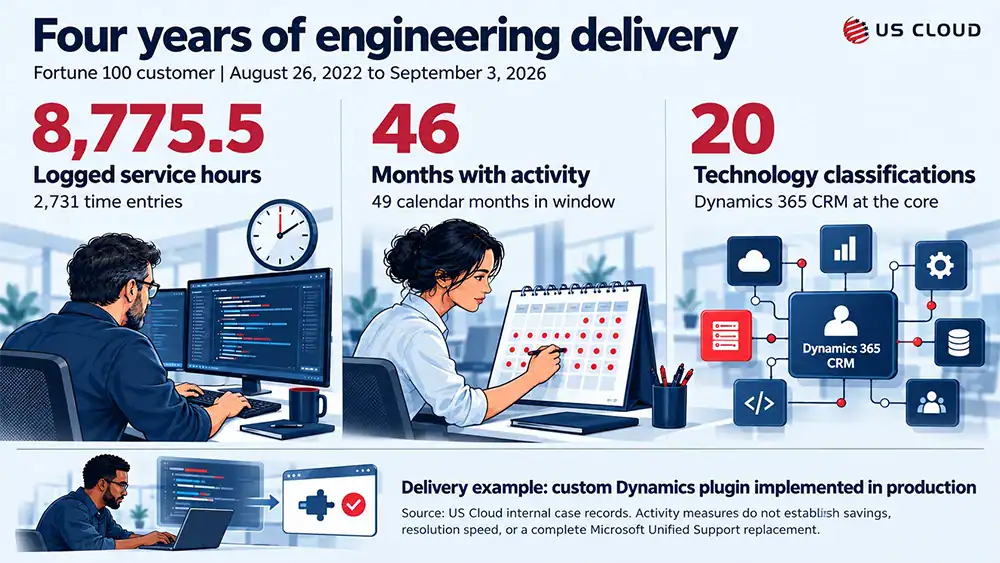
US Cloud’s internal records cover August 26, 2022, through September 3, 2026. Across that window, the account accumulated 8,775.5 logged service hours and 2,731 individual time entries. Activity appeared in 46 of the 49 calendar months included in the reporting period.
The ticket record showed 122 of 124 valid tickets resolved, a 98.4% resolution rate at the reporting snapshot, with two tickets still active. This is a status measure. Long-running engineering and advisory work is not treated as incident time to resolution, and the data does not establish an SLA attainment rate or a comparison with Microsoft’s resolution speed.
US Cloud’s internal benchmark ranked the account third by logged service hours among 856 external-facing, non-test customer accounts with at least 10 tickets during the same measurement window. The source reports the engagement at the 99.8th percentile for service hours.
That comparison indicates unusually high service consumption within the benchmarked US Cloud population. It is not an independent industry ranking, and the population was not adjusted for customer size or contract type. More logged hours demonstrate the depth of recorded participation; the implemented solutions provide the accompanying evidence of what that participation produced.
The commercial record adds another dimension. Following the initial award, the customer renewed its designated Dynamics engineering engagement for three consecutive annual cycles. The four contracts totaled $2,708,514 in signed bookings. Bookings describe contracted value, rather than invoiced revenue, customer savings, or a calculated return on investment.
Customer feedback was favorable within a limited sample. Thirteen completed ticket surveys from 2023 through 2025 averaged a reported 17.4 out of 20. Every response scored at least 16, and four scored 20. The surveys contained no written comments, so the case does not attribute a testimonial or a specific renewal motive to the customer.
Read together, the records support a sustained relationship with substantial service delivery, concrete engineering outputs, repeated commercial commitments, and positive recorded feedback. Each measure answers a different question about the engagement.
What Buyers Can Validate
For an IT Director, this case provides a useful basis for testing whether an independent Microsoft support provider can work at the required technical depth. Start with comparable engineering examples and ask what the provider delivered, who implemented it, and how the work was documented.
Then examine continuity. The approximately 2,973-hour designated Dynamics engagement shows sustained participation in this customer’s environment. In a proposed engagement, ask how environment knowledge will be maintained, how changes in personnel will be handled, and how specialists will contribute without leaving your team to reconstruct the history.
A CIO can use the same evidence to evaluate enterprise delivery capacity. Sustained participation across 46 active months and multiple Microsoft technology areas is relevant proof. The next step is to compare that experience with your own governance, workload, and escalation requirements.
Finance and Procurement should connect the technical scope to the commercial proposal. This case documents signed commitments and renewals, but provides no comparable incumbent cost baseline. A savings or ROI assessment for your organization requires its own current costs, proposed fees, scope assumptions, and internal effort estimates.
Before approving a year-end support commitment, request answers to these questions:
- Which recurring problems and engineering initiatives will the proposed engagement address?
- Who will maintain technical continuity, and how will additional specialists participate?
- What code, documentation, implementation guidance, and reporting will your team receive?
- Which activities require separate project scope or additional commercial approval?
- How will the customer and provider coordinate any required Microsoft involvement?
The final question is particularly relevant here because the customer maintained its own Unified Support routing path. Another buyer should establish its required arrangement explicitly. The engineering evidence can inform that evaluation without implying that this customer followed a full Unified replacement path.
Review Your Engineering Needs
Before year-end budgets close or your next Microsoft support renewal is approved, put your unresolved engineering requirements into the decision. Identify the Dynamics issues that keep returning, the custom work awaiting specialist attention, and the projects that need consistent technical involvement.
This Fortune 100 engagement shows what sustained participation can include: implemented code, documented proofs of concept, CRM modernization work, portal recovery, and ongoing assistance across a broader Microsoft environment. It gives your team specific evidence to compare against its own needs.
Dynamics Support FAQs
What does a DSE do?
A Designated Support Engineer provides ongoing expertise within an agreed engagement. In this case, designated Dynamics engineering supported recurring coordination, advisory work, development assistance, and deployment activity, with broader specialists contributing as needed. Staffing, commitments, and included services should be defined in the customer’s agreement.
Can US Cloud do custom work?
This case documents US Cloud building a custom Dynamics plugin proof of concept with code and documentation that the customer implemented in production. It also describes a custom hierarchy demonstration and implementation guide. Those examples support evaluating US Cloud for comparable work, subject to the proposed scope.
How large was this engagement?
The Fortune 100 manufacturer’s relationship recorded 8,775.5 service hours across 2,731 time entries between August 26, 2022, and September 3, 2026. Fifty-eight professionals contributed across several delivery roles, and recorded work spanned 20 Microsoft technology classifications.
Did US Cloud replace Unified?
The case materials state that the customer maintained its own Microsoft Unified Support routing path. They demonstrate US Cloud’s embedded engineering role within that arrangement. They do not document a complete Unified Support replacement or quantify savings from such a change.
What did customer feedback show?
All 13 completed ticket surveys scored at least 16 out of 20, including four perfect scores. The reported average was 17.4 out of 20. The sample was limited and included no written comments, so it should be read alongside the delivery and renewal records.