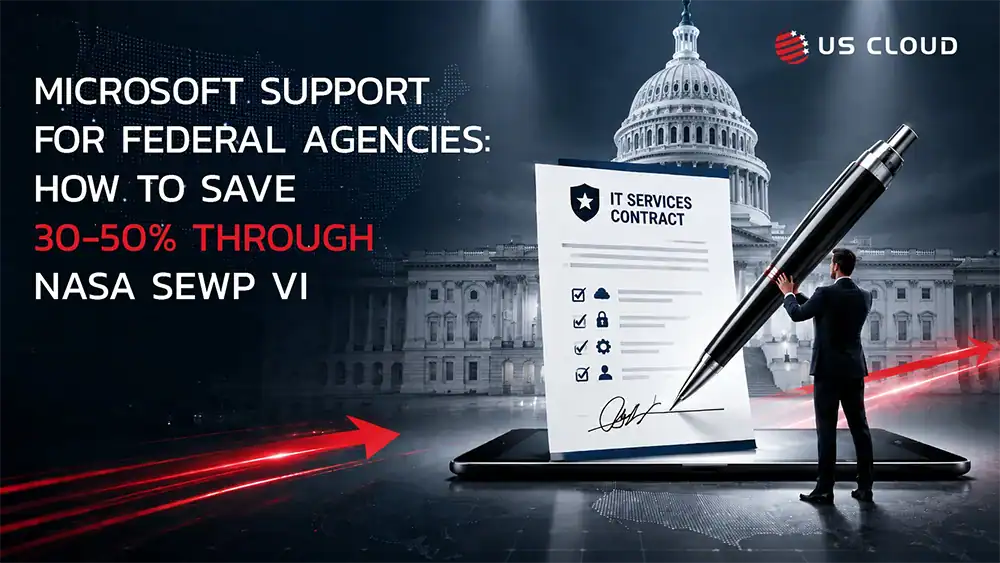
Microsoft Support for Federal Agencies: How to Save 30–50% Through NASA SEWP VI.

Samenvatting
- Federal agencies have the option to explore alternatives to Microsoft Unified Support while still maintaining Microsoft 365, Azure Government, GCC, or GCC High licenses, subscriptions, and their ongoing relationship with Microsoft.
- NASA’s published SEWP VI awardee list includes US Cloud in Category C, which covers mission-based IT, cybersecurity, consulting, hosting, and related services. NASA is still completing the SEWP VI award process, while SEWP V remains available during the transition.
- US Cloud can typically provide Microsoft support cost savings of 30–50%, predictable annual pricing, US-citizen engineers, 24/7 coverage, and a sub-15-minute response SLA for critical incidents.
- Agencies spending $1 million annually on Microsoft support could potentially recover $1.5 million to $2.5 million over five years for cybersecurity, AI, modernization, technical debt, or citizen services.
Can Federal Agencies Buy a Microsoft Unified Support Alternative Through NASA SEWP VI?
Yes. The NASA SEWP VI award from US Cloud offers agencies an option to assess an independent support provider when ordering becomes possible. US Cloud’s NASA SEWP VI award gives agencies a path to evaluate an independent support provider when ordering is available.
Introduction
The federal government does not have a Microsoft technology problem. It has a Microsoft support sourcing problem. Agencies have spent years treating Unified Support as an unavoidable extension of Microsoft licensing. It is not. Agencies can maintain their Microsoft products, cloud services, licensing agreements, and strategic relationship with Microsoft while competitively sourcing the support surrounding those technologies.
The market for Microsoft support for federal agencies is changing. Agencies no longer have to assume that Microsoft is the only enterprise-grade option. US Cloud provides a Microsoft enterprise support alternative without requiring agencies to replace Microsoft technology or weaken their Microsoft relationship. Federal agencies that switch from Microsoft Unified Support to US Cloud’s offering on NASA SEWP VI typically cut support costs by 30–50% while gaining faster response times and US-citizen engineers. That one adjustment allows CIOs to allocate funds toward cybersecurity, AI adoption, and updating infrastructure. These are the priorities already vying for the same limited budget.
Over the past ten years, most agencies with Microsoft-focused systems believed that Microsoft was their sole support provider. NASA SEWP VI removes that assumption. It gives agencies a compliant, already-vetted acquisition vehicle to buy enterprise Microsoft support from a competitive alternative instead of renewing direct with Microsoft by default.
Microsoft support is one of the least-scrutinized line items in the federal IT budget
Spending on Microsoft support typically doesn’t undergo the same scrutiny as software licensing, cybersecurity funds, or modernization efforts. This is because agencies often believe they have no choice but to renew directly with Microsoft.
That assumption carries a real cost. Agencies running large Microsoft estates — spanning Azure Government, Microsoft 365 GCC and GCC High, Teams, SharePoint, Exchange, Windows Server, SQL Server, Dynamics 365, and Power Platform — can spend hundreds of thousands to millions of dollars a year on support alone. Every dollar spent there is a dollar unavailable for zero-trust initiatives, AI pilots, or legacy system migration.
NASA SEWP VI changes the default. With US Cloud’s contract approval, agencies don’t just need to consider “how much should we spend on Microsoft support.” They can now evaluate “what value are we receiving for that expenditure” and take action based on that evaluation using a contract that is already authorized for federal use.
Microsoft Unified Support vs. US Cloud on SEWP VI
Federal buyers should evaluate various government Microsoft support providers based on their pricing, the level of Microsoft coverage they offer, access to engineers, commitments to critical response times, handling of escalations, security controls, and how they affect the agency’s current Microsoft relationship.
| Evaluatiegebied | Microsoft Unified Support | US Cloud via SEWP VI |
|---|---|---|
| Microsoft products and licensing | Retained | Retained |
| Microsoft customer relationship | Retained | Retained |
| Support provider | Microsoft | Independent Microsoft support provider |
| Acquisition Path | Direct Microsoft agreement | SEWP VI ordering vehicle |
| Small Business Credit | Nee | Ja |
| WOSB Credit | Nee | Ja |
| Support Personnel | Mixed delivery model | US-citizen engineers |
| Reactietijd | Standard Unified SLA | Sub-15-minute SLA available |
| Resolution Speed | Verschilt | Focused Microsoft-only support model |
| Prijzen | Typically tied to Microsoft spend | Fixed annual support pricing |
| Competition | Vendor-provided support | Independent alternative |
| Mission Reinvestment | Higher support spend | 30-50% potential savings |
The main structural difference lies in pricing. Microsoft Unified Support adjusts based on total Microsoft spending, whereas US Cloud’s SEWP VI pricing remains constant each year. This allows for more predictable budget planning, no matter how much an agency’s use of Microsoft expands.
Four reasons agencies are moving off Microsoft Unified Support
Federal technology teams evaluate support providers on more than price. The effectiveness of mission readiness hinges on a provider’s response speed, the quickness in resolving issues, the responsible party for the task, and the consistency of costs annually.
- Faster response times. Agencies are more often choosing providers that offer direct access to senior engineers, instead of using complex escalation procedures. This is because the time it takes to get an engineer involved after an issue arises affects how much damage occurs before it can be fixed.
- Faster resolution times. The speed at which an issue is resolved, rather than how quickly a response is made, is what impacts the operational risk during an outage. This is true whether the system is used by a defense contractor, a civilian agency, or for a citizen-facing service.
- Access to experienced engineers. Federal environments combine hybrid infrastructure, legacy systems, cloud platforms, and compliance requirements, so engaging a specialist who already understands that mix immediately cuts troubleshooting time. Agencies should confirm that the provider offers experienced Azure Government support rather than relying on general commercial-cloud knowledge
- Predictable support costs. Support costs tied to overall Microsoft consumption escalate unpredictably as an agency’s footprint grows; a fixed annual cost does not.
Consider an Entra ID issue that prevents agency personnel from accessing Microsoft 365, an Azure Government workload supporting a citizen-facing service, or a Defender incident requiring immediate containment. The initial response target matters, but it is only the beginning. The agency also needs an engineer who understands the environment, owns the case, communicates with mission stakeholders, and stays engaged through resolution. Agencies should evaluate the operational difference, not just whether a vendor responds to a ticket within a set time frame. The same standard applies to Microsoft 365 GCC support, GCC High incidents, Teams, Exchange, Defender, identity, and hybrid server environments.
SEWP VI removes the procurement friction that usually blocks switching providers
For agencies evaluating NASA SEWP VI Microsoft support, the vehicle provides a structured path for conducting market research, requesting quotations, and comparing eligible contract holders. Procurement timelines, not technical merit, are usually what stalls a switch away from an incumbent support provider — even after an agency identifies a better option.
NASA SEWP VI is a government-wide acquisition vehicle already built to remove that friction. Ordering through it gives agencies:
- An established, already-compliant acquisition vehicle
- A streamlined ordering process
- Reduced procurement complexity
- Faster acquisition timelines
- Built-in compliance with federal procurement requirements
- Support for agency competition objectives
For contracting officers, this lowers the administrative burden of switching providers. For CIOs, it means the agency can act on a savings opportunity in the current budget cycle instead of waiting for the next one.
Why Is Federal Microsoft Support an Overlooked Sourcing Category?
Microsoft support often escapes the scrutiny applied to licensing, cybersecurity, cloud consumption, and modernization. The cost is treated as fixed because the supplier is assumed to be fixed. That is how agencies lose leverage.
Large federal environments can spend millions each year supporting Microsoft platforms. The Microsoft Unified Support cost may increase as an agency’s broader Microsoft consumption grows across Azure, Microsoft 365, security, data, and AI. US Cloud’s fixed-fee model separates support pricing from that consumption growth. Familiar renewal is not automatically a defensible renewal. The incumbent should have to earn the business.
The largest difference is not simply price. It is control. An independent alternative creates competition in a category often renewed by default. Even if an agency remains with Microsoft, a credible benchmark strengthens its ability to question pricing, coverage, terms, and performance.
Switching to US Cloud on SEWP VI also counts toward Small Business and WOSB goals
US Cloud qualifies as both a Small Business and a Woman-Owned Small Business (WOSB) — so agencies that switch their Microsoft support spend to US Cloud through SEWP VI simultaneously advance the socioeconomic contracting goals that agency leadership, contracting officers, and OSDBU teams are measured against.
That means a single procurement decision can deliver:
- Improved service levels
- Lower costs
- Increased competition
- Small Business participation credit
- WOSB participation credit
- Mission support improvements
Few procurement decisions move that many metrics in the same direction at once.
US-citizen support reduces a specific, named risk: third-party visibility into sensitive systems
Support engineers see inside an agency’s infrastructure configuration and operational processes by necessity — which is exactly why supply chain security and data sovereignty have become standard evaluation criteria for support contracts, not just cybersecurity tools.
US Cloud delivers support exclusively through US-citizen engineers. For agencies asking where their support engineers are located, who has system access, how data is handled, and what controls govern support interactions, that staffing model answers all four questions with one fact instead of a vendor policy document.
A 40% reduction on $1 million in annual Microsoft support frees $2 million over five years
An agency spending $1 million annually on Microsoft support that cuts that cost by 40% by switching to US Cloud on SEWP VI frees approximately $400,000 per year — $2 million over a five-year period — without reducing the scope of support received.
That capital is large enough to fund a new cybersecurity initiative, an AI pilot program, a cloud migration project, or a meaningful reduction in technical debt outright, rather than functioning as a rounding error in next year’s budget request. Agencies with larger Microsoft estates see proportionally larger numbers.
How Microsoft Support Cost Savings Can Reach $2.5 Million Over Five Years
Potential Microsoft support cost savings depend on the agency’s existing agreement, coverage requirements, environment complexity, ticket demand, and final contract terms.. For example, an agency spending $1 million annually on Microsoft support could potentially recover between $300,000 and $500,000 per year at a 30–50% savings range. Over five years, that represents approximately $1.5 million to $2.5 million that could be redirected to cybersecurity, AI, cloud modernization, technical debt, or citizen services.
| Potential Reduction | Annual Savings | 5 Year Potential |
|---|---|---|
| 30% | $300,000 | $1.5 million |
| 40% | $400,000 | $2 million |
| 50% | $500,000 | $2.5 million |
Actual savings depend on the agency’s existing Microsoft support agreement, required coverage, environment complexity, ticket demand, and final contract structure.
Where the savings go: cybersecurity, AI, cloud modernization, and citizen services
Money freed from Microsoft support spending doesn’t have to sit idle — it can be redirected immediately into the initiatives already competing for budget attention:
- Cybersecurity: Zero Trust initiatives, identity modernization, security operations enhancements, threat detection, vulnerability management, continuous monitoring
- Artificial intelligence: Copilot initiatives, AI pilot programs, data modernization, automation projects, knowledge management solutions
- Cloud modernization: Application modernization, cloud migration, infrastructure optimization, platform engineering initiatives
- Citizen services: Service accessibility, digital experience improvements, operational efficiency, workforce productivity
The Alternative is Already Operating
Independent Microsoft support is no longer an untested model reserved for small organizations or low-risk systems. US Cloud provides Microsoft support for government agencies, federal organizations, and large regulated enterprises across Microsoft 365, Azure, security, hybrid cloud, servers, and databases. A confidential Department of Defense component reduced its Microsoft support costs by 40% while achieving 98.9% SLA adherence across a hybrid cloud environment after switching to US Cloud. This evidence gives federal buyers a more concrete basis for evaluating a Microsoft Unified Support alternative against an incumbent renewal.
The larger point is difficult to dismiss: agencies are not being asked to choose between an expensive incumbent and an unproven alternative. The independent Microsoft support market is already serving complex, regulated, and mission-dependent environments. A familiar provider should not receive an automatic renewal merely because the environment is large or the mission is critical. Those conditions make evidence, competition, and measurable performance more important—not less.
SEWP VI introduces competition into a category that historically had almost none
Microsoft support was treated as a sole-source category for years by default, not because no alternative existed, but because no compliant, competitive acquisition path made switching easy.
Federal acquisition policy favors competition because it improves service, drives innovation, strengthens accountability, and lowers pricing — the same benefits competition produces in any other procurement category. NASA SEWP VI gives agencies a credible alternative in a category that previously had none, which is the mechanism through which agencies and taxpayers both benefit.
Bottom Line for Federal CIOs and Contracting Officers
Microsoft support for federal agencies is a strategic sourcing decision, not an automatic extension of Microsoft licensing. The federal government does not need less Microsoft capability. It needs more control over the economics and accountability surrounding that capability.
NASA SEWP VI gives agencies a path to evaluate a Microsoft enterprise support alternative that may improve response, increase accountability, and reduce support costs without replacing Microsoft products or services. US Cloud offers an independent Unified Support alternative built around predictable pricing, US-citizen engineers, faster response commitments, and potential savings of 30–50%.
The question is no longer whether an alternative exists. The question is whether Microsoft has earned the renewal.
Before the next Unified Support decision, benchmark the agency’s current cost, coverage, escalation performance, security requirements, and procurement path. A federal Microsoft support assessment can show where savings may exist and how to evaluate an alternative without giving up Microsoft products or the Microsoft relationship.
Procurement Request for Quote (RFQ) Information
Contract Holder Name: US CLOUD LC
Contract Category/Group: Category C: IT Mission Based Services
Contract Period of Performance: November 1, 2026 to October 31, 2036
Unique Entity Identifier (UEI): GNQPHM1ZSDM1
CAGE Code: 4XKR3
Business Designations: Small Business, WOSB
Frequently Asked Questions About Microsoft Support for Federal Agencies
Can a Federal Agency Replace Microsoft Unified Support?
Yes. An agency can retain Microsoft software, cloud services, licensing, subscriptions, and its Microsoft relationship while using an independent enterprise support provider.
Is US Cloud Available Through NASA SEWP VI?
NASA’s published SEWP VI awardee workbook lists US Cloud under Category C. As of July 2026, NASA is still completing the award process, and SEWP V remains active during the transition.
Does Changing Support Providers Affect Azure Government or Microsoft 365 Government?
Changing the support provider does not inherently cancel Microsoft products or subscriptions. Agencies should confirm coverage, escalation rights, access procedures, and contract responsibilities during evaluation.
How Much Can Agencies Save?
US Cloud reports typical savings of 30–50%. An agency spending $1 million annually could potentially recover $300,000 to $500,000 per year, depending on scope and terms.
What Should Agencies Compare in a Government Microsoft Support Provider?
Agencies should compare engineering access, coverage, critical-incident response, escalation ownership, security controls, data handling, pricing predictability, government-environment experience, and the provider’s ability to escalate issues to Microsoft when necessary.
Can the Independent Support Provider Support the Full Government Microsoft Environment?
Agencies should confirm that the provider can support the full scope of their Microsoft environment, not just isolated products. That includes Azure Government support, Microsoft 365 GCC support, GCC High expertise, identity, security, endpoint management, databases, servers, applications, and hybrid infrastructure. Buyers should also verify escalation procedures, data-handling controls, engineering depth, and experience supporting regulated government environments.

Partner-Delivered Microsoft Support: A Unified Support Alternative for Enterprises
The Channel Support Spiral: How Microsoft Partners Can Protect Margin as Unified for Partner Rolls Out