Microsoft Unified Support Pricing: How It’s Calculated & What It Costs (2026).

Microsoft Unified Support pricing is a percentage of your historical annual Microsoft product spend, applied through graduated rate bands. Analysts report starting rates near 10% for Azure and server products and 7.5% for user products like Microsoft 365, declining in higher spend bands.

Key takeaways

  • Formula: Unified fee = annual Microsoft spend × graduated support rate. Microsoft prices it as a percentage of historical annual product spend.
  • Rates: Analysts report infrastructure (Azure, on-prem server) rates from about 10% down to 1.75%, and user-product rates (Microsoft 365, Dynamics 365) from about 7.5% down to 3.5%, by spend band.
  • Spend base: Cloud and Software Assurance purchases from the prior 12 months, plus license-only purchases from the prior 60 months, as described by licensing analysts.
  • Minimum: About $50,000 per year, per public summaries of Gartner’s 2026 market guide.
  • Trend: Gartner reports annual Unified increases of 20% to 50%, driven by spend growth rather than support usage.

How is Microsoft Unified Support pricing calculated?

Short Answer:
Microsoft multiplies your historical annual Microsoft product spend by graduated support rates, similar to tax brackets: each band of spend has its own rate, and rates fall as spend rises. The result is billed as an annual subscription, regardless of how many support tickets you open.

Annual Microsoft spend × graduated support rate = Unified Support fee

Pricing also varies with organization size, environment complexity and the specialized services you add. Microsoft provides estimates through its account teams and does not publish a public rate card.

What counts toward your Microsoft spend for Unified pricing?

Short answer
Licensing analysts describe the spend base as cloud service purchases and Software Assurance purchases from the previous 12 months, plus license-only purchases from the previous 60 months. Azure consumption, Microsoft 365 and Copilot licenses, and Dynamics 365 all count.
Components of the Unified spend base, as described by licensing analysts
Purchase type Look-back period Exemples
Cloud services Previous 12 months Azure consumption, Microsoft 365, Copilot, Dynamics 365
Assurance logicielle Previous 12 months SA on server and client licenses
License-only Previous 60 months Perpetual licenses bought without SA

Because the base is backward-looking, a large true-up or cloud migration in one year raises your support price in the next, even if your support needs don’t change.

What are Microsoft Unified Support rates?

Short answerPublic analyst reports describe two rate schedules. Infrastructure products (Azure and on-premises server) start near 10% and decline to about 1.75% in the highest bands. User products (Microsoft 365, Dynamics 365, on-premises user software) start near 7.5% and decline to about 3.5%.
Reported Unified rate ranges by product category (analyst reports; confirm with your Microsoft quote)
Catégorie Starting rate Lowest band rate
Infrastructure (Azure, on-prem server) ≈10% ≈1.75%
User (Microsoft 365, Dynamics 365, on-prem user) ≈7.5% ≈3.5%

Worked example: graduated math

Hypothetical band rates on $6M of Azure spend (illustrative, not a Microsoft quote)
Spend band Rate Support cost
First $1.8M 10% $180,000
Remaining $4.2M 7% $294,000
Total on $6M ≈7.9% effective $474,000

Your effective rate is total support cost divided by total spend. It is the single best number to benchmark at renewal.

How much does Microsoft Unified Support cost per year?

Short answer
The commonly cited minimum is about $50,000 per year. At enterprise scale, effective rates of 3–7% put Unified at roughly $1.5–3.5 million a year on $50 million of Microsoft spend, and $3 million to more than $10 million a year on $100–200 million of spend.
Annual Unified cost by spend and effective rate (illustrative)
Annual Microsoft spend 3% effective 5% effective 7% effective
$10M $0.3M $0.5M $0.7M
$50M $1.5M $2.5M $3.5M
$100M $3.0M $5.0M $7.0M
$200M $6.0M $10.0M $14.0M

Estimate your Unified Support cost

Enter your annual spend and an assumed effective rate for each category. Defaults are illustrative mid-range assumptions, not Microsoft rates.

Year-1 Unified fee$3.35M
Blended effective rate4.8%
3-year Unified total$12.2M
3-year difference with alternative$6.16M

Illustrative estimate. Unified pricing uses graduated bands that vary by contract; use your Microsoft quote for decisions. The alternative is modeled at a flat price.

What add-ons and hidden cost drivers affect Unified pricing?

Short answer
Specialized services such as Value Acceleration Services (Designated and Enhanced Designated Engineering) and Mission Critical Services are priced on top of the base fee. Spend growth from Azure, Copilot and Microsoft 365 upgrades also raises the base automatically.
  • Specialized services. Dedicated engineering and mission-critical coverage add cost beyond Unified Enterprise.
  • SKU upgrades. Moving users to higher-priced Microsoft 365 or Copilot licenses raises the spend base, and the support fee with it.
  • Azure consumption. Cloud growth flows directly into next year’s base.
  • True-ups. Licensing growth discovered at true-up increases the base.
  • Shrinking discounts. Lower licensing discounts mean higher measured spend.

Why does Unified Support pricing go up every year?

Short answer
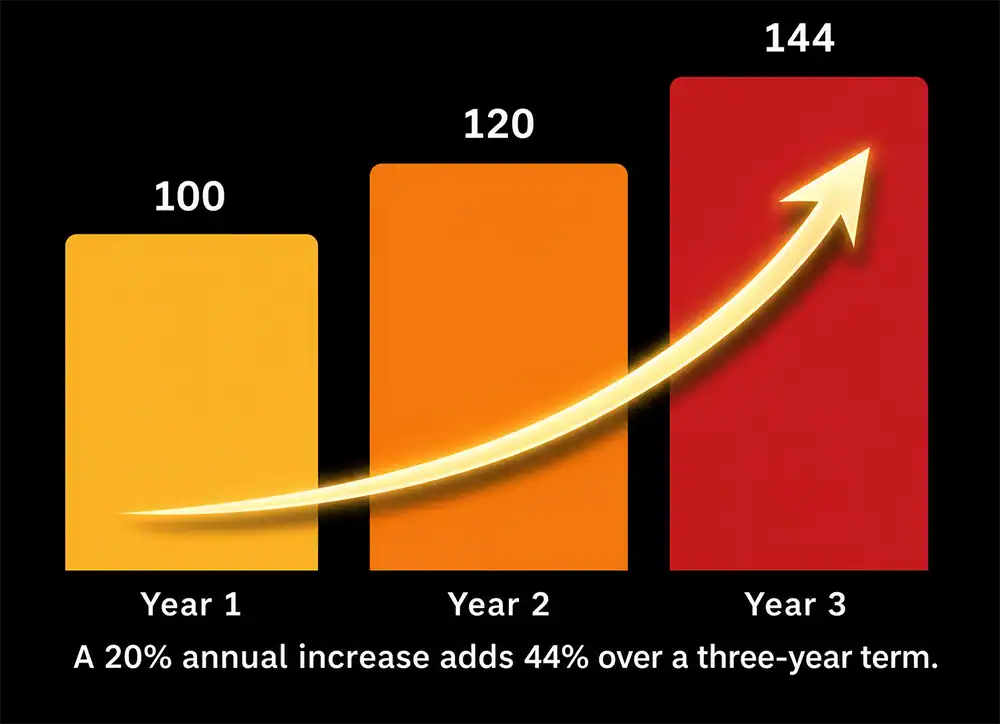
Because the fee is tied to Microsoft spend, which grows with cloud adoption, license upgrades and true-ups. Gartner reports annual Unified increases of 20% to 50%. Some organizations moving from Premier to Unified saw increases of 200% or more.
Why Unified Support pricing goes up every year

How can you lower Microsoft Unified Support costs?

Short answer
Audit the spend base Microsoft uses, benchmark your effective rate, right-size add-ons, negotiate support separately from your Enterprise Agreement, seek multi-year caps, and bring a credible, fully priced alternative. Gartner reports typical third-party savings of 30% to 60%.
  1. Audit the base.Request the spend breakdown and check for items that shouldn’t count.
  2. Benchmark.Compare your effective rate and three-year cost with the market.
  3. Price alternatives.Get independent and hybrid bids before your deadline.
  4. Negotiate.Seek caps on increases and written performance commitments.

Unified Support pricing FAQ

Is Microsoft Unified Support priced per user?

No. Unified is priced as a percentage of your organization’s Microsoft product spend, not per user or per incident.

Is there a minimum price for Unified Support?

Yes. Public summaries of Gartner’s 2026 market guide cite a minimum of about $50,000 per year. Legacy Core, Advanced and Performance packages had different minimums.

Does Microsoft publish a Unified Support price list?

No. Microsoft provides estimates through its account teams. Published rate ranges come from analysts and licensing advisors.

Does Copilot increase Unified Support costs?

It can. Copilot and other Microsoft 365 add-on licenses increase your spend base, which raises the support fee calculated from it.

Is Unified cheaper than Premier was?

Usually not for the same environment. Premier was priced on support hours; Unified is priced on spend. Gartner reports some organizations saw increases of 200% or more after moving to Unified.

Can you negotiate Unified Support pricing?

Yes. Your strongest leverage is a benchmarked effective rate and a credible, fully priced alternative, negotiated before the renewal deadline.

Benchmark your Unified pricing

See how your effective rate and three-year support cost compare with the independent market. US Cloud provides a confidential support-cost assessment.

Request a confidential cost assessment

Sources and methodology

Methodology: The worked example uses hypothetical band rates to show how graduated pricing behaves. Cost tables and the estimator use illustrative effective rates, not Microsoft quotes. Microsoft does not publish a public Unified rate card; your rates depend on product mix, spend bands, add-ons and negotiation. Information current as of October 17, 2026.

Video transcript

Key takeaways

How much does Microsoft Unified Support cost, and why does the price keep going up? Unified Support is priced as a percentage of what you spend with Microsoft. In this video we break down the formula, the rate bands, what counts toward your spend, real cost examples, and the levers that actually lower the bill.

How is Microsoft Unified Support pricing calculated?

Microsoft calculates Unified Support as a percentage of your historical annual Microsoft product spend, using graduated rates. Think of it like tax brackets. Each band of spend has its own rate, and the rates fall as spend rises. The result is billed as an annual subscription. Notice what’s missing from that formula: how many support tickets you open. Your price is driven by how much Microsoft you buy, not how much support you use. Microsoft doesn’t publish a public rate card. Estimates come from your account team, and pricing also varies with environment complexity and the services you add.

What counts toward your Microsoft spend for Unified pricing?

So what goes into the spend base? Licensing analysts describe three parts. Cloud services purchased in the previous twelve months, like Azure, Microsoft 365, Copilot and Dynamics 365. Software Assurance purchased in the previous twelve months. And license-only purchases from the previous sixty months. Because the base looks backward, a big cloud migration or true-up this year raises your support price next year, even if your support needs stay the same.

What are Microsoft Unified Support rates?

Analyst reports describe two rate schedules. Infrastructure products, meaning Azure and on-premises servers, start near ten percent and fall to about one point seven five percent in the highest bands. User products, like Microsoft 365 and Dynamics 365, start near seven and a half percent and fall to about three and a half percent. Here’s how the math works with hypothetical rates. Six million dollars of Azure spend, at ten percent on the first one point eight million and seven percent on the rest, comes to four hundred seventy-four thousand dollars. That’s an effective rate near eight percent. Your effective rate, total support cost divided by total spend, is the number to benchmark at renewal.

How much does Microsoft Unified Support cost per year?

What does that mean in real dollars? Gartner’s 2026 market guide, as publicly summarized, cites a minimum of around fifty thousand dollars a year. At enterprise scale, effective rates of three to seven percent put Unified at roughly one and a half to three and a half million dollars a year on fifty million dollars of Microsoft spend. At one hundred to two hundred million dollars of spend, the bill runs from three million to more than ten million a year. Use the estimator on this page to model your own numbers.

What add-ons and hidden cost drivers affect Unified pricing?

The base fee is only part of the story. Specialized services, like Value Acceleration Services and Mission Critical Services, are priced on top. And several things raise the base automatically: Azure consumption growth, Microsoft 365 and Copilot license upgrades, licensing true-ups, and shrinking discounts. None of these require you to open a single extra ticket.

Why does Unified Support pricing go up every year?

That’s why Gartner reports annual Unified increases of twenty to fifty percent. Even at twenty percent a year, a support bill grows by forty-four percent over a three-year term. And for organizations that moved from Premier, Gartner notes some saw increases of two hundred percent or more, because Premier was priced on support hours while Unified is priced on spend.

How can you lower Microsoft Unified Support costs?

So how do you bring the price down? Four steps. First, audit the spend base Microsoft is using, and challenge anything that shouldn’t count. Second, benchmark your effective rate and your three-year cost against the market. Third, price alternatives, independent and hybrid, before your renewal deadline. Gartner reports typical third-party savings of thirty to sixty percent. Fourth, negotiate support separately from your Enterprise Agreement, and ask for caps on increases and written performance commitments.

Unified Support pricing FAQ

Quick answers. Is Unified priced per user? No, it’s a percentage of spend. Is there a minimum? About fifty thousand dollars a year, per public summaries of Gartner. Does Copilot raise the price? It can, because Copilot licenses add to your spend base. And can you negotiate? Yes. Your best leverage is a benchmarked rate and a credible, fully priced alternative. Before you renew Microsoft Unified Support, benchmark your pricing against the independent market. Request a confidential support cost assessment at uscloud.com.

Kevin Zink
Obtenez un devis auprès de US Cloud pour que Microsoft réduise ses tarifs d'assistance Unified.

Ne négociez pas à l'aveuglette avec Microsoft

Dans 91 % des cas, les entreprises qui soumettent une estimation du cloud américain à Microsoft bénéficient immédiatement de remises et de concessions plus rapides.

Même si vous ne changez jamais, une estimation US Cloud vous donne :

  • Les prix réels du marché remettent en question la position « à prendre ou à laisser » de Microsoft
  • Concrete savings targets – our clients save 30-50% vs Unified
  • Négocier les munitions – prouver que vous disposez d'une alternative légitime
  • Renseignements sans risque – aucune obligation, aucune pression


« US Cloud nous a permis de réduire notre facture Microsoft de 1,2 million de dollars. »
— Fortune 500, directeur informatique