
マイクロソフト プレミア サポート
マイクロソフト エンタープライズ向けサポート
Microsoft Unified Support Renewal: What to Verify Before You Sign.

Before approving a Microsoft Unified Support renewal, verify five things: comparable costs and coverage, engineering and escalation commitments, security and entitlement dependencies, transition readiness, and ownership of the final decision. Each should have documented evidence and a named internal reviewer.
October is a useful time to complete that work if your renewal or budget approval falls in Q4. A proposal can look ready because pricing has been negotiated and stakeholders have attended the presentations. Yet the remaining questions may determine whether the agreement protects the business: Who owns a stalled incident? What costs sit outside the quote? Can the proposed service start when the current coverage ends?
Procurement’s job at this stage is to make those answers visible. Finance needs defensible economics. IT needs confidence that critical workloads and escalation paths are covered. The executive sponsor needs to understand the recommendation and any unresolved risk before signing.
Use the following approval framework to evaluate Microsoft Unified Support and any alternative against the same requirements.
エグゼクティブ・サマリー
- Verify the full commitment. Compare scope, fees, service obligations, exclusions, and contract timing before approving a Microsoft Unified Support renewal.
- Make savings defensible. Separate recurring fee reductions from transition expenses, optional services, and estimated internal productivity gains.
- Require operational evidence. Validate access to qualified engineers, incident ownership, escalation procedures, and reporting beyond initial response.
- Resolve dependencies early. Have Security, Legal, and IT confirm the controls, entitlements, and access arrangements relevant to the proposed support model.
- Match the decision to readiness. Four weeks or two weeks remaining should determine the work sequence, not lower the evidence standard.
- Create a credible choice. Request a comparable US Cloud quote and complete a renewal review before committing to another support term.
Why Review the Renewal Now
A renewal review should establish whether the next support commitment meets your business requirements at an acceptable total cost. Familiarity with the incumbent is useful context, but it does not answer that question.
Start by separating three dates: the budget approval deadline, the contractual notice deadline, and the date support coverage ends. They may fall in different months. Ask the agreement owner to confirm each date from the applicable documents, then work backward from the earliest decision that requires action.
For an October buyer facing a November or December renewal, this creates a practical schedule for final validation. For an organization renewing later, the same work can inform its next budget without implying that a provider change must happen before year-end.
Our earlier Microsoft support procurement guide addresses the broader preparation process. This final review has a narrower purpose: determine what is verified, what remains open, and whether the organization is ready to approve the recommended option.
Create one list of unresolved questions. Give each question an owner, a required document or demonstration, and a due date. “IT is reviewing” is too vague for a decision meeting. “Infrastructure will approve the escalation workflow after Thursday’s technical session” tells the committee what is happening next.
Are the Quotes Comparable
A Microsoft Unified Support renewal quote and an alternative proposal are comparable only when their coverage, obligations, pricing assumptions, and contract periods are aligned. A lower headline price is the beginning of the evaluation.
Microsoft’s published Unified Enterprise pricing details describe graduated rates applied to historical annual Product Spend across specified categories. Microsoft also states that annual agreements have a fixed price during the contract year, without additional charges for license and cloud purchases made during that term. Growth in qualifying spend can therefore matter to a later renewal calculation without automatically changing the current annual fee.
Ask for the calculation behind your renewal. Confirm the spending period, product classifications, adjustments, add-ons, and negotiated terms. Have Finance reconcile the proposal with the records used to build it rather than assuming last year’s budget is the correct baseline.
Next, normalize each viable proposal against the same operating requirements:
- Covered workloads, business entities, regions, and service hours.
- Reactive support, proactive services, and any specialist engagements.
- Consumption assumptions, included hours, and charges for additional work.
- Escalation charges, optional services, and pricing during future terms.
- Onboarding expenses, overlap between providers, and internal implementation effort.
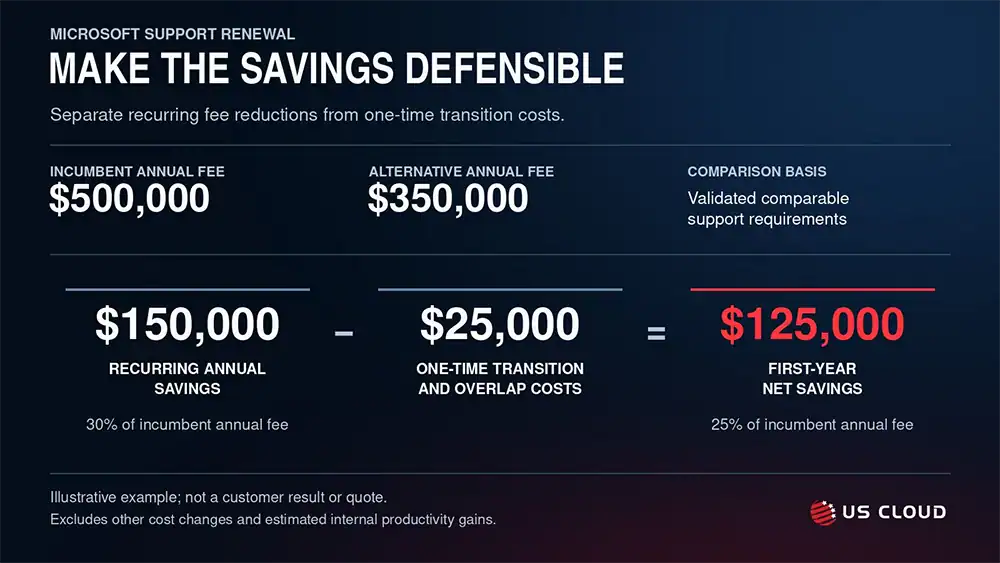
Keep recurring savings separate from one-time expenses and estimated productivity gains. For example, an illustrative comparison might show a $500,000 incumbent annual fee and a $350,000 alternative annual fee for validated comparable requirements. The recurring fee difference is $150,000, or 30%. If first-year transition and overlap expenses total $25,000, first-year net savings fall to $125,000 before other changes. These figures demonstrate the calculation; they are not a customer result or a quote.
This distinction gives Finance something it can defend. It also prevents estimated reductions in ticket-chasing time from being presented as cash savings unless the organization has a credible method for realizing them.
Who Owns the Support Outcome
Before signing, require a documented path from case submission through qualified engineering engagement, escalation, restoration, and closure. The path should identify who remains accountable when technical work moves between teams.
Ask both the incumbent and any alternative to walk through a representative incident from your environment. Choose one that crossed products or required several handoffs. Remove sensitive information before sharing it. Then ask the provider to explain the people, decisions, and communication involved at each stage.
Test the engineering commitment
Who begins troubleshooting? How is the right specialist engaged? What happens outside normal business hours? What information must your team supply, and who coordinates work when several technologies are involved?
Request evidence that supports the answers: a sample case record, an escalation procedure, service-level language, or a reference conversation relevant to your environment. A general assurance about senior expertise is less useful than a clear explanation of how you reach it during an incident.
Separate the service measures
Review initial response, time to qualified expertise, mitigation, restoration, and total time to resolution separately. Ask how each measure is defined, which clock pauses apply, and what reporting your team will receive. If a commitment includes a contractual remedy, confirm the conditions for receiving it.
An average resolution figure also needs context. Product mix, incident severity, measurement period, and exclusions affect whether it is a useful comparison. Averages alone cannot establish what will happen during your most disruptive incident.
Verify Microsoft involvement
An alternative provider should explain which cases require Microsoft, how it engages Microsoft, and what responsibilities remain with your organization. Our Microsoft escalation overview describes US Cloud’s use of Microsoft Premier Support for Partners. Buyers should validate the applicable route and obligations for their proposed agreement.
Ask who maintains the case history, coordinates updates, and follows the issue after escalation. Document any customer permissions or prerequisites. The committee should be able to explain the escalation model without relying on the phrase “Microsoft access.”
What Risks Remain Unresolved
Security and contractual dependencies need explicit review before the support decision receives final approval. Put unanswered questions in front of the people authorized to resolve them.
For Security, the review should follow the actual delivery workflow. Identify how engineers gain access, what approvals are required, what diagnostic information is collected, where it is handled, and how access is removed. Include subcontractor involvement and incident notification obligations where relevant to your requirements.
A certificate or questionnaire can support that review, but it should not substitute for understanding the proposed service. Ask whether the evidence covers the organization, systems, and activities that will handle your support cases.
For Legal and IT asset management, create a dependency register. Record each support-related portal, tool, download, service, or benefit the team relies on and the agreement that provides it. Ask the appropriate owner to confirm whether it continues, changes, or requires a replacement under the proposed arrangement.
Avoid blanket assumptions about what leaving Unified Support preserves or removes. Licensing, product subscriptions, support agreements, and discretionary services need to be evaluated on their applicable terms. If a specific right or benefit is essential, obtain the relevant written confirmation before treating it as resolved.
The approval record should distinguish mandatory requirements from preferences. A missing mandatory access control cannot be offset by a stronger price score. A preferred reporting format may be manageable if the required information is available and the business owner accepts the approach.
For each accepted exception, name the person accepting it, the reason, and the follow-up action. That makes the decision auditable and prevents unresolved assumptions from becoming the support team’s surprise after signature.
Can the Transition Work
A provider change is ready for approval when the organization has a credible plan to maintain coverage, establish access, transfer necessary context, and handle open incidents. A proposed start date should follow that plan.
Ask the incoming provider and your internal service owner to document the first operational milestones. Include account setup, authorized contacts, environment discovery, severity definitions, escalation contacts, reporting access, and the procedure for submitting the first case.
Open incidents deserve their own review. Determine which provider owns each case during the change, how diagnostic history will be preserved, and whether any Microsoft case can continue under the intended arrangement. Do not assume a case or its associated access transfers automatically.
Have IT identify change freezes, critical business events, planned migrations, and staff availability. A transition that appears simple on a calendar may conflict with a financial close, production peak, or infrastructure release. Those constraints should influence timing and any overlap requirements.
US Cloud’s service overview describes an onboarding team and Technical Account Manager involvement, including environment discovery, user setup, and intake of unresolved tickets. For your decision, request a plan tied to your environment and review obligations. General onboarding timelines should not be treated as a commitment for every enterprise.
Before coverage changes, verify that authorized users can reach the service, the correct contacts are recorded, and a sample case follows the agreed route. Record who confirms readiness. If a mandatory dependency remains unresolved, determine how coverage will continue while it is addressed.
Who Signs Off and When
Procurement should bring the committee one recommendation supported by an approval matrix. Each row should point to current evidence, a responsible reviewer, and a clear status. The matrix below provides a starting point; assign owners according to your organization’s governance.
| Approval area | Evidence required | Suggested owner |
|---|---|---|
| Economics | Comparable quotes and total-cost assumptions | Finance and Procurement |
| Service delivery | Scope, engineering access, SLAs, escalation process | IT service owner |
| セキュリティ | Delivery controls and vendor-risk review | セキュリティ |
| Contract dependencies | Terms, notice dates, entitlement findings | Legal and ITAM |
| Transition | Coverage dates, open-case plan, readiness checks | IT and incoming provider |
| Final recommendation | Decision rationale and accepted exceptions | Executive sponsor |
Use three statuses: verified, open, or accepted exception. Attach the document version or meeting record supporting each status. An unqualified “complete” can conceal the difference between evidence received and evidence approved.
With four weeks remaining
Concentrate on the work that could change the decision. Complete the comparable quote, resolve mandatory scope questions, hold the engineering and escalation review, and confirm who owns Security and Legal approval. Run those reviews concurrently where your process allows.
Agree on a decision meeting and a realistic service start date. If a trial or proof of concept is required, assess whether there is enough time to run it meaningfully. A shortened demonstration should not be presented as equivalent to a completed operational evaluation.
With two weeks remaining
Reduce the committee’s reading burden by preparing a concise recommendation with links to supporting evidence. Highlight unresolved conditions, pricing validity, coverage dates, and the specific approvals still needed.
If switching cannot be validated in time, investigate available continuity arrangements and document their terms. Do not assume an extension is available. A competitive quote can still inform negotiations, but it does not guarantee a concession or justify a coverage gap.
The purpose of this final meeting is to decide whether the evidence supports renewing, renegotiating, or selecting an alternative. It should also establish who will verify that the signed agreement reflects the approved recommendation.
Renewal Questions Answered
What should we check before renewing Unified Support?
Verify comparable costs and scope, engineering and escalation obligations, security controls, contractual dependencies, transition readiness, and internal approvals. Record the evidence for each requirement. Apply the same review to Microsoft and alternative providers so the recommendation reflects business needs rather than familiarity or price alone.
Does higher Microsoft spend affect renewal pricing?
It can. Microsoft’s published Unified Enterprise model uses historical Product Spend and graduated rates. Changes in qualifying spending may affect a future renewal calculation. Review your actual calculation and negotiated terms; a change in overall technology spending does not establish the exact change in your support fee.
Can we compare providers without committing to switch?
Yes. A comparable quote gives Procurement another option to evaluate. The organization can use the findings to assess price, coverage, and service commitments before choosing a provider. The incumbent may remain the selected option, but the decision should document why it offers the best fit against approved requirements.
Is two weeks enough to change support providers?
There is no universal timeline. Readiness depends on completed approvals, contractual dates, access requirements, open incidents, and onboarding work. Two weeks may be sufficient for an organization that has already validated those items. Another enterprise may need substantially longer. Confirm the plan before committing to a service start date.
Can an independent provider involve Microsoft?
Some providers have arrangements for escalating cases to Microsoft. Evaluate the specific mechanism, coverage, customer prerequisites, charges, and ongoing case ownership. US Cloud describes its route in its Microsoft escalation overview. Require the proposed agreement and operating process to support the capabilities your organization needs.
Book Your Renewal Review
Your next Microsoft Unified Support renewal should come with a documented reason to approve the cost and confidence in the service your business will receive.
US Cloud is an independent third-party provider of Microsoft enterprise support serving Global 2000 and Fortune 500 organizations. Bring us your renewal date, current scope, and proposed commitment. Request a comparable quote and use the review to identify the financial, operational, and transition questions your committee still needs answered.
If your renewal falls in Q4, schedule that conversation before your internal approval deadline. Give Finance a clear cost comparison, give IT a support model it can validate, and give Procurement a credible option to bring to the decision.
Book a Microsoft Support Renewal Review
Compare US Cloud with your Unified Support renewal before you sign the next term.