
Soporte técnico de Microsoft para IA
Soporte técnico de Microsoft para Copilot
7 Questions Enterprise Buyers Should Answer After Microsoft’s FY26 Earnings.

Resumen ejecutivo
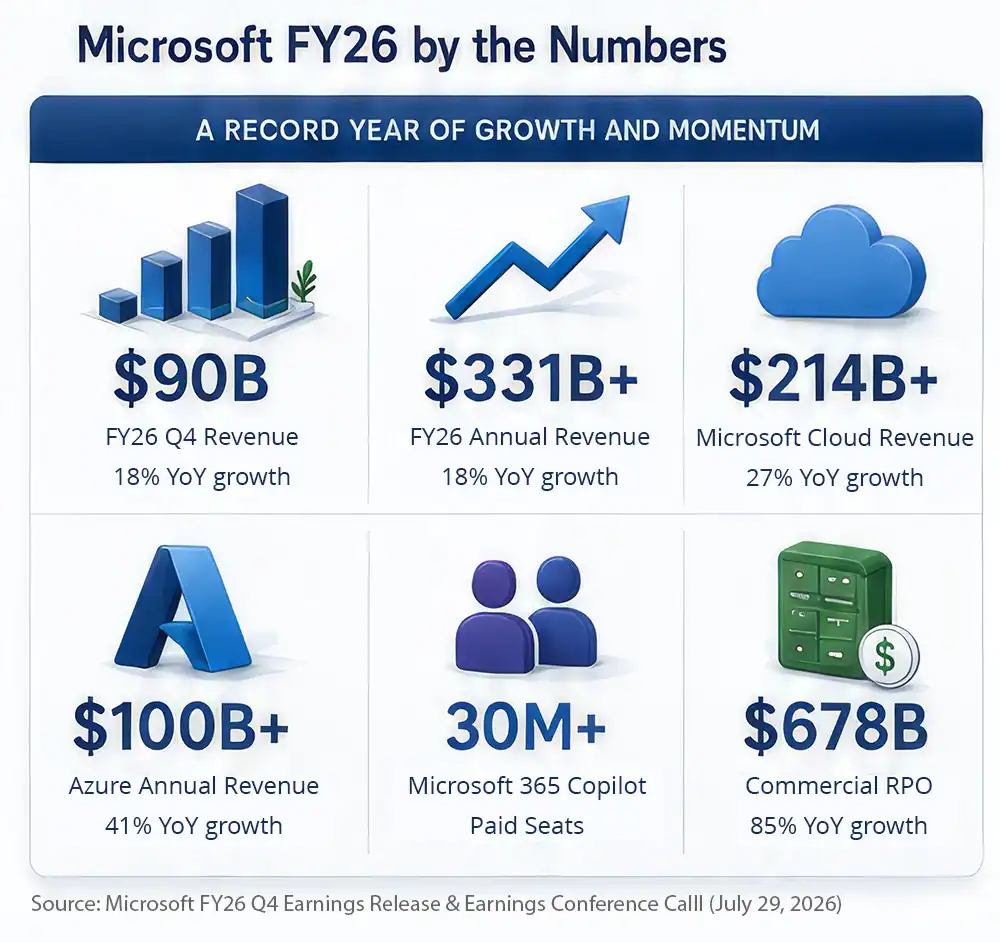
- Microsoft reported $90 billion in FY26 Q4 revenue and more than $331 billion for the full fiscal year.
- Azure surpassed $100 billion in annual revenue and grew 43% during the fourth quarter.
- Microsoft 365 Copilot exceeded 30 million paid seats as enterprise deployments expanded.
- Commercial remaining performance obligation reached $678 billion, signaling substantial contracted demand.
- The earnings call gives buyers a reason to review whether support coverage and accountability are keeping pace with the Microsoft estate.
- The support decision should be evaluated separately from product adoption and licensing.
Microsoft FY26 Earnings Summary
Quick Answer: The results confirm that the Microsoft environment is becoming larger, more interconnected, and more consumption-driven. That increases the value of a support model that can cover the environment, maintain ownership through escalation, and produce outcomes the buying committee can measure.
This is where many buyers get stuck. They can see that Azure and Copilot are growing, but they are not sure what an earnings call should change in their own support evaluation. The answer is not to turn an investor update into a reason to replace support blindly. It is to use the reported growth as a practical test: has the support model evolved with the environment it is supposed to protect?
What did Microsoft report in FY26 Q4?
Quick Answer: Microsoft reported $90 billion in revenue for the quarter ended June 30, 2026, up 18% year over year. For the full year, Microsoft reported more than $331 billion in revenue, more than $214 billion in Microsoft Cloud revenue, and more than $100 billion in Azure revenue.
Microsoft closed fiscal year 2026 with record growth across its cloud and AI businesses. The company reported $90 billion in fourth-quarter revenue and more than $331 billion for the full year. Microsoft Cloud revenue surpassed $214 billion, Azure exceeded $100 billion in annual revenue, and Microsoft 365 Copilot reached more than 30 million paid seats. Microsoft also added 31 datacenters during the quarter, bringing its FY26 total to 88 as it expanded capacity for continued cloud and AI demand.
For enterprise buyers, these results confirm that the Microsoft environment is becoming larger, more interconnected, and more consumption-driven. The earnings call gives the buying committee a reason to ask whether support coverage, engineer access, escalation ownership, cost visibility, and measurable service outcomes are keeping pace with the technology estate they now depend on.
| Metric< | Microsoft’s reported result | Buyer implication |
|---|---|---|
| FY26 Q4 revenue | $90.0B, up 18% | Microsoft continues expanding across enterprise IT |
| FY26 annual revenue | $331B+, up 18% | The commercial relationship is growing in scale |
| Microsoft Cloud revenue | $214B+, up 27% | Cloud services are more central to operations |
| Azure annual revenue | $100B+, up 41% | Azure is increasingly mission-critical |
| Q4 Azure growth | 43% | Cloud demand remained strong at year-end |
| Microsoft 365 Copiloto | 30M+ paid seats | AI is moving into daily enterprise workflows |
| Commercial RPO | $678B, up 84% | Microsoft has substantial contracted future demand |
| Datacenter expansion | 31 in Q4; 88 in FY26 | Microsoft is adding capacity for cloud and AI demand |
Some of the seven questions for enterprise buyers to answer in the wake of Microsoft’s latest earnings call must be answered by your internal technology and finance teams. Others should be put to Microsoft and every alternative support provider being evaluated.
1: Is support coverage current?
Buyer answer: Coverage should be mapped against the environment the organization operates now, not the environment that existed at the last support renewal.
Azure surpassing $100 billion in annual revenue confirms how quickly cloud dependence is growing. For an individual enterprise, the important question is what that growth looks like inside its own architecture.
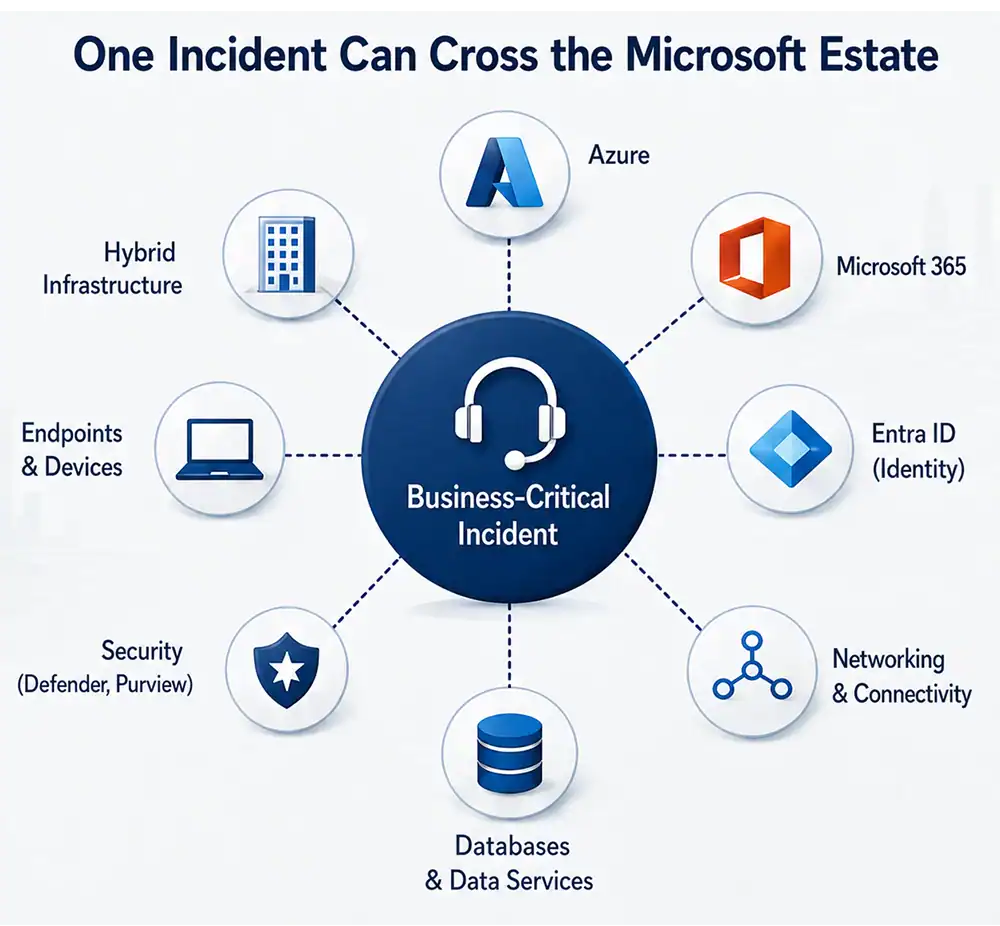
A business-critical incident may begin in Azure and involve Microsoft Entra ID, Microsoft 365, Defender, networking, databases, endpoints, hybrid infrastructure, or a third-party application. A contract that lists products is not enough. The buyer needs to know how the provider works when the issue crosses those boundaries.
Require a written workload map. Identify the systems that support revenue, operations, regulated processes, customer service, manufacturing, healthcare, or public-sector missions. Then compare the map with the proposed support scope.
Buyer takeaway: Coverage is credible only when it reflects current dependencies and names what happens when an incident crosses workloads.
2: Who owns cross-workload issues?
Buyer answer: The support provider should maintain visible ownership while technical work moves between engineers, workloads, internal teams, and Microsoft escalation.
This is one of the most important differences buyers should test from support providers. An initial response can meet an SLA while the customer still spends hours coordinating teams, repeating context, and pursuing updates. Ask who owns the incident after the first handoff. Ask who coordinates Microsoft when Microsoft must become involved. Ask whether the original provider remains accountable for communication, next steps, and progress toward restoration.
A support model works when it reduces the customer’s coordination burden. It does not work when the customer becomes the integration layer between support queues.
Buyer takeaway: Ownership is credible only when the provider remains accountable through technical handoffs, Microsoft escalation, customer communication, and measurable progress toward restoration.
3: Does Copilot change expand support?
Buyer answer: Yes. Copilot introduces additional identity, permissions, data, governance, security, service, and consumption dependencies that buyers should confirm are covered.
Microsoft reported more than 30 million paid Microsoft 365 Copilot seats. Net paid seat additions more than doubled quarter over quarter, and the number of customers with more than 50,000 seats increased more than sevenfold year over year. Copilot is the visible experience, but the support issue may sit underneath it. The cause may involve Entra ID, Microsoft Graph, Exchange, Teams, SharePoint, OneDrive, Purview, security controls, enterprise data, connected applications, or Azure services.
Do not accept a general statement that the provider supports Microsoft 365 or AI. Ask for the exact scope, the engineer skills available, the escalation path, and the process for usage, capacity, billing, entitlement, permissions, and data-grounding issues.
Common buyer objection: “Copilot is a Microsoft product, so shouldn’t Microsoft support be the automatic choice?”
Not automatically. Product ownership and support-provider selection are separate decisions. The buyer should compare which model provides the required coverage, expertise, ownership, response, and cost.
4: What Is Microsoft’s cost stack?
Buyer answer: The buying committee should model licensing, cloud consumption, Copilot and agent consumption, support, advisory services, and internal administration together.
Microsoft described continued movement toward per-seat-plus-consumption models. Usage-based AI and agent services make the Microsoft budget less predictable when buyers look only at licenses. A complete baseline may include product licensing, Azure consumption, Copilot seats, agent consumption, enterprise support, project services, and the internal effort required to administer and escalate issues.
Every category should have an owner, a forecast, and an expected outcome. Finance needs to understand variability. IT needs usage controls and alerts. Procurement needs to know which costs are committed, which are consumption-based, and whether support pricing rises with the broader Microsoft relationship.
Buyer takeaway: A price-per-seat comparison is incomplete when the operating model includes consumption, support, and internal coordination costs.
5: What does Microsoft’s RPO mean?
Buyer answer: It signals substantial contracted future demand and reinforces the need to evaluate long-term Microsoft commitments with clear cost, governance, and support criteria.
Remaining performance obligation, or RPO, is contracted revenue that Microsoft has not yet recognized. Microsoft reported commercial RPO of $678 billion, up 84%, and said approximately 30% is expected to be recognized within the following 12 months.
This is not immediate quarterly revenue, and it should not be treated as one. It does show the scale of future customer commitments. The practical buyer question is whether a growing Microsoft commitment is creating better commercial visibility or simply more dependency. A support benchmark can help separate product commitment from support-provider selection.
Buyer takeaway: Larger and longer-term Microsoft commitments make it more important to separate product purchasing from support-provider selection before additional dependency limits the buyer’s options.
6: Does Unified Support add value?
Buyer answer: No. Datacenter expansion and product investment demonstrate Microsoft’s platform strategy. They do not measure the cost or performance of a customer’s support contract.
Microsoft added 31 datacenters across five continents during Q4 and 88 during FY26. It added another gigawatt of capacity and said it remained on track to roughly double overall capacity within two years. Those investments may improve capacity and product capabilities. They do not establish whether a customer receives fast access to qualified engineers, persistent ownership, transparent reporting, or competitive support economics.
This distinction matters because buyers often hear a version of the same objection: “We buy the products, cloud, and AI services from Microsoft. Why would we separate support?”
Because support is an operating model. It should be judged by coverage, engineer access, escalation, communication, resolution progress, reporting, risk, and cost, not by the size of the product relationship.
Buyer takeaway: Microsoft’s platform investment is not evidence of customer-specific support value. Unified Support should still be measured against cost, coverage, engineer access, escalation ownership, reporting, and service outcomes.
7: What evidence do buyers need?
Buyer answer: Require a common evaluation framework that compares support options on cost, scope, engineer access, escalation ownership, service outcomes, reporting, transition, and references.
| Evaluation area | Evidence to request |
|---|---|
| Coste | Total support cost, pricing method, increases, add-ons, and internal administration |
| Cobertura | Azure, Microsoft 365, Copilot, identity, security, servers, databases, endpoints, and hybrid dependencies |
| Engineer access | Required skill level, time to qualified engagement, and access to senior expertise |
| Escalada | Persistent ownership, Microsoft coordination, handoff controls, and executive communication |
| Rendimiento | Response, progress toward resolution, restoration, reopened incidents, and customer effort |
| Reporting | Ticket data, service reviews, escalation history, trends, and transparent performance measures |
| Transition | Scope validation, onboarding steps, responsibilities, continuity controls, and readiness gates |
| Proof | Relevant references, enterprise examples, contract language, and measurable results |
Buyer takeaway: A defensible decision requires every support option to be scored against the same documented requirements and evidence, not compared through different criteria, assumptions, or vendor promises.
Microsoft growth requires review
Microsoft had a record year. Azure and Copilot are becoming more important to enterprise operations, and Microsoft is investing aggressively to support continued demand. The buyer conclusion is not that Microsoft technology is less valuable. It is that the support decision is becoming more consequential.
A larger Microsoft environment requires broader coverage, clearer ownership, better cost visibility, and evidence that the support model produces measurable outcomes. Microsoft’s earnings show where Microsoft is investing. Your evaluation should show whether your organization is receiving the support value it needs in return.
Preguntas frecuentes
What were Microsoft’s FY26 Q4 earnings?
Microsoft reported $90 billion in FY26 Q4 revenue, up 18% year over year. For the full fiscal year, annual revenue exceeded $331 billion, Microsoft Cloud revenue exceeded $214 billion, and Azure revenue exceeded $100 billion.
How much revenue did Microsoft Azure generate in FY26?
Microsoft reported that Azure surpassed $100 billion in annual revenue during FY26, an increase of 41%. Azure and other cloud services revenue grew 43% during Q4.
How many paid Microsoft 365 Copilot seats did Microsoft report?
Microsoft reported more than 30 million paid Microsoft 365 Copilot seats. The company also said net paid seat additions more than doubled quarter over quarter.
What is Microsoft commercial remaining performance obligation?
Commercial remaining performance obligation is contracted Microsoft revenue that has not yet been recognized. Microsoft reported commercial RPO of $678 billion and said approximately 30% was expected to be recognized within the following 12 months.
Do Microsoft’s earnings prove Microsoft Unified Support delivers more value?
No. The earnings demonstrate the strength of Microsoft’s products, cloud, and AI businesses. They do not measure the price, coverage, engineer access, escalation ownership, or service performance of an individual customer’s support contract.
Does using Azure and Microsoft 365 require Microsoft Unified Support?
Product adoption and enterprise support can be evaluated separately. An organization can continue licensing and using Microsoft products while comparing Microsoft Unified Support, independent support, and hybrid support models.
What should buyers compare before renewing Microsoft support?
Compare total cost, workload coverage, engineer access, severity and response commitments, escalation ownership, resolution performance, reporting, transition requirements, and relevant customer proof.
Benchmark Your Microsoft Support Costs
Blog source: Microsoft Investor Relations with US Cloud analysis.